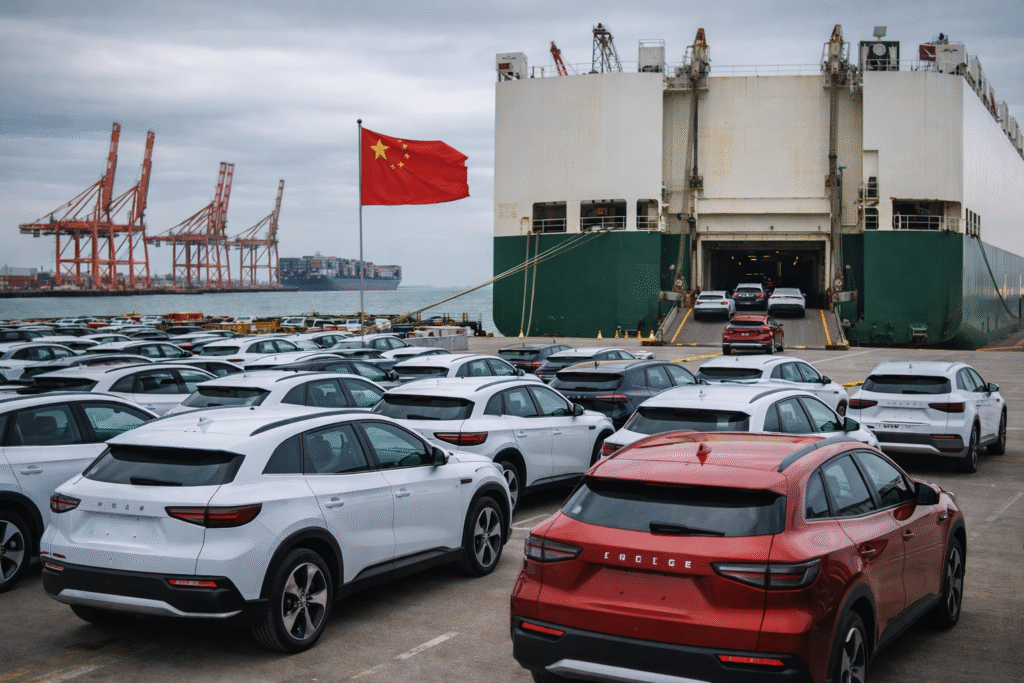
America Steps Back as China Pushes Forward
The U.S. auto industry’s retreat from electric vehicles is raising growing concern among analysts and executives that American manufacturers may be ceding long-term global competitiveness — just as Chinese automakers accelerate their international expansion.
What began as a slowdown in EV adoption has evolved into a strategic divergence. While U.S. companies refocus on gasoline-powered trucks and SUVs, China is doubling down on electric vehicles and exporting them worldwide.
A Warning Signal From Detroit
The latest alarm came after Stellantis disclosed a roughly $26 billion charge tied to a major business overhaul that included a pullback from EV investments. Shares fell more than 20%, with management citing an overestimation of how quickly the energy transition would unfold.
Other U.S. automakers are making similar adjustments, prioritizing high-margin vehicles like full-size pickups and SUVs as EV demand softens and federal incentives fade.
China’s Auto Industry Takes the Lead
While U.S. companies retrench, China’s automotive sector has emerged as the world’s largest vehicle exporter since 2023. Growth has been driven by:
- Aggressive EV production
- Vertically integrated supply chains
- Heavy government support
- Rapid product development cycles
Chinese automakers are expanding across Europe, South America, India, Mexico, and Canada — often undercutting local competitors on price.
Legacy Automakers Under Pressure
Major U.S. automakers have absorbed steep losses tied to EV investments:
- General Motors and Ford Motor Company have written down tens of billions tied to EV programs.
- Production targets have been reduced.
- New EV launches have been delayed or canceled.
Even Tesla, once the clear EV leader, has lost market share overseas. Chinese automaker BYD has surpassed Tesla in global EV sales, particularly in Europe.
Tesla has also discontinued its two oldest vehicle models to repurpose U.S. manufacturing capacity for robotics — signaling a strategic pivot away from near-term vehicle expansion.
Market Share Tells the Story
The competitive shift is showing up clearly in global data:
- Chinese automakers’ global market share has surged nearly 70% over five years.
- Detroit’s “Big Three” have fallen from over 21% global share in 2019 to under 16% today.
- BYD and Geely now command more than 11% of global market share combined.
Why EVs Changed the Game
Industry experts argue electrification lowered barriers for China’s rise. EV platforms require fewer mechanical components and place greater emphasis on batteries, software, and manufacturing scale — areas where China invested heavily long before Western automakers.
As China’s domestic market matures, excess capacity is now being exported aggressively into global markets.
The Stakes for the U.S. Auto Industry
Autos account for roughly 5% of U.S. GDP, making this shift more than an industry problem. While tariffs limit Chinese EV imports into the U.S., they have not prevented Chinese brands from gaining ground globally.
Executives increasingly describe the threat as existential — driven by speed, scale, and coordination rather than EV technology alone.
WSA Take
The U.S. EV pullback may reduce short-term financial pain, but it risks conceding leadership in the next generation of vehicles. As China accelerates globally, the window for American auto makers to reclaim momentum is narrowing fast.
The longer the retreat lasts, the harder it may be to regain lost ground.
Disclaimer
WallStAccess is a financial media platform providing market commentary and analysis for informational and educational purposes only. This content does not constitute investment advice, a recommendation, or an offer to buy or sell any securities. Readers should conduct their own research or consult a licensed financial professional before making investment decisions.