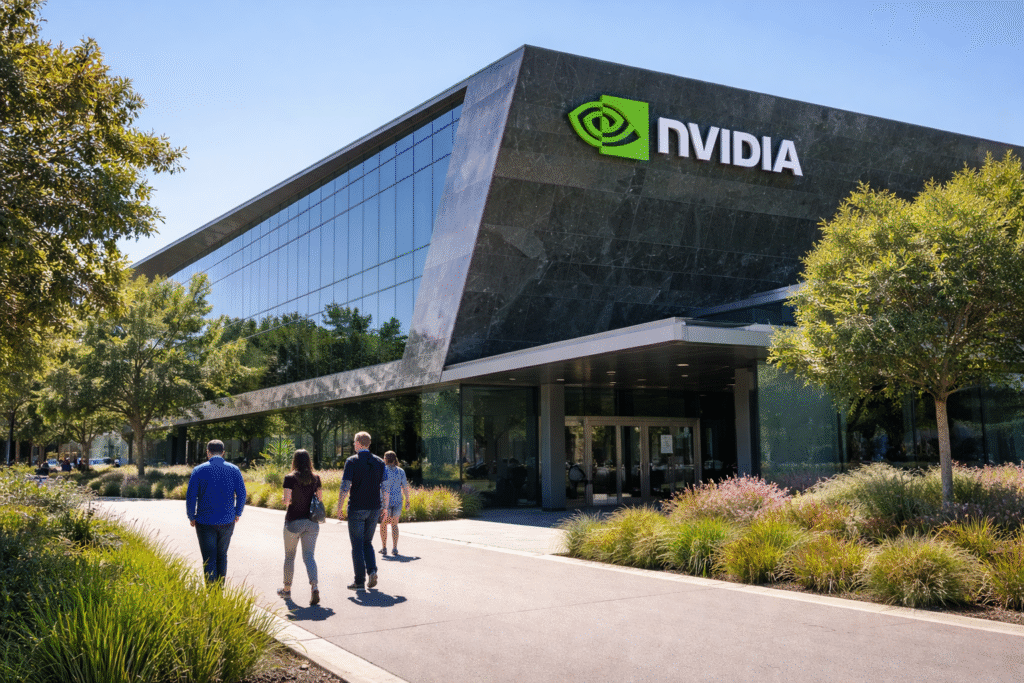
Nvidia Shares Cool Off as AI Spending Explodes
Big Tech’s artificial intelligence spending plans keep climbing. Nvidia’s stock? Not so much.
Despite a projected surge in AI infrastructure investment from Meta Platforms, Alphabet, Microsoft, and Amazon — expected to top $600 billion in 2026 — shares of Nvidia have largely stalled.
The stock is down more than 1% since the start of the fourth quarter and has traded in a relatively tight range after hitting a record high in late October. It has also underperformed the S&P 500 to begin 2026, a notable shift after its nearly 40% gain in 2025 and back-to-back triple-digit percentage increases in prior years.
In Friday trading, Nvidia shares fell as much as 2.6%.
The Capex Paradox
The unusual disconnect has left investors debating a key question:
If AI spending is ballooning, why isn’t Nvidia soaring with it?
The answer may lie in rising concerns that revenue from AI deployments won’t keep pace with the extraordinary capital expenditures being announced.
More spending today could mean a faster arrival at market saturation tomorrow. If hyperscalers overbuild capacity, the industry may reach a digestion phase sooner than expected — a pattern familiar to anyone who has followed semiconductor cycles.
Growth Is Still Strong — But Slowing
The cyclical nature of the chip industry is increasingly influencing Nvidia’s valuation.
Revenue is projected to grow:
- 58% in the current calendar year
- 28% in 2027
That’s still strong growth — but it represents deceleration from the hyper-growth phase that fueled Nvidia’s historic rally.
The stock currently trades around 24 times forward earnings, roughly in line with the Nasdaq-100 and slightly above the S&P 500. While that multiple is well below Nvidia’s five-year average of 38x earnings, investors do not appear to view it as a bargain.
Valuation Compression Risk
Strategists are beginning to warn that infrastructure providers could face valuation pressure as capital spending growth eventually moderates.
If hyperscalers scale back or slow incremental spending, suppliers like Nvidia could feel the impact first.
This isn’t necessarily about collapsing demand. It’s about rate of change.
Markets tend to price momentum — not just absolute numbers.
All Eyes on February 25
The next major catalyst for Nvidia will arrive on February 25, when the company reports earnings after the close.
Investors will be focused on:
- Forward guidance
- Data center chip demand
- AI infrastructure backlog
- Commentary on hyperscaler spending
Wall Street estimates for 2026 revenue and earnings have barely moved despite the megacap spending announcements — suggesting analysts are waiting for direct signals from Nvidia before adjusting models.
Psychology After a Historic Run
After one of the most dramatic stock runs in modern market history, consolidation is not unusual.
When sentiment reaches peak optimism, even strong fundamentals can fail to push shares higher in the short term. Expectations become harder to beat.
In markets, valuation and psychology often matter as much as revenue growth.
WSA Take
Nvidia isn’t falling because AI is slowing.
It’s pausing because expectations were extreme.
The market already priced in near-perfect execution and endless AI demand. Now investors want proof that spending converts into durable revenue growth — not just headline capex numbers.
If Nvidia’s February earnings reinforce strong chip demand and extend the AI buildout narrative, momentum could return quickly.
But if guidance hints at normalization or digestion in spending, the stock may remain range-bound despite enormous industry investment.
AI spending is booming.
The question is whether returns will boom with it.
Disclaimer
WallStAccess is a financial media platform providing market commentary and analysis for informational and educational purposes only. This content does not constitute investment advice, a recommendation, or an offer to buy or sell any securities. Readers should conduct their own research or consult a licensed financial professional before making investment decisions.