The Big Picture: AI Is Moving From “Thinking” to “Doing”
The market spent the last cycle obsessing over AI models and GPU spend. That’s the digital layer. But the real economy runs on physical throughput:
- How fast inventory moves from inbound to storage
- How accurately orders get picked
- How cheaply a distributor can scale volume without scaling headcount
- How resilient supply chains are when demand gets choppy
When companies talk about “AI efficiency,” a huge part of that payoff shows up in warehouses — because that’s where time, errors, and labor costs compound.
That’s why warehouse automation is getting treated less like a “nice-to-have” and more like a structural advantage: it improves speed, reduces mistakes, and allows businesses to grow without their distribution footprint turning into a bottleneck.
What Symbotic Actually Does
Symbotic (NASDAQ: SYM) designs and deploys end-to-end warehouse automation systems for large distribution centers.
At a high level, it’s a blend of:
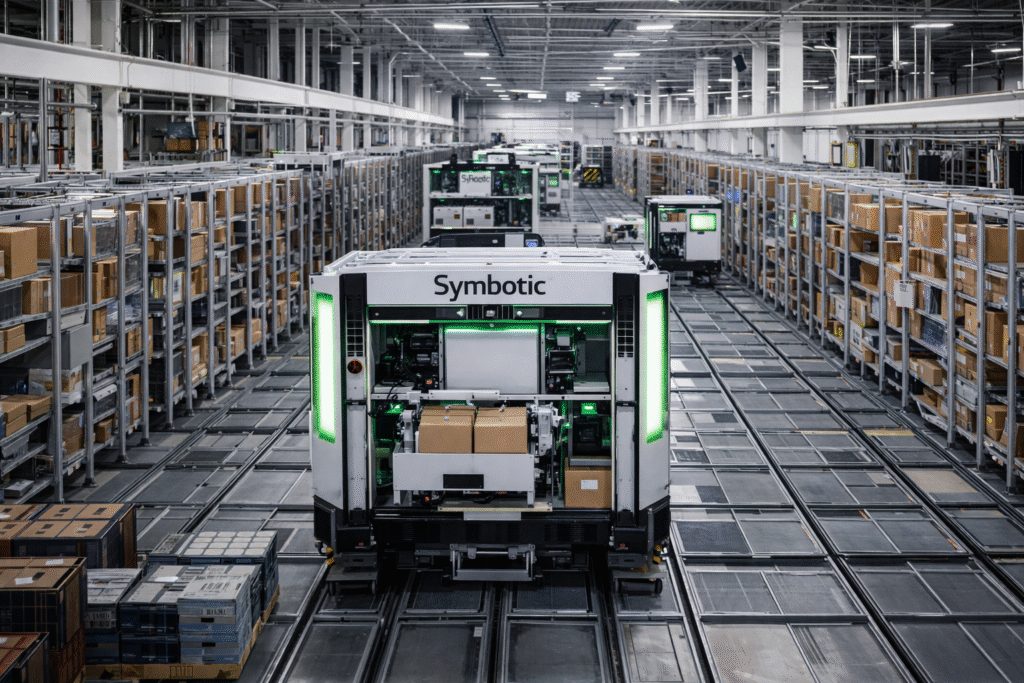
- Robotics (to move, store, and sequence cases/totes)
- Software + AI orchestration (to route inventory intelligently and keep throughput high)
- Systems integration (retrofits + full deployments inside massive, real-world facilities)
This isn’t a consumer robot story. It’s industrial automation where the value is measured in:
- Higher throughput per square foot
- Faster order cycle times
- Better inventory accuracy
- Less dependence on “always available” labor
Symbotic’s sweet spot is high-volume environments — the kind of facilities that decide who wins on cost and service levels in modern retail and distribution.
The Numbers That Matter (and Why They’re Market-Relevant)
A few metrics tell you whether this is “real scaling” or just hype:
1) Backlog = long runway
Symbotic’s backlog has been cited around $22.5 billion — a meaningful signal that large customers are committing to multi-year system rollouts rather than “pilot projects.”
2) Margins + EBITDA = proof the model improves with scale
The most recent snapshot referenced shows:
- Revenue around $618M
- Adjusted gross margin ~22.1%
- Adjusted EBITDA ~$49M
That combination matters because warehouse automation is complex — investors want to see that deployments don’t just grow revenue, but also improve profitability as the playbook matures.
3) Customer concentration = the central debate
Walmart has been about 85% of fiscal 2025 revenue (per the same coverage), which is both:
- A feature (validation + scale partner)
- A risk (dependency)
Wall Street tends to re-price these stories sharply when the concentration starts to unwind in a healthy way (more customers), or when the market fears the opposite (one customer dominates the narrative).
Why Our Analysts Are Bullish on Symbotic
This is the core of the SYM thesis in our view:
Symbotic is positioned at the intersection of three durable trends
- Retail and distribution are still modernizing
Even after years of “digital transformation,” a surprising amount of warehouse ops are still human-heavy and error-prone. - AI isn’t only software — it’s orchestration of real-world systems
In a warehouse, “intelligence” isn’t a chatbot. It’s the system deciding:
- where inventory sits,
- when it moves,
- how to sequence orders,
- how to keep flow stable during peak demand.
- Automation becomes more valuable when the environment is unstable
When demand whipsaws, labor gets tight, or service expectations rise, automation isn’t optional — it’s how you prevent the entire supply chain from becoming the constraint.
The “Walmart gravity” effect is real — and it cuts both ways
Walmart-scale rollouts are a proving ground most automation vendors never get. If you can deploy reliably at that scale, it becomes your credibility engine.
The market’s next big question is: how quickly does Symbotic translate that credibility into a broader customer base?
Expansion beyond retail is the unlock
One of the most notable developments cited recently is a new partnership with Medline, signaling entry into healthcare distribution — a segment with huge logistics complexity and high accuracy requirements.
That’s important because it supports the idea that Symbotic is building a repeatable platform, not a one-customer project.
WSA Take
Symbotic (NASDAQ: SYM) is one of those companies that doesn’t look like the AI trade — until you remember the AI economy still has to ship real product, on real timelines, at real margins.
If the next phase of this cycle is about efficiency, throughput, and execution, warehouse automation stops being “industrial tech” and starts looking like core infrastructure.
Our analysts stay bullish because SYM sits in a spot where:
- backlog signals multi-year demand,
- margins suggest the engine is scaling,
- and expansion beyond its anchor customer could be the re-rating catalyst investors keep waiting for
Disclaimer
WallStAccess is a financial media platform providing market commentary and analysis for informational and educational purposes only. This content does not constitute investment advice, a recommendation, or an offer to buy or sell any securities. Readers should conduct their own research or consult a licensed financial professional before making investment decisions.