A European drone company joins defense tech’s billion-dollar class
Quantum Systems has secured $1.2 billion in new financing, placing the German autonomous-systems developer among Europe’s most valuable privately held defense companies.
The Series D round valued Quantum Systems at approximately $8 billion on a post-money basis. Blackstone, Noteus, Airbus and Advent co-led the financing, with additional participation from investors including Bond, Fidelity Management & Research, Wellington Management, Balderton Capital and HV Capital.
The size of the round reflects a major shift in how private markets view the defense sector.
Venture capital once treated military procurement as too slow, politically sensitive and dependent on a small number of government customers. Wars in Ukraine and the Middle East, rising NATO budgets and growing demand for low-cost autonomous platforms have changed that calculation.
Defense is increasingly being viewed as a technology market capable of supporting fast-growing private companies alongside established contractors.
Battlefield demand is moving toward autonomous systems
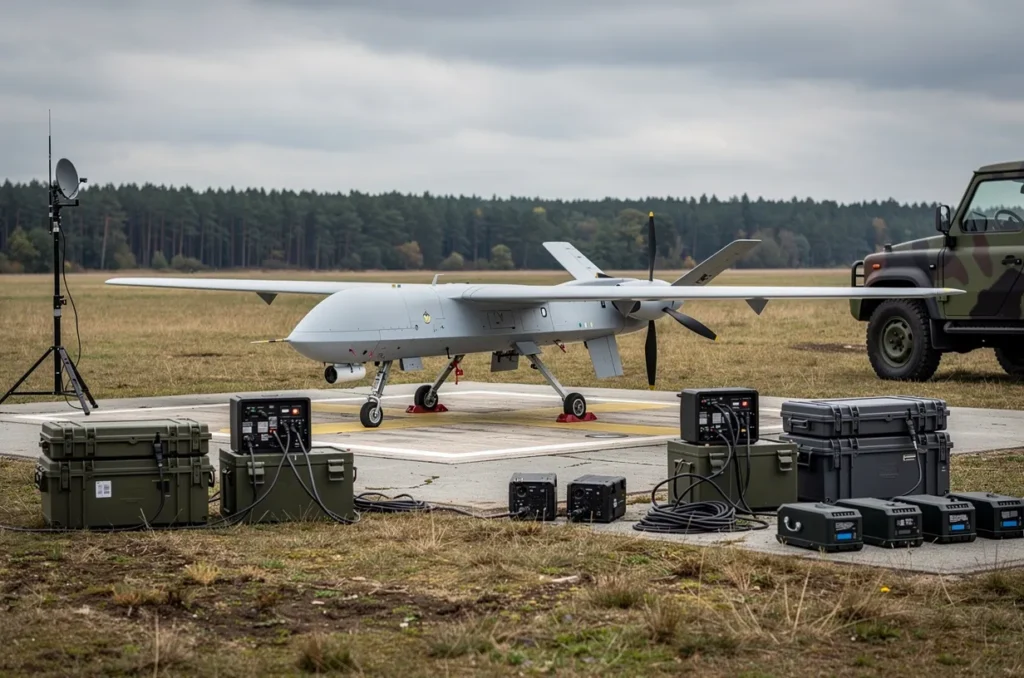
Quantum Systems develops unmanned platforms and software designed to operate across air, land and maritime environments.
Its best-known products include electric vertical-takeoff reconnaissance drones capable of launching without a runway, flying fixed-wing missions and transmitting intelligence to operators in real time.
The company is also building Mosaic UXS, a software platform intended to connect unmanned systems from different manufacturers through one command-and-control environment.
That interoperability is becoming increasingly important.
Modern military operations may involve reconnaissance drones locating a target, ground systems processing the data, electronic-warfare equipment monitoring the surrounding area and another platform carrying out the mission. Each component must communicate quickly and continue functioning in contested environments where navigation signals or communications may be disrupted.
Quantum Systems is positioning itself as more than an aircraft manufacturer. Its objective is to provide the software and autonomous operating layer linking multiple systems across the battlefield.
Ukraine has become a proving ground for the technology
Quantum Systems’ products have been used extensively in Ukraine, where the company says its systems completed more than 19,000 missions during 2025.
That operational record gives the company something difficult to reproduce in a laboratory: direct evidence of how its technology performs against electronic warfare, rapidly changing tactics and real battlefield conditions.
Lessons from Ukraine have reshaped the global drone industry.
Low-cost unmanned systems can provide surveillance, identify targets, relay communications and carry out missions that would otherwise place personnel or far more expensive aircraft at risk. They can also be modified quickly as enemy countermeasures evolve.
Traditional defense procurement programs may take years to move from design to deployment. Drone software and hardware often need to change within weeks.
Companies able to absorb frontline feedback and update their systems rapidly are gaining an advantage over contractors built around slower development cycles.
The new capital will support industrial scale
Quantum Systems plans to use the financing to expand production capacity, strengthen supply-chain resilience and increase deliveries across allied markets.
The company already operates or maintains a production presence across Germany, Ukraine, the United States, Australia, Romania, the United Kingdom and the Baltic region.
That geographic footprint serves both commercial and strategic purposes.
Governments increasingly want critical defense equipment manufactured within their own countries or trusted allied jurisdictions. Local production can reduce transportation delays, support domestic employment and limit exposure to vulnerable foreign suppliers.
Distributed manufacturing also allows products to be modified for specific customers and operating environments.
For Quantum Systems, the challenge is now shifting from proving that its products work to producing them reliably at much greater volume.
Airbus adds strategic value beyond capital
Airbus participated as one of the round’s co-lead investors and agreed to deepen its strategic relationship with Quantum Systems.
The partnership combines the startup’s autonomous drone and software capabilities with Airbus’s experience in military aircraft, sensors, communications and large-scale aerospace programs.
Established defense companies often possess extensive government relationships and systems-integration expertise but can struggle to develop new products quickly. Startups typically move faster but may lack manufacturing capacity, regulatory experience and access to major procurement programs.
A closer relationship could help Quantum Systems enter larger European and NATO projects while allowing Airbus to incorporate newer autonomous technologies without developing every capability internally.
It also reflects a broader industry pattern in which traditional contractors are investing in, partnering with or acquiring defense startups rather than treating them only as competitors.
Investors are funding a new generation of defense contractors
Quantum Systems describes its ambition as becoming a next-generation “neo-prime.”
Traditional prime contractors manage large military programs, integrate complex systems and coordinate networks of suppliers. Companies such as Lockheed Martin, RTX, Northrop Grumman, BAE Systems and Airbus have occupied that role for decades.
New defense companies are attempting to build a different model around software, autonomy, rapid production and privately financed development.
Rather than waiting for governments to fund every stage of research, these businesses raise private capital, build technology ahead of full procurement contracts and seek to deliver operating systems more quickly.
Anduril has become the leading US example, raising $5 billion in May at a $61 billion valuation. Maritime-autonomy company Saronic secured approximately $1.75 billion, while Shield AI raised $2 billion to expand its autonomous-flight software and aircraft programs.
European companies are now attracting similarly large rounds. Helsing has been pursuing approximately $1.2 billion at a reported $18 billion valuation, while German drone manufacturer Stark recently secured roughly €500 million.
Quantum Systems’ financing places it firmly within that group.
Defense-tech funding has already surpassed last year
Defense-technology companies have raised an estimated $17.4 billion so far in 2026, compared with approximately $11.2 billion during all of 2025.
The increase reflects more than short-term enthusiasm.
European governments are raising military budgets, NATO members are attempting to rebuild depleted inventories and armed forces are incorporating drones, artificial intelligence and autonomous software into future procurement plans.
Private investors are also recognizing that military demand is changing.
Governments still purchase aircraft, ships and missiles through large multiyear programs. They are increasingly seeking smaller, cheaper and more adaptable systems that can be deployed in large numbers.
Autonomous platforms fit that requirement because software improvements can expand their capabilities without replacing the entire physical system.
The valuation depends on more than drone production
At an $8 billion valuation, Quantum Systems will be expected to develop beyond a specialized reconnaissance-drone manufacturer.
Its longer-term case rests on creating a family of autonomous platforms connected by a common software architecture.
A military customer could theoretically use one operating environment to coordinate aircraft, ground vehicles and maritime systems supplied by Quantum Systems or outside manufacturers.
That approach resembles the platform strategies used by commercial technology companies: establish the software layer, support an expanding network of devices and make the system increasingly difficult for customers to replace.
Defense markets operate differently from consumer technology. Procurement cycles are slower, national-security requirements are stricter and customers may insist on sovereign control over data and software.
Still, a company that establishes its platform across several allied militaries could build valuable recurring relationships extending beyond the original hardware sale.
Profitability separates Quantum Systems from many startups
Co-founder and co-CEO Florian Seibel said Quantum Systems is profitable, a notable distinction in a market where many highly valued technology startups continue to consume substantial cash.
Profitability suggests that the company’s existing contracts and product sales can support at least part of its expansion.
The $1.2 billion round can therefore be directed toward industrial capacity, acquisitions, software development and market expansion rather than simply covering operating losses.
Investors will still need to assess the durability of those profits.
Defense revenue can be uneven, contracts may depend on government budgets and rapid expansion introduces manufacturing and execution risks. Entering new product categories also requires substantial research spending before meaningful orders materialize.
The funding gives Quantum Systems a much larger financial cushion, but the valuation requires the company to convert its battlefield credibility into long-term procurement programs.
Europe wants its own autonomous-defense champions
Quantum Systems’ rise also carries strategic importance for Europe.
European militaries have long depended heavily on American technology for advanced aircraft, intelligence systems and digital battlefield infrastructure. Governments are now seeking stronger domestic capabilities as security concerns increase and transatlantic policy becomes less predictable.
Drones and autonomous systems provide Europe with an opportunity to build competitive companies in a relatively new category rather than trying to displace entrenched suppliers in mature markets.
Germany has emerged as an important centre of that effort, with Quantum Systems, Helsing and Stark attracting substantial private capital.
Developing European champions could strengthen regional supply chains, retain intellectual property and give governments more control over critical defense technologies.
Large funding rounds bring large execution demands
The surge in private capital does not guarantee that every defense startup will become a successful prime contractor.
Building prototypes and demonstrating products in combat are only the first steps. Companies must also manufacture consistently, obtain military certifications, secure long-term contracts and support systems for years after deployment.
International expansion adds export controls, security requirements and country-specific procurement rules.
Quantum Systems must also manage a production network spanning several countries while protecting sensitive technology and ensuring that components remain available during geopolitical disruptions.
The new financing provides the resources needed to address those challenges. It also raises expectations substantially.
At an $8 billion valuation, investors are no longer backing an early-stage drone company. They are financing a potential global defense platform.
WSA Take
Quantum Systems’ $1.2 billion raise shows how rapidly autonomous defense has moved from a specialized venture-capital category into a major institutional investment theme.
The company offers investors several qualities that have become increasingly valuable: battlefield-tested technology, profitability, exposure to rising allied defense budgets and a strategy extending beyond individual drones into multi-domain software and autonomy.
The funding boom also reflects a structural change in military procurement. Governments need systems that can be developed faster, produced in greater quantities and updated through software as battlefield conditions change.
Quantum Systems still has to prove that it can industrialize its technology and become the next-generation prime contractor its founders envision. Its Ukraine experience and global production footprint provide a stronger starting position than most defense startups.
The $8 billion valuation assumes that unmanned systems will become a central component of allied military power—and that Quantum Systems can become one of the companies controlling the architecture behind them.
Disclaimer
WallStAccess is a financial media platform providing market commentary and analysis for informational and educational purposes only. This content does not constitute investment advice, a recommendation, or an offer to buy or sell any securities. Readers should conduct their own research or consult a licensed financial professional before making investment decisions.