
A niche copper trade is now tracking White House policy
The price gap between US copper futures and London prices is turning into a real-time measure of tariff expectations.
The COMEX-LME spread has traditionally been used by traders, producers and banks to exploit short-term pricing differences between New York and London.
Historically, that spread moved on things like Chinese demand, mine disruptions or regional shortages.
Now it is being driven by one question: whether the US will impose new tariffs on refined copper.
The premium is pricing in tariff odds
Societe Generale has tried to translate the current COMEX premium into implied tariff probabilities.
The bank estimates the spread currently reflects about a 14.6% chance that the US imposes a universal 15% tariff on refined copper beginning in January 2027.
That rises to a 37% chance of a 30% tariff beginning in January 2028.
The Commerce Department has recommended that phased structure, but the White House has not yet made a final decision.
ING commodities strategist Ewa Manthey said the wider COMEX premium is increasingly signaling greater perceived tariff risk.
Copper keeps moving into the US
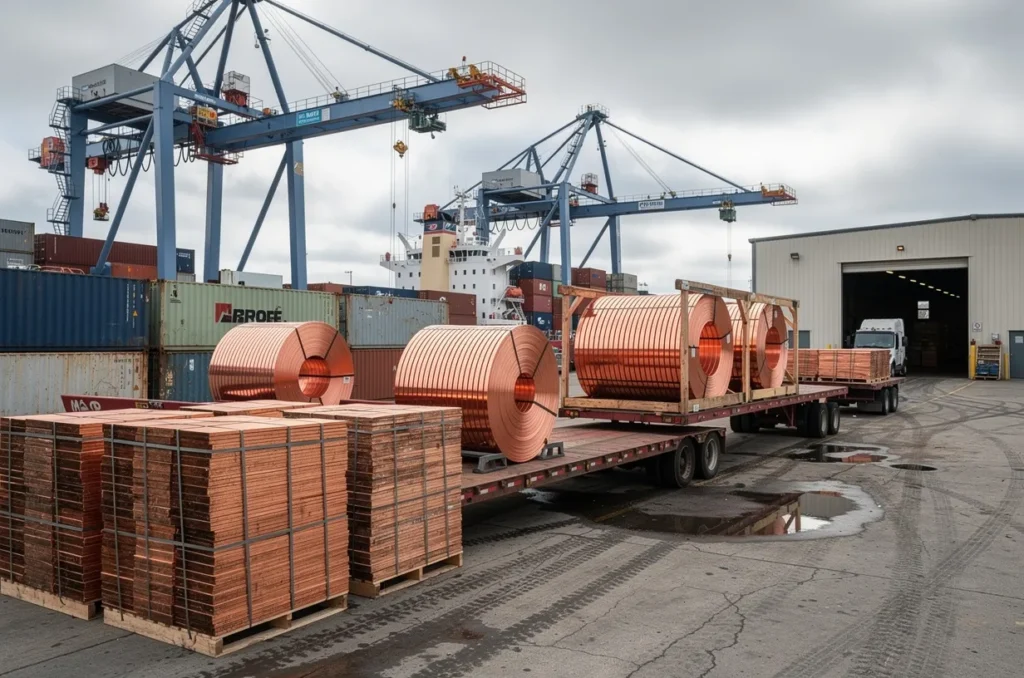
The pricing gap is also changing physical trade flows.
The US imported more than 200,000 metric tons of copper in July, the highest monthly total in 12 years.
Traders have been moving metal into the US to take advantage of higher COMEX prices, reducing available supply elsewhere.
That flow has helped build inventories in America while tightening the market outside the US.
The trade remains attractive as long as the New York premium is large enough to cover freight, financing and handling costs.
Washington is treating copper as strategic
The tariff debate comes as copper becomes more important to US industrial policy.
Demand is rising from AI infrastructure, power-grid modernization, defense systems, construction and transportation.
Societe Generale said the Section 232 investigation reflects growing concern over US dependence on imported refined copper.
The US already imposes a 50% tariff on some semi-finished copper products and copper derivatives. The unresolved question is whether those protections will now extend to refined metal.
The tariff decision could reverse the whole trade
StoneX strategist Natalie Scott-Gray called the Section 232 decision the biggest catalyst facing the copper market.
If tariffs are imposed, traders could keep pulling metal into the US ahead of implementation, tightening supply elsewhere.
If the White House decides against new duties, the COMEX premium could collapse and the arbitrage could unwind quickly.
Metal that has been stockpiled in the US could begin flowing back toward other markets.
Copper stays tight while traders wait
The tariff trade is developing against an already strong copper market.
Futures recently reached a record near $6.90 per pound, while mine supply remains tight and competition between the US and China for available metal continues.
ING remains constructive on copper but expects volatility to stay elevated until Washington makes a decision.
For now, one of the clearest signals is not coming from a policy speech or government filing. It is coming from the price gap between New York and London.
Explore More Stories in Commodities
Disclaimer
WallStAccess is a financial media platform providing market commentary and analysis for informational and educational purposes only. This content does not constitute investment advice, a recommendation, or an offer to buy or sell any securities. Readers should conduct their own research or consult a licensed financial professional before making investment decisions.