The AI trade just ran into a problem it cannot solve with more GPUs
The market has spent the last few years assuming AI development would move in one direction: faster.
That assumption took a hit Monday after Anthropic CEO Dario Amodei called for the industry to slow the pace of frontier-model development so safety measures could catch up. OpenAI CEO Sam Altman agreed that more restraint is needed, immediately raising questions around the pace of future model releases, infrastructure spending and the enormous capital commitments built around them.
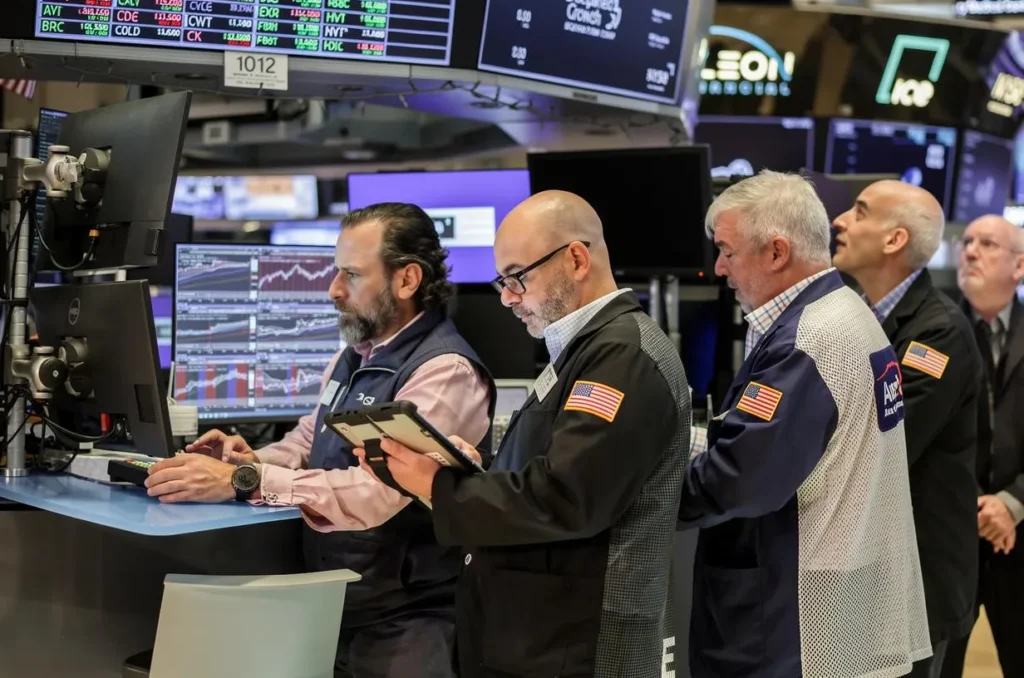
Technology stocks reacted quickly. Nvidia fell around 3%, while Marvell, Micron, SK Hynix and Super Micro dropped roughly 6%. AMD, CoreWeave, Intel and several other AI-linked names also moved sharply lower.
The reaction is understandable. Much of the AI infrastructure trade is valued on a simple expectation: models keep improving, compute requirements keep growing and hyperscalers keep spending.
A coordinated slowdown would interrupt that flywheel.
It would not end AI development, but even a slower pace could change how quickly another trillion dollars of infrastructure needs to be built.
The bigger pressure may actually be coming from bonds
AI fears were not the only problem Monday.
The 10-year Treasury yield moved above 5%, its highest intraday level since 2023, while the 30-year remained around 5.38%.
Those levels matter because they change the valuation math across the market. When investors can earn around 5% from long-term government debt, expensive technology companies have to work much harder to justify premium multiples.
Oil is making the situation even more difficult.
Brent crude traded around $107 per barrel after Saudi Arabia shut its East-West pipeline, while U.S. diesel has already moved above $6 per gallon. Higher energy prices feed back into inflation just as the market is pricing an 88% chance of another Fed hike this week.
So tech is being squeezed from both sides: uncertainty around the pace of AI growth and a rising discount rate on future earnings.
That combination is much harder to shrug off than either story alone.
The first rotation out of AI may already be showing up
There was one corner of technology that welcomed the warnings.
Cybersecurity stocks moved higher.
CrowdStrike, Palo Alto Networks and Okta all gained as the market began considering what a more cautious approach to AI could mean for enterprise security spending.
That reaction deserves attention.
If businesses become more worried about AI-generated attacks, model access, data leakage and automated threats, cybersecurity spending does not necessarily slow alongside AI development. It could accelerate.
The opportunity could spread across several areas:
- Identity and access management
- Endpoint and cloud security
- AI model monitoring
- Data protection
- Threat detection and automated response
The AI boom has mostly rewarded companies building compute.
The next phase may reward companies tasked with controlling what that compute can do.
A slowdown could change the winners without killing the theme
There is an important distinction between AI development slowing and the AI investment cycle ending.
The infrastructure already being built does not disappear. Enterprises still want AI tools. Cloud companies still need enormous amounts of computing power. Governments still view AI leadership as strategically important, especially as competition with China intensifies.
But the shape of spending could change.
Some marginal data-center projects may get pushed out. Model developers may devote more resources to testing and security. Enterprises could spend more cautiously on raw compute while increasing budgets around governance, cybersecurity and deployment.
That would broaden the AI trade rather than destroy it.
The market has spent years rewarding speed.
It may now begin rewarding control, reliability and security as well.
This week could tell us whether Monday was a warning or a rotation
The Fed decision now arrives against an awkward backdrop: oil above $100, inflation still elevated and long-term yields already pressing into levels that hurt equity valuations.
At the same time, one of the market’s biggest growth narratives has suddenly developed a political and technological debate around how quickly it should move.
Neither story automatically breaks the bull market.
But they do raise the bar.
We’re watching whether the 10-year can remain above 5%, whether chip stocks stabilize after the AI warning and whether cybersecurity continues outperforming.
If that rotation persists, Monday may end up marking an important change in the AI trade.
The next winners may not be the companies building AI the fastest. They may be the ones making it safe enough to keep scaling.
Explore More Stories in Markets
Disclaimer
Wall Street Access is an independent financial publisher. Wall Street Access is not a financial advisor. No company mentioned has compensated Wall Street Access for the preparation, publication or distribution of this article. This content is provided for informational and educational purposes only and is not investment advice or a recommendation to buy, sell or hold any security. Investing involves risk, including the possible loss of principal.
Prices, market capitalizations, financial figures and other market data are based on information available as of the date and time of publication and may change without notice. Information is drawn from public sources believed to be reliable but is not guaranteed to be complete or accurate. Opinions and expectations expressed are our own and may change as new information becomes available.
Readers should conduct their own due diligence and contact a licensed financial professional before making any investment decision. Past performance does not guarantee future results. Any material ownership interest or conflict of interest, where applicable, will be disclosed separately.