Inflation is becoming Wall Street’s biggest headache again
Wall Street just received another reminder that strong earnings cannot solve every problem.
U.S. consumer prices climbed 3.7% in September, up from 3.4% in August and above the 3.6% economists expected. Gasoline prices jumped 9.1% during the month, accounting for more than half of the overall increase, while underlying inflation also accelerated.
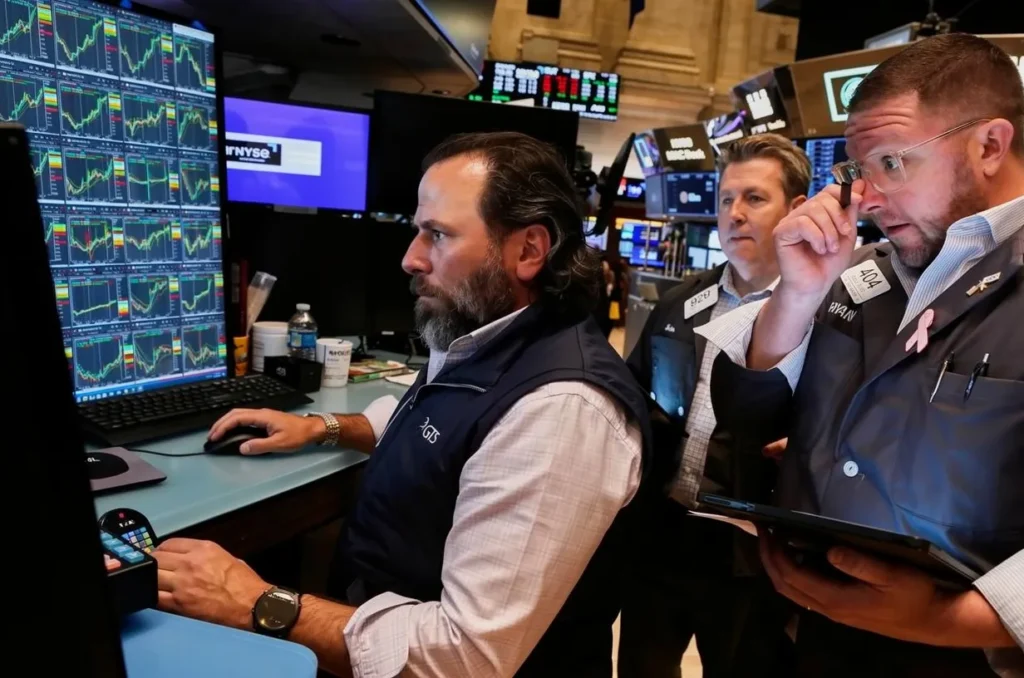
Stocks responded quickly. The S&P 500 slipped around 0.4% in early trading Wednesday, while the technology-heavy Nasdaq lost approximately 0.9%. The Dow held closer to flat as investors reconsidered how much longer interest rates could remain elevated.
Oil is making the situation particularly difficult. Brent crude remains above $105 a barrel as continued attacks on Middle Eastern energy infrastructure threaten global supplies. Higher fuel costs are already flowing into transportation, manufacturing and consumer prices, creating a fresh inflation problem just as markets were hoping for some relief.
The Federal Reserve now faces an uncomfortable choice: tolerate higher inflation or raise borrowing costs further and risk slowing an economy that has become increasingly dependent on investment spending.
Interest-rate futures immediately reflected the shift. Expectations for another Fed hike increased sharply following the report, with traders assigning roughly a 45% probability to an October increase, up from around 20% beforehand.
Even strong AI earnings are struggling to impress
Perhaps the most revealing part of Wednesday’s selloff is that semiconductor demand remains exceptionally strong.
ASML (NASDAQ: ASML), whose advanced lithography equipment is essential for manufacturing leading-edge chips, delivered another impressive quarter.
The Dutch company reported record quarterly sales of €11.7 billion, with net income reaching approximately €5 billion. Management also raised its full-year outlook, forecasting revenue between €44 billion and €45 billion as customers continue expanding AI chip production.
Demand is becoming so strong that some customers are already discussing equipment requirements for 2029 and 2030. ASML is considering additional manufacturing capacity because its current expansion plans may not be enough to satisfy demand in 2027 and 2028.
Yet the semiconductor sector continues to face selling pressure.
Investors are becoming increasingly sensitive to the price they pay for future growth. AI infrastructure companies may continue delivering excellent results, but higher interest rates make distant earnings less valuable today and raise financing costs for the enormous data-center projects supporting the industry.
AI demand is not disappearing. The market is questioning how much investors should pay for it when the cost of capital keeps rising.
Thursday’s TSMC earnings could set the tone
Another major test arrives Thursday when Taiwan Semiconductor Manufacturing (NYSE: TSM) reports third-quarter results.
TSMC manufactures advanced chips for Nvidia, AMD and many of the world’s largest technology companies, giving its results unusual importance for the broader AI trade. Investors will be watching revenue, advanced-chip demand and management’s outlook for capacity expansion.
The company previously projected third-quarter revenue of $44.6 billion to $45.8 billion, reflecting the extraordinary demand for advanced semiconductors.
Strong results could reassure investors that the AI investment cycle remains intact. Disappointing guidance, however, would arrive at a particularly difficult moment for a sector already facing valuation pressure.
Bank earnings are adding another layer of uncertainty. Bank of America (NYSE: BAC) fell sharply after a $1.2 billion regulatory penalty weighed on profits, while Morgan Stanley (NYSE: MS) also came under pressure. BlackRock (NYSE: BLK) offered a brighter result, rising after earnings exceeded expectations.
Consumers are still spending, businesses are still investing and AI infrastructure demand remains substantial. Yet financial markets are beginning to confront a problem that strong corporate earnings cannot easily resolve.
With inflation moving higher and oil prices showing little sign of relief, another round of rate hikes could put even greater pressure on stock valuations.
Wall Street has spent much of 2026 rewarding companies for how quickly their earnings can grow. The next phase of the market may be determined by how much investors are willing to pay for that growth.
Explore More Stories in Markets
Disclaimer
Wall Street Access is an independent financial publisher. Wall Street Access is not a financial advisor. No company mentioned has compensated Wall Street Access for the preparation, publication or distribution of this article. This content is provided for informational and educational purposes only and is not investment advice or a recommendation to buy, sell or hold any security. Investing involves risk, including the possible loss of principal.
Prices, market capitalizations, financial figures and other market data are based on information available as of the date and time of publication and may change without notice. Information is drawn from public sources believed to be reliable but is not guaranteed to be complete or accurate. Opinions and expectations expressed are our own and may change as new information becomes available.
Readers should conduct their own due diligence and contact a licensed financial professional before making any investment decision. Past performance does not guarantee future results. Any material ownership interest or conflict of interest, where applicable, will be disclosed separately.