
Wall Street is selling the AI boom before demand has slowed
More than $1 trillion in market value has disappeared from 20 of the world’s largest AI and semiconductor companies this week. Nvidia (NASDAQ: NVDA), AMD (NASDAQ: AMD) and Micron Technology (NASDAQ: MU) have led another wave of selling, joined by chipmakers across South Korea, Japan and Europe.
Yet something interesting is happening beneath the panic. The companies building AI infrastructure are still reporting extraordinary demand.
Investors are reacting to two problems that have little to do with how many chips customers currently need: expensive financing and the possibility that today’s semiconductor shortages eventually become tomorrow’s oversupply.
September’s U.S. inflation rate climbed to 3.7%, exceeding expectations as gasoline prices jumped 9.1% during the month. Treasury yields responded immediately, with the 10-year yield briefly touching 5.3% before retreating as investors sought safety.
Higher rates reduce the value investors place on future earnings, particularly for expensive growth stocks. They also make borrowing more costly for companies financing enormous data centers. Highly leveraged AI infrastructure operators have good reason to worry.
But chip manufacturers with substantial cash flow and contracted customers are in a different position.
Taiwan Semiconductor Manufacturing (NYSE: TSM) provided fresh evidence Thursday, reporting record quarterly revenue of $46.72 billion and forecasting another increase to $52.3 billion to $54.3 billion next quarter.
The stock market is repricing the cost of AI growth, even as the companies supplying that growth continue reporting record business.
That disconnect is worth paying attention to.
Micron’s customers are already planning for 2028
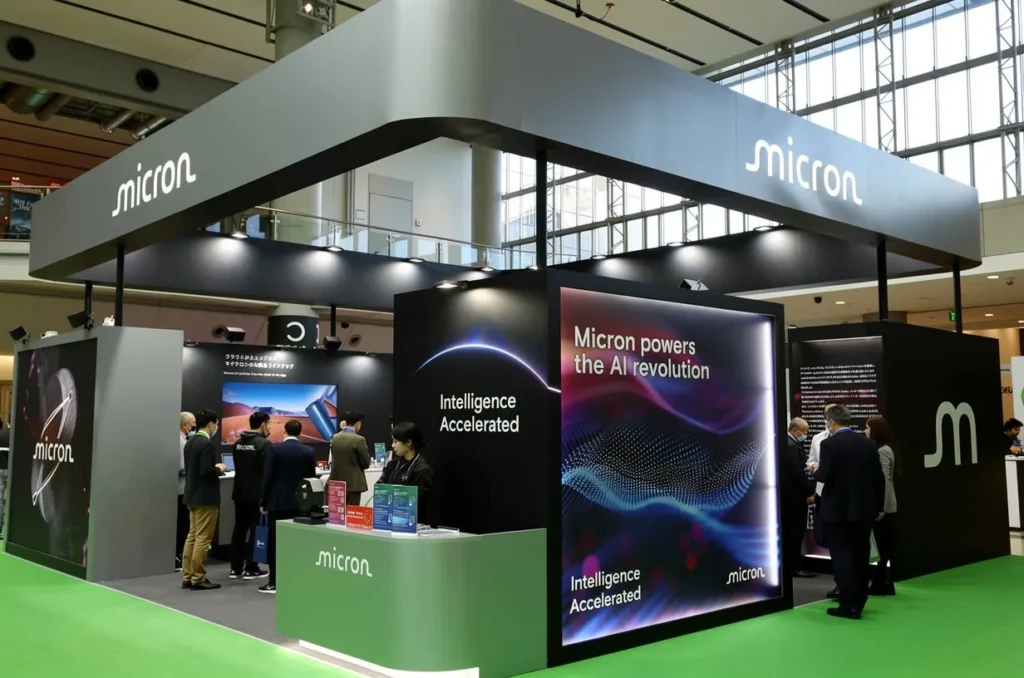
Among the companies caught in the selloff, Micron presents one of the more interesting opportunities.
The company supplies high-bandwidth memory (HBM), DRAM and data-center storage, critical components that work alongside advanced processors from Nvidia, AMD and other AI chip designers.
As AI models become larger and more sophisticated, they require increasing amounts of memory to process information quickly. More powerful GPUs accomplish little if the memory feeding them cannot keep up.
Micron’s latest earnings call revealed just how aggressively customers are securing future supply.
- More than 75% of Micron’s total 2027 output is already committed to customers
- A large portion of its 2027 HBM production is already sold, at prices significantly higher than those negotiated for 2026
- Customer discussions have increasingly shifted toward 2028 supply, with some agreements extending into 2031
- Micron has signed 26 strategic customer agreements, representing approximately $150 billion in remaining contracted performance obligations
These are not speculative projections of what AI demand might look like. They reflect commitments and negotiations taking place now, although the $150 billion represents future contracted obligations rather than revenue already earned.
Management outlined these commitments during its September earnings call, while describing a market where customers continue requesting more memory than Micron can readily supply.
Even more encouraging is the pricing environment. Customers are not merely reserving future capacity. Many are agreeing to pay significantly more to secure it.
Micron expects demand to remain tight through 2027 and 2028, with additional manufacturing capacity taking years to bring online.
Wall Street is selling memory stocks over fears of future oversupply while Micron is negotiating supply commitments years in advance at higher prices.
China’s memory breakthrough may be getting too much credit
Another source of selling comes from China’s ChangXin Memory Technologies (CXMT), which recently announced progress on a denser memory-chip architecture that could eventually improve manufacturing efficiency.
The concern is understandable. Memory is a cyclical industry, and increasing supply has historically led to falling prices and shrinking profit margins.
Yet a technical breakthrough is not the same as manufacturing advanced memory at commercial scale.
CXMT still faces challenges in proving its new technology can compete on performance, manufacturing yields and cost. Meanwhile, established suppliers such as Micron, SK Hynix and Samsung already have qualified products and long-standing customer relationships across AI infrastructure.
American trade policy creates another obstacle.
Under U.S. semiconductor procurement restrictions scheduled to take effect in December 2027, federal agencies will be prohibited from purchasing covered products containing chips from CXMT and Yangtze Memory Technologies.
These restrictions do not amount to a blanket prohibition on every private American company buying Chinese memory. However, they demonstrate Washington’s growing resistance to Chinese suppliers entering sensitive U.S. technology supply chains.
Competition from China could eventually put pressure on conventional memory pricing, particularly as additional production capacity comes online toward 2029. But those risks should be weighed against the demand and contracted supply already visible through 2027.
Micron’s business is also in a different position from earlier memory cycles. Long-term supply agreements and take-or-pay commitments provide greater revenue visibility, making it harder for sudden changes in spot pricing to immediately undermine the entire business.
A future memory glut is a legitimate risk. Treating it as though it has already arrived may be an overreaction.
The distinction between stock prices and business fundamentals is becoming increasingly important.
Micron shares entered October following an extraordinary rally, so a correction is not automatically evidence of undervaluation. Higher bond yields could continue pressuring semiconductor multiples, while weaker hyperscaler spending would eventually threaten even the strongest order books.
But investors should be watching actual demand signals rather than assuming every declining stock reflects deteriorating business conditions.
If memory pricing remains firm, customers honor their commitments and AI capital spending continues expanding, the recent selling could offer attractive entry points into companies positioned at the center of the buildout.
Micron stands out because its customers are already making commitments for the next several years while Wall Street is increasingly focused on what might go wrong further down the road.
Sometimes markets correctly anticipate a slowdown before the numbers show it. Other times, fear creates an opportunity to buy a growing business at a better price.
With Micron’s order book extending years into the future, the evidence currently makes the second possibility worth taking seriously.
Disclaimer
Wall Street Access is an independent financial publisher. Wall Street Access is not a financial advisor. No company mentioned has compensated Wall Street Access for the preparation, publication or distribution of this article. This content is provided for informational and educational purposes only and is not investment advice or a recommendation to buy, sell or hold any security. Investing involves risk, including the possible loss of principal.
Prices, market capitalizations, financial figures and other market data are based on information available as of the date and time of publication and may change without notice. Information is drawn from public sources believed to be reliable but is not guaranteed to be complete or accurate. Opinions and expectations expressed are our own and may change as new information becomes available.
Readers should conduct their own due diligence and contact a licensed financial professional before making any investment decision. Past performance does not guarantee future results. Any material ownership interest or conflict of interest, where applicable, will be disclosed separately.