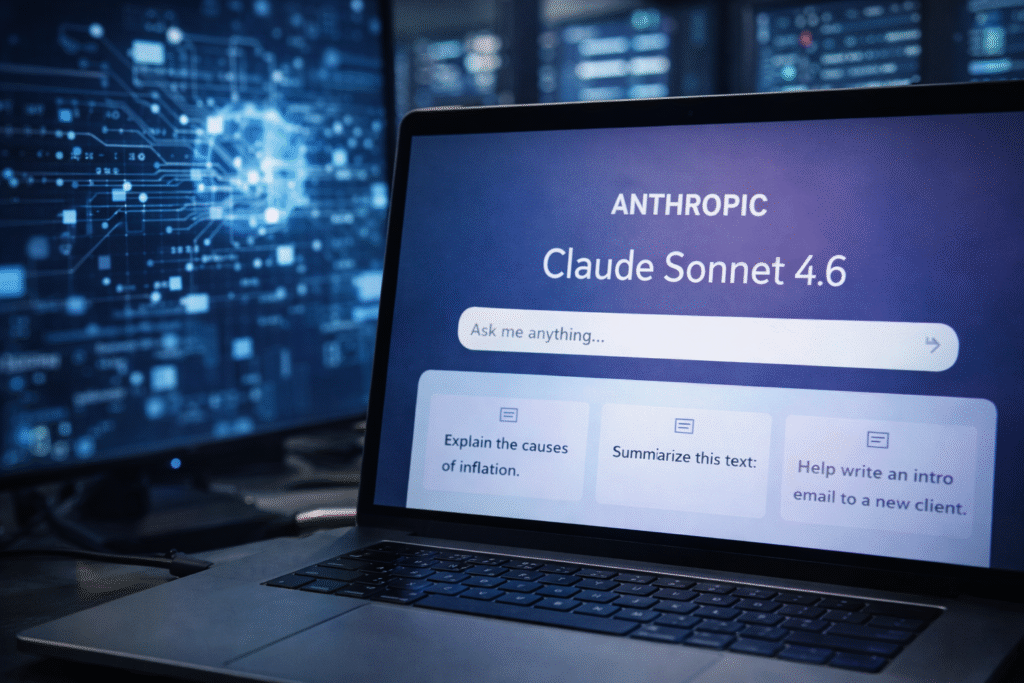
What’s New in Claude Sonnet 4.6?
According to Anthropic, Claude Sonnet 4.6 improves performance in:
- Advanced coding and debugging
- Computer-use workflows
- Design and structured document creation
- Data-heavy analysis tasks
- Complex knowledge work execution
For free and paid Pro users, Sonnet 4.6 now becomes the default model inside the Claude chatbot and the company’s enterprise-facing productivity tool, Claude Cowork.
Anthropic says the model now delivers performance levels that previously required its more computationally expensive Opus-tier models — particularly for economically valuable office tasks.
In practical terms, that lowers the cost barrier for advanced AI-assisted work.
A Rapid-Fire Release Cycle
The pace of development has become a defining feature of the current AI cycle.
Anthropic’s Sonnet 4.6 release follows the debut of Claude Opus 4.6 less than two weeks earlier. That cadence mirrors aggressive rollout schedules at competitors like:
- OpenAI
- Other frontier-model developers
Each iteration narrows the performance gap between mid-tier and flagship models — meaning more users gain access to capabilities once reserved for premium enterprise environments.
Why Software Investors Are Watching Closely
Anthropic’s advancements arrive amid significant volatility in software equities.
The iShares Expanded Tech-Software Sector ETF (IGV) has fallen more than 20% year to date, as investors reassess how generative AI could reshape traditional SaaS revenue models.
The core question:
If AI agents can write code, generate design systems, draft reports, and automate internal workflows, how much value remains in conventional subscription software layers?
Claude Sonnet 4.6 deepens that conversation by improving:
- Instruction-following consistency
- Coding reliability
- Multi-step task execution
The model’s gains in practical enterprise use cases make it harder to dismiss AI as merely experimental.
Anthropic’s Expanding Financial Firepower
Founded in 2021 by former OpenAI researchers and executives, Anthropic has quickly grown into one of the leading frontier-model labs.
Its model family includes:
- Opus (largest, most capable)
- Sonnet (mid-sized, high-performance)
- Haiku (lightweight, cost-efficient)
Last week, Anthropic announced it closed a $30 billion funding round, valuing the company at a $380 billion post-money valuation, more than doubling its September valuation.
Meanwhile, OpenAI is reportedly in discussions for a funding round that could reach $100 billion.
Capital inflows of this scale are enabling model development cycles measured in weeks — not years.
The Bigger Competitive Landscape
The AI industry is increasingly defined by:
- Faster model iteration
- Improved cost efficiency per performance tier
- Enterprise integration depth
- Growing “agentic” capabilities (models that act autonomously across tools and systems)
Sonnet 4.6 strengthens Anthropic’s position in the enterprise AI stack, especially for organizations evaluating:
- AI-powered coding copilots
- Automated knowledge workflows
- Internal AI-driven productivity systems
The differentiation battle is shifting from “who has the smartest model” to “who can deliver economically useful performance at scale.”
WSA Take
Claude Sonnet 4.6 isn’t just another model update.
It reflects the compression of capability into more accessible tiers — meaning advanced AI performance is cascading downward into broader user bases.
The competitive tempo suggests that waiting for a stable plateau in AI capability may be unrealistic. The pace itself is becoming the story.
As enterprise adoption deepens, the ripple effects across software infrastructure, productivity platforms, and digital services are becoming harder to ignore.
The question isn’t whether AI models are improving.
It’s how quickly the surrounding ecosystem has to adapt.
Disclaimer
WallStAccess is a financial media platform providing market commentary and analysis for informational and educational purposes only. This content does not constitute investment advice, a recommendation, or an offer to buy or sell any securities. Readers should conduct their own research or consult a licensed financial professional before making investment decisions.