Danaher Makes a $9.9 Billion Bet on Hospital Tech
Danaher Corporation is buying Masimo for $9.9 billion including debt, marking the largest transaction in Danaher’s history and a significant move deeper into hospital diagnostics and monitoring technology.
The deal values Masimo at $180 per share — a 38% premium to its last close — and instantly reshapes Danaher’s clinical diagnostics footprint.
For Masimo, it caps off a turbulent stretch that included legal battles, revenue volatility, and questions about long-term growth.
For Danaher, it adds another high-margin, recurring-revenue business to a portfolio that already spans life sciences, bioprocessing, diagnostics, and environmental technologies.
What Danaher Actually Does
Danaher is not just a conglomerate — it’s one of the most disciplined operators in the healthcare and industrial technology space.
The company owns and operates dozens of specialized brands that serve:
- Biopharmaceutical manufacturing
- Clinical diagnostics laboratories
- Hospital systems
- Environmental and applied solutions
Through its “Danaher Business System,” the company focuses on operational efficiency, margin expansion, and bolt-on acquisitions that compound value over time.
With a market capitalization north of $150 billion, Danaher has built a reputation for acquiring niche leaders, improving execution, and scaling them globally.
Masimo fits that playbook.
What Masimo Brings to the Table
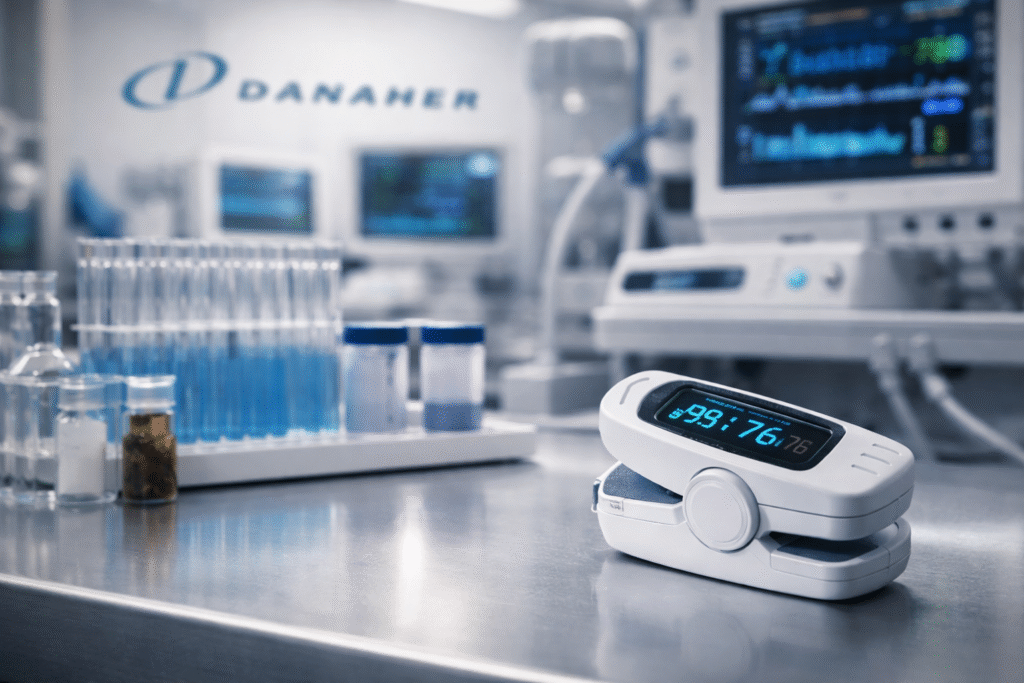
Masimo is best known for its non-invasive patient monitoring technologies, particularly pulse oximetry — the technology used to measure blood oxygen levels.
Its products are used in hospitals worldwide and expanded dramatically during the COVID era, when oxygen monitoring became critical.
Beyond pulse oximetry, Masimo has been pushing into:
- Capnography (monitoring carbon dioxide levels)
- Brain function monitoring
- Hemodynamic monitoring
- Wearable and home-based health devices
Despite posting $2.18 billion in revenue, Masimo reported a net loss of $240 million over the past year, reflecting investment cycles and uneven hospital spending trends.
Shares have been volatile:
- Down roughly 28% over the past year
- Down 8% over the past month
- Trading around $130 before the acquisition announcement
The company had also been locked in a high-profile patent dispute with Apple over pulse oximetry technology used in the Apple Watch, adding additional uncertainty to the stock.
A Premium — But Debate Remains
The $180 per share offer highlights a valuation gap that had divided investors.
One valuation narrative suggested Masimo was worth roughly $183 per share based on margin expansion and increased specialty sales penetration.
Another discounted cash flow model valued the company closer to $101 per share, suggesting the stock had run ahead of its cash flow trajectory.
Danaher’s bid effectively resolves that debate.
The premium signals confidence not just in Masimo’s current portfolio, but in what operational refinement and scale could unlock.
Why This Matters for Diagnostics
Contract research organizations and healthcare suppliers have faced growing uncertainty:
- Drug pricing regulation debates
- Tariff policy risks
- Slower academic and government funding
- Hospital capital budget tightening
Against that backdrop, owning differentiated, high-switching-cost hospital monitoring platforms becomes more strategic.
Patient monitoring is deeply embedded in hospital workflows. Once installed, systems are rarely replaced quickly. That stickiness tends to produce durable recurring revenue.
Masimo’s footprint inside operating rooms, ICUs, and acute care facilities gives Danaher an expanded presence at the point of care — not just in labs or manufacturing.
That broadens its healthcare exposure meaningfully.
The Competitive Angle
Danaher competes indirectly with diagnostic and medical device heavyweights across multiple verticals.
By adding Masimo’s monitoring technologies, Danaher deepens its integration into hospital infrastructure — a space that has become more strategically important as healthcare systems modernize and digitize patient care.
It also positions the company alongside other technology players that have pushed into health data, wearables, and remote monitoring.
But Danaher’s approach remains different: clinical-grade infrastructure first, consumer optionality second.
WSA Take
Danaher doesn’t chase trends. It acquires infrastructure.
Masimo’s volatility, legal distractions, and uneven performance likely obscured the underlying value of its hospital-installed base. Danaher appears to see something steadier beneath the noise.
In a market environment where healthcare spending patterns are shifting and capital allocation is under scrutiny, acquiring embedded clinical technology — at scale — quietly strengthens positioning without fanfare.
This isn’t a splashy AI deal.
It’s a durable diagnostics move.
And those often age well.
Explore More Stories in Markets
Disclaimer
WallStAccess is a financial media platform providing market commentary and analysis for informational and educational purposes only. This content does not constitute investment advice, a recommendation, or an offer to buy or sell any securities. Readers should conduct their own research or consult a licensed financial professional before making investment decisions.