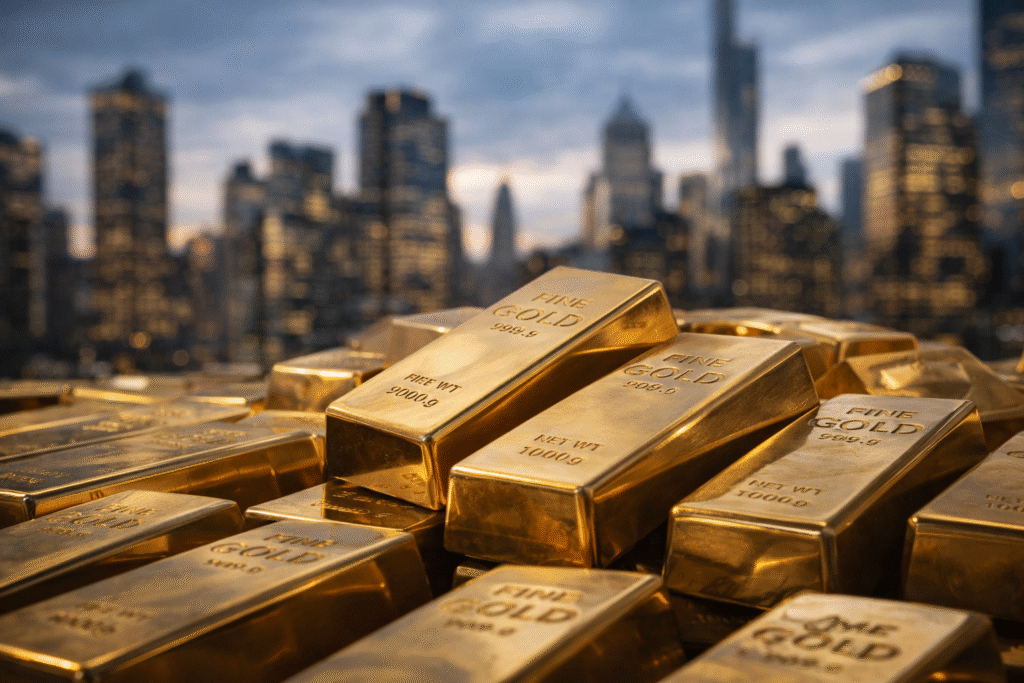
Gold Stabilizes After Violent Reversal
Gold prices climbed back above the $5,000-per-ounce level on Monday, as investors cautiously returned to the market following one of the most volatile stretches in precious metals trading in years.
Bullion rose as much as 1.8%, recovering further ground after a sharp late-January collapse that marked gold’s steepest drawdown in more than a decade. Prices have now regained roughly half of the losses sustained after hitting an all-time high on Jan. 29. A weaker U.S. dollar provided additional support.
Market participants are watching closely to see whether gold can hold this psychological threshold.
Gold’s ability to remain above $5,000 “will be critical in determining whether the market can transition from a reactive bounce to a more sustainable advance,” said Ahmad Assiri, an analyst at Pepperstone Group.
Central Bank Demand Remains a Key Pillar
Support for gold continues to come from official-sector buying, particularly from China.
Data released over the weekend showed the People’s Bank of China extended its gold purchases for a 15th consecutive month, underscoring persistent demand from central banks seeking to diversify reserves away from traditional assets. Chinese state media reported that these purchases are expected to continue, albeit in smaller increments designed to avoid destabilizing prices.
That steady accumulation was a central driver of the powerful multi-month rally that preceded last month’s collapse and remains a long-term bullish factor for bullion.
From Frenzy to Reset
Gold and silver had surged to record highs earlier this year, fueled by a combination of geopolitical risk, the so-called debasement trade, and rising concerns around fiscal discipline and central-bank credibility.
Speculative activity amplified the move. Leveraged positioning, heavy options buying, and strong retail participation helped push prices higher — until momentum abruptly reversed. Both metals plunged during Asian trading hours late last month, with silver suffering its largest single-day decline on record.
U.S. Treasury Secretary Scott Bessent attributed part of the turbulence to what he described as “unruly” trading behavior in China, which exacerbated volatility across global markets.
Institutions Still Back Gold’s Long-Term Case
Despite the recent whipsaw, major financial institutions continue to support the long-term outlook for gold.
Asset managers and banks including Deutsche Bank, Goldman Sachs, and Pictet Asset Management have reiterated expectations for a recovery, pointing to structural drivers such as:
- Continued diversification away from U.S. assets
- Persistent policy uncertainty
- Elevated central-bank gold accumulation
At the same time, reports indicate Chinese regulators have encouraged domestic financial institutions to limit exposure to U.S. Treasuries, citing concentration risks and market instability — a shift that could indirectly support further allocation toward gold.
Silver Remains the Wild Card
Silver’s rebound has been sharper — and riskier.
The metal jumped as much as 6% on Monday, topping $82 per ounce, after having fallen more than one-third from its recent peak. Analysts note that silver has entered a much higher-volatility regime compared to gold.
“Silver has entered a markedly higher-volatility regime,” said Marc Loeffert, a trader at Heraeus Precious Metals, adding that retail dip buying has driven strong inflows into silver-backed ETFs.
That retail participation has helped stabilize prices, but volatility remains elevated.
What Comes Next
Traders are now looking ahead to key U.S. economic data for clues on the Federal Reserve’s policy path. This week’s jobs report and upcoming inflation figures are expected to influence rate expectations and dollar direction — both critical variables for precious metals.
Lingering political scrutiny of the Fed has added another layer of uncertainty, reinforcing gold’s role as a hedge during periods of institutional and policy stress.
WSA Take
Gold’s rebound above $5,000 is less about momentum and more about structure. The speculative excess has been flushed out, but the foundations that drove the multi-month rally — central-bank demand, diversification away from U.S. assets, and policy uncertainty — remain firmly in place.
If gold can hold this level through upcoming macro data, the market may be shifting from panic correction to a slower, more durable grind higher. Silver, meanwhile, remains a high-beta companion — offering upside, but at the cost of significantly higher risk.
Explore More Stories in Commodities
Disclaimer
WallStAccess is a financial media platform providing market commentary and analysis for informational and educational purposes only. This content does not constitute investment advice, a recommendation, or an offer to buy or sell any securities. Readers should conduct their own research or consult a licensed financial professional before making investment decisions.