AI’s Hidden Constraint: Power
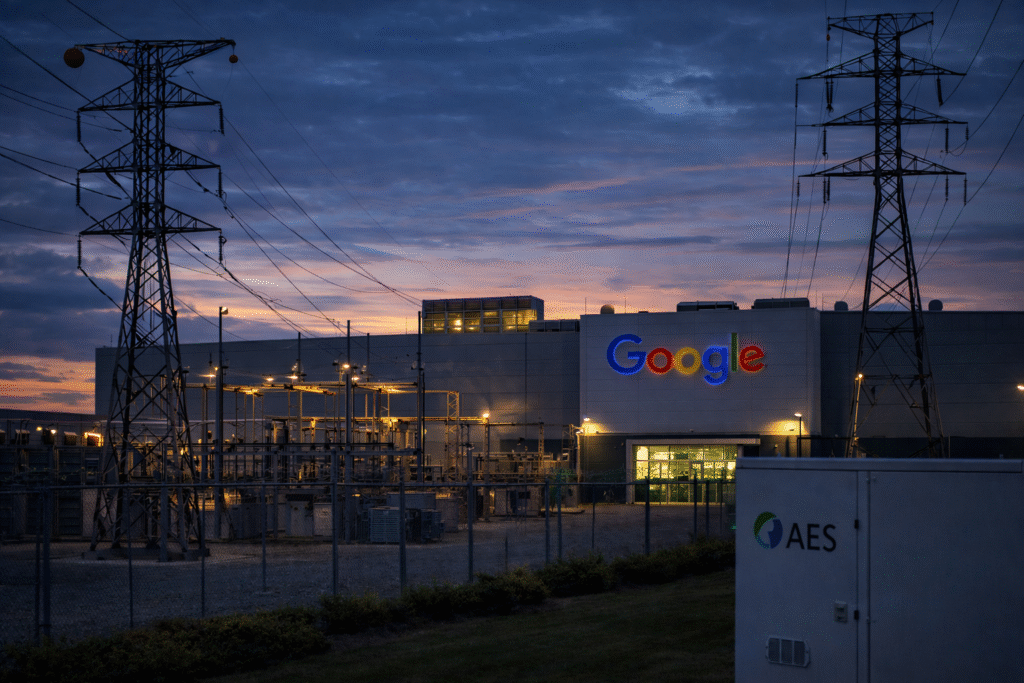
Alphabet’s Google is doubling down on securing energy for its rapidly expanding data center footprint.
The company signed separate agreements with AES Corp and Xcel Energy, locking in long-term power supply as AI-driven demand continues to surge.
While the AI race often centers around chips and models, the real bottleneck may be electricity.
Training models, running inference, and scaling cloud services require massive and stable energy inputs — and hyperscalers are racing to secure it before supply tightens.
The Minnesota Build-Out: 1.9 Gigawatts of Clean Energy
Under its agreement with Xcel Energy, Google will power a new data center in Pine Island, Minnesota.
The deal brings 1,900 megawatts of new clean energy to the grid, including:
- 1,400 MW of wind
- 200 MW of solar
- 300 MW of long-duration storage
Google will also invest $50 million into Xcel’s battery storage network across Minnesota.
Importantly, Xcel said the project will not raise costs for existing customers, as Google will cover the costs tied to its service expansion.
Texas Expansion: A 20-Year Deal With AES
In Texas, Google signed a 20-year agreement with AES to power a new data center in Wilbarger County.
The energy generation will be co-located with the facility — meaning supply is built directly alongside compute capacity.
AES will construct the required shared electricity infrastructure, allowing Google to expand operations as AI demand grows.
The Bigger Pattern: Hyperscalers Securing the Grid
Google’s move isn’t isolated.
It previously partnered with NextEra Energy on 3.5 gigawatts of generation capacity — enough electricity to power roughly 2.5 million homes.
Other utilities such as Southern Co and AEP also count Google as a major customer.
Meanwhile, Meta, Microsoft, and Amazon Web Services have signed their own long-term power supply agreements as part of their AI expansion strategies.
AI Is Driving a Utility Supercycle
Data centers are now one of the fastest-growing sources of electricity demand in the U.S.
To meet that surge, utilities are investing heavily in:
- Grid upgrades
- Renewable capacity
- Battery storage
- Co-located generation
This capital cycle is beginning to reshape the power industry, with AI as the primary catalyst.
For hyperscalers, securing energy is no longer optional — it’s strategic.
WSA Take
The AI boom isn’t just about GPUs and software.
It’s about infrastructure — physical, long-duration, capital-intensive infrastructure.
Google’s power deals show that the next phase of AI competition may hinge as much on megawatts as model performance.
Companies that lock in reliable, scalable energy supply today will have a structural advantage tomorrow.
The AI race is becoming an energy race — and utilities are suddenly central to the story.
Disclaimer
WallStAccess is a financial media platform providing market commentary and analysis for informational and educational purposes only. This content does not constitute investment advice, a recommendation, or an offer to buy or sell any securities. Readers should conduct their own research or consult a licensed financial professional before making investment decisions.