Google Lands One of the Biggest AI Deals on Earth
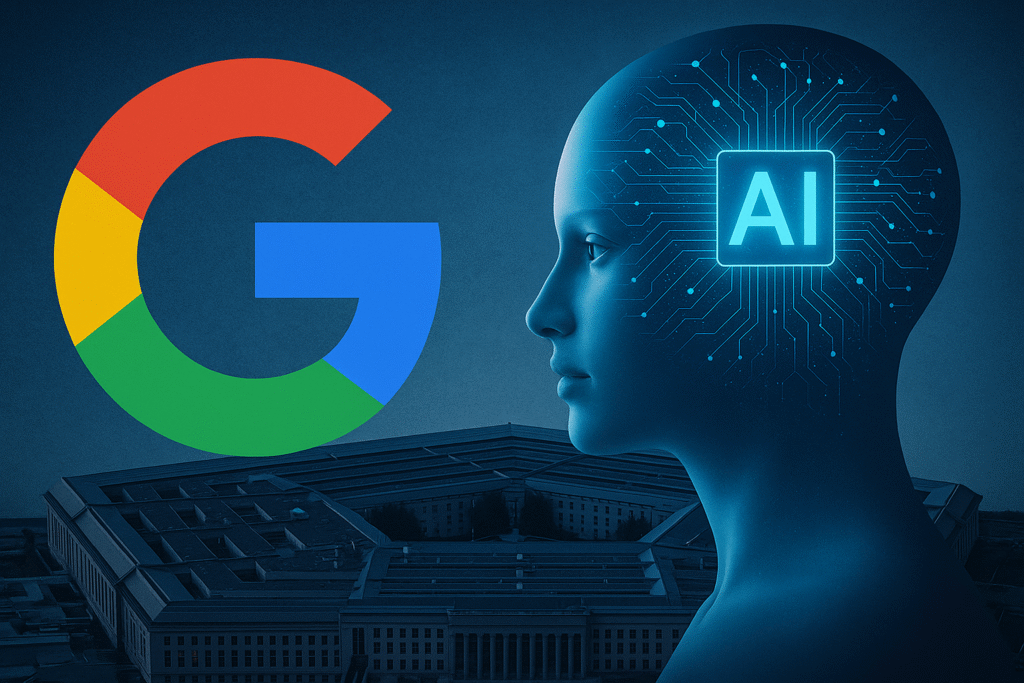
The U.S. Department of Defense has officially selected Google’s Gemini for Government platform to bring artificial intelligence tools to roughly three million workers across the military and civilian workforce.
The platform — now branded GenAI.mil — is being rolled out to support everything from intelligence review to logistics and real-time battlefield analysis.
Defense Secretary Pete Hegseth framed the decision bluntly:
“The future of American warfare is here, and it’s spelled AI.”
According to Pentagon officials, the goal isn’t just software deployment — it’s a full cultural shift toward AI-native operations that will define digital warfare for decades.
This follows Google Cloud’s $200 million DoD contract earlier this year, alongside similar — but smaller — awards to OpenAI, Anthropic, and xAI.
Google already works with the U.S. Navy, Air Force, and Defense Innovation Unit.
But this is the largest and most far-reaching AI adoption event in U.S. defense so far.
Why Google, and Why Now?
The Pentagon selected Google for one reason:
Speed + security + scale.
Gemini for Government is a locked-down version of Google’s flagship model suite built for classified workflows, imagery analysis, and high-volume data environments.
The military sees the platform as a force multiplier for:
- Analyzing drone and satellite footage
- Intelligence summarization
- Cybersecurity automation
- Training simulations
- Administrative workflows across millions of users
The DoD is moving toward a world where AI is as essential as hardware — and Google wants to own the operating system behind it.
Google’s Other Front: Winning the AI Talent War Through Students
While Google is deploying AI at the highest levels of U.S. national security, it’s also executing a quieter — but equally strategic — play:
Offering a free year-long Gemini subscription to students.
This is the same competitive move that helped Microsoft dominate Windows and Office in the 90s:
win students → win the future workforce.
By making Gemini Ultra free for academic audiences, Google is:
- Training the next generation of professionals on its ecosystem
- Reducing dependence on ChatGPT in schools and universities
- Increasing daily-use adoption among 18–25 year olds
- Building long-term stickiness for Google Cloud and corporate AI tools
It’s a preemptive land grab designed to weaken OpenAI’s consumer dominance and establish Gemini as the default AI learning environment globally.
While OpenAI remains the cultural leader, Google is pushing scale — across defense, enterprise, cloud, and now academia.
AI Dominance Is Becoming a Multi-Front Battle
Between national defense, hyperscaler cloud clients, and education, Google is now executing one of the most aggressive expansion strategies in the AI sector.
And unlike other players, Google has:
- A trillion-dollar search business
- Total control of the Android ecosystem
- The world’s largest cloud-enabled data infrastructure
- A direct pipeline to future decision-makers through academia
The Pentagon deal signals trust at the highest levels of government.
The student strategy signals long-term ecosystem capture.
Both point to the same story:
Google wants Gemini to be the dominant AI platform worldwide — from classrooms to combat command centers.
WSA Take
Google just landed one of the most strategically important AI contracts in modern U.S. history — and it’s pairing that win with a grassroots push to own the next generation of AI users.
This is not incremental expansion.
It’s a full-spectrum offensive against OpenAI, Microsoft, and every competitor positioning for long-term AI leadership.
If Google succeeds in owning defense + education + enterprise simultaneously, Gemini could become the operating system of global AI deployment.
This is the clearest sign yet that the AI race is becoming a geopolitical, commercial, and generational contest — and Google is playing on all fronts at once.
Read our recent coverage on Why Walmart is Moving to Nasdaq.
Explore more market insights on the WallStreetAccess homepage.
Disclaimer
WallStAccess does not work with or receive compensation from any companies mentioned. This content is for informational and educational purposes only and should not be considered financial advice. Always conduct independent research before investing.