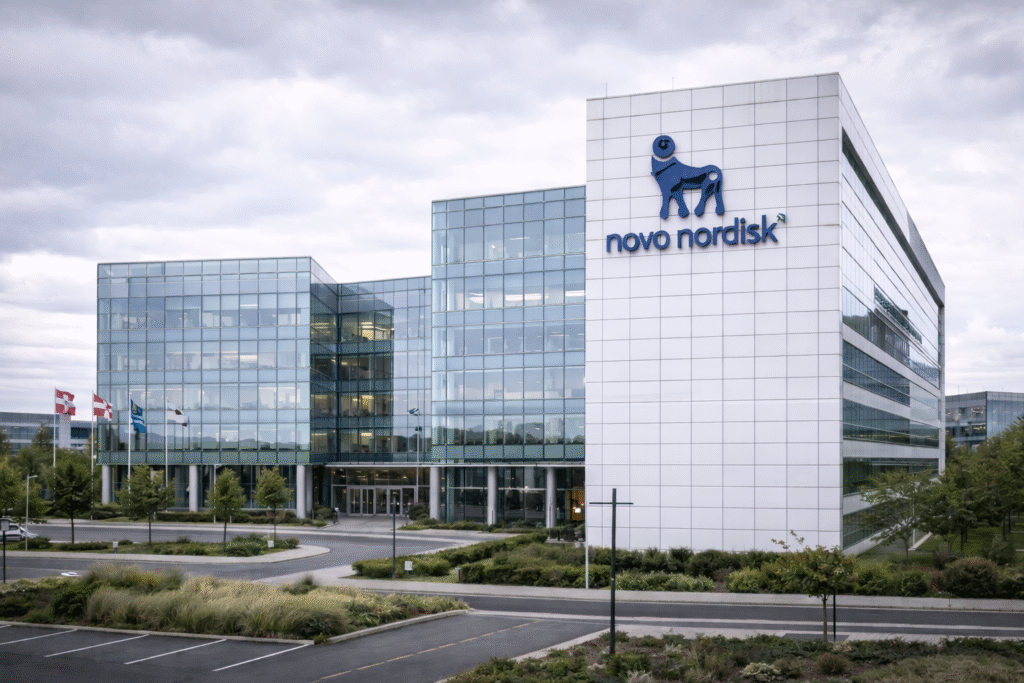
From Europe’s Most Valuable Company to Market Reality
Novo Nordisk’s meteoric rise during the Wegovy era has officially come full circle.
Shares of the Danish drugmaker plunged more than 16%, wiping out the remaining gains tied to the explosive growth of its weight-loss drug Wegovy. The catalyst: disappointing trial data for its next-generation obesity therapy, CagriSema, which underperformed a competing treatment from Eli Lilly.
At its peak in 2024, Novo Nordisk’s market value topped $650 billion. Since then, roughly $475 billion in value has been erased, returning the stock to levels seen before the obesity-drug boom transformed it into Europe’s most valuable company.
The stock was among the biggest decliners in Europe’s STOXX 600 index, while shares of Eli Lilly climbed roughly 4% in U.S. trading.
The Obesity Drug Arms Race Intensifies
The global obesity treatment market has become one of the fastest-growing segments in pharmaceuticals. Demand is being driven by:
- Expanding clinical adoption
- Insurance coverage gains
- Direct-to-consumer awareness
- Long-term treatment strategies
But in this space, incremental advantage matters.
Analysts at J.P. Morgan described the CagriSema trial miss as a “significant setback,” noting it could dampen long-term sales expectations and make it harder for Novo to regain share against competitors offering stronger weight-loss efficacy.
Investors are increasingly focused on one core metric: which drug delivers the most effective results.
That competitive reality has reshaped valuations across the sector.
A Market That Rewards Performance — Quickly
The Wegovy surge once symbolized a new era for metabolic disease treatment. But biotech and pharma markets are unforgiving when pipeline expectations shift.
Novo’s setback comes amid rising competition in obesity treatments, where Eli Lilly has emerged as a formidable rival. The data miss reinforces investor concerns that maintaining dominance in this category will require continual product innovation — not just brand strength.
Interestingly, shares of Zealand Pharma, another Danish biotech developing amylin-based weight-loss therapies, also fell — though analysts largely downplayed broader implications for its own pipeline.
What This Signals for the Sector
The reaction highlights how sensitive biotech valuations are to:
- Clinical trial outcomes
- Comparative efficacy
- Long-term market share assumptions
Obesity drugs remain one of the largest growth categories in global pharma. But leadership in this space isn’t guaranteed — it’s earned trial by trial.
WSA Take
Novo Nordisk’s $475 billion market-value swing tells a bigger story than just one trial result.
The obesity drug boom isn’t fading — it’s maturing.
As competition intensifies, markets are shifting from rewarding early dominance to scrutinizing pipeline depth and comparative performance.
For investors, the message is clear: in biotech, today’s breakthrough can quickly become tomorrow’s baseline. And in a category growing this fast, the bar keeps rising.
Explore More Stories in Health
Disclaimer
WallStAccess is a financial media platform providing market commentary and analysis for informational and educational purposes only. This content does not constitute investment advice, a recommendation, or an offer to buy or sell any securities. Readers should conduct their own research or consult a licensed financial professional before making investment decisions.