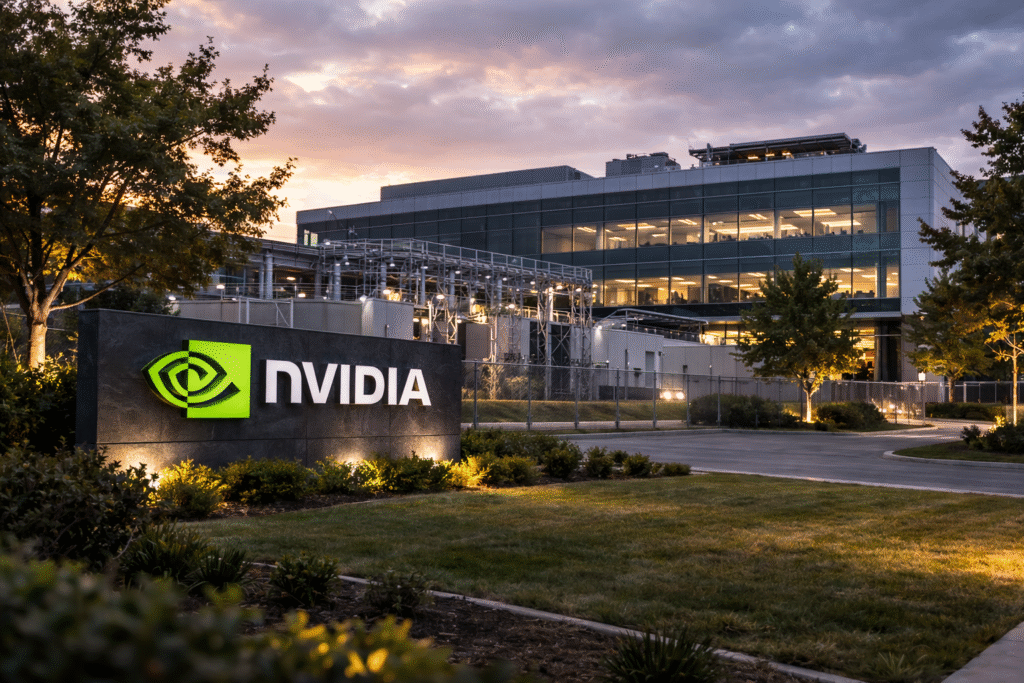
Strong Quarter. Softer Reaction.
Nvidia delivered another eye-catching quarter — but the stock still fell.
Shares dropped as much as 5.6%, marking the biggest intraday decline in three months, after investors reacted coolly to the company’s forward guidance.
On paper, the results were impressive:
- Fiscal fourth-quarter revenue jumped 73% to $68.1 billion
- Adjusted earnings came in at $1.62 per share, above expectations
- Adjusted gross margin reached 75.2%
- Data center revenue surged to $62.3 billion
For the upcoming quarter, Nvidia projected revenue of roughly $78 billion, well above consensus — though some analysts had been looking for numbers closer to $80 billion.
The takeaway: Nvidia beat expectations. But expectations were already sky-high.
The AI Question Isn’t About Today — It’s About 2027
Nvidia remains the dominant supplier of AI accelerator chips used to train and run large-scale models.
But after years of explosive growth, investors are asking a different question:
Can this pace continue?
Analysts are increasingly focused on whether the current AI infrastructure boom can sustain momentum once hyperscalers finish their initial build-outs — and as AI shifts from model training toward inference and everyday deployment.
CEO Jensen Huang pushed back during the earnings call, arguing that customers are monetizing AI compute capacity and generating cash flow — supporting continued investment.
But skepticism remains.
Purchase Commitments and China Risk
One figure drawing attention: Nvidia’s purchase obligations have climbed to over $95 billion, up sharply from roughly $16 billion a year ago.
That level of forward commitment suggests confidence — but it also increases risk if demand cools.
China remains another variable. While the U.S. government has granted limited licenses to ship certain processors, regulatory uncertainty continues to cloud outlooks in one of the world’s largest chip markets.
For now, Nvidia is excluding China data center revenue from its forecasts.
Blackwell, Rubin, and the Next Leg of Growth
The company’s Blackwell GPU lineup is ramping, with successor architecture “Rubin” already in development.
Nvidia has previously projected that these platforms could generate hundreds of billions in cumulative revenue by 2026.
Meanwhile, hyperscalers continue to sign multiyear agreements — including major deployment commitments from Meta.
These deals are intended to reinforce that AI infrastructure demand remains intact.
But markets are recalibrating.
Other Segments Show Cracks
While data center revenue remains the growth engine, other divisions were softer:
- Gaming revenue came in below expectations
- Automotive sales also missed forecasts
- Ongoing memory chip shortages continue to pressure certain product lines
The AI narrative remains dominant — but Nvidia is still a diversified semiconductor company navigating broader industry dynamics.
WSA Take
Nvidia didn’t disappoint on performance. It disappointed on narrative reassurance.
When a stock becomes the centerpiece of an entire market theme, beating estimates isn’t enough — it has to crush doubt.
For now, the AI build-out remains massive. Hyperscaler spending is still strong. And Nvidia remains the central supplier.
But the market is shifting from asking, “How big is this?”
To asking, “How long can this last?”
That’s a tougher question.
And in this cycle, expectations may be the hardest thing to scale.
Disclaimer
WallStAccess is a financial media platform providing market commentary and analysis for informational and educational purposes only. This content does not constitute investment advice, a recommendation, or an offer to buy or sell any securities. Readers should conduct their own research or consult a licensed financial professional before making investment decisions.