What Happened
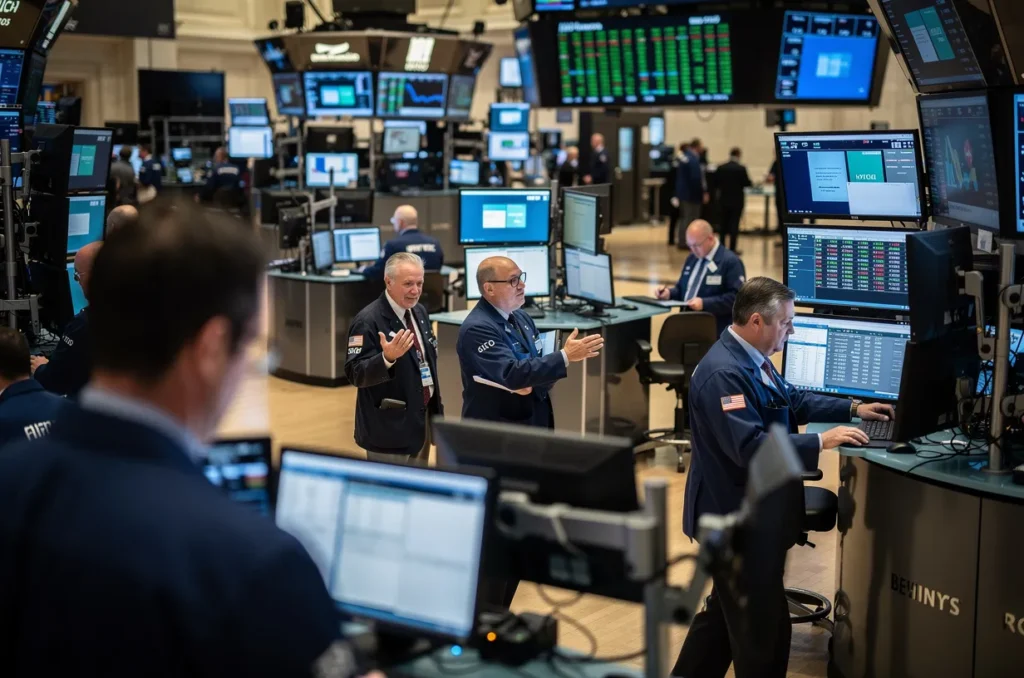
U.S. stocks traded mixed around midday on Friday as investors weighed a hotter-than-expected March inflation report against hopes that upcoming U.S.-Iran talks could help stabilize the market’s biggest macro risk.
The Nasdaq Composite was up about 0.2%, while the Dow Jones Industrial Average fell roughly 0.5%. The S&P 500 slipped around 0.1%.
The split action reflected a market that is trying to hold recent gains while still dealing with two major pressures at once: rising inflation tied to the Iran war and uncertainty around whether the fragile ceasefire can hold.
Inflation Reaccelerated On Energy
The main economic data point of the day was the latest Consumer Price Index report.
It showed:
- annual headline CPI rose to 3.3% in March
- prices increased 0.9% from February
- that was the largest monthly gain since 2022
The sharp move higher came as the U.S.-Iran war pushed gas prices up quickly, feeding directly into broader inflation.
That matters because a new inflation spike complicates the market’s view on interest rates. If energy costs stay elevated, it becomes harder for investors to price in an easier path from the Federal Reserve, even if growth starts to soften elsewhere.
Weekend Iran Talks Stayed Front And Center
At the same time, investors were already looking beyond the CPI report to the next geopolitical catalyst.
The market is focused on weekend talks between the U.S. and Iran, with traders watching for signs that the current two-week truce could develop into something more durable.
That remains critical because the market’s inflation problem is tied directly to the conflict. If diplomacy makes progress and shipping conditions improve, some of the recent pressure on oil and gasoline could ease. If talks stall, markets may have to keep pricing in tighter energy supply and more persistent inflation risk.
Ahead of the talks, President Trump increased pressure on Iran to lift its blockade of the Strait of Hormuz, but traffic through the waterway remained thin.
Hormuz Is Still The Pressure Point
The Strait of Hormuz remains the market’s most important variable in this story.
It is the key route for a major share of global energy shipments, and as long as traffic there stays constrained, the market will have a hard time fully relaxing.
That keeps pressure on several fronts:
- oil prices
- gasoline costs
- inflation expectations
- broader risk sentiment
So even though Friday’s immediate catalyst was inflation, the deeper market driver is still the same geopolitical bottleneck.
The Major Indexes Are Still In Different Places
The mixed session also reflected how uneven the broader market recovery has been.
The Dow moved back into positive territory for the year on Thursday, while the Nasdaq and S&P 500 were still down by just under 1% for the year heading into Friday’s trading.
That tells investors something important. The market has stabilized from its worst levels, but leadership is still uneven and conviction is not yet broad-based.
The S&P 500 Still Has A Strong Streak Working
One of the more constructive technical signals in the market is the S&P 500’s recent run of gains.
The index was trying to post its eighth straight up day on Friday. Over the last decade, similar streaks have often been followed by further upside, even if the market pauses first.
The setup also looks different from the late-2021 version of this signal. Back then, the relative strength index, or RSI, was near 77, a level often associated with an overbought market. By contrast, the more recent streaks, including the current one, came with RSI closer to 60, which is a much less stretched reading.
That does not guarantee a rally from here, but it does suggest the market’s momentum may still have room if the macro backdrop improves.
Tech Held Up Better Than The Blue Chips
The fact that the Nasdaq was green while the Dow lagged also fit the broader tone of the session.
Growth-oriented investors appeared more willing to stay involved in technology even as the hotter CPI print raised fresh rate questions. Meanwhile, more cyclical and blue-chip exposure looked heavier, especially with energy uncertainty and global macro risks still unresolved.
That kind of split usually signals a market that is not panicking, but also is not fully comfortable pressing risk aggressively.
What Traders Are Watching Next
The next major market questions are straightforward:
- do the U.S.-Iran talks produce real progress
- does traffic through Hormuz improve
- do energy prices start to cool
- does inflation ease back after March’s surge
If those answers improve, the recent equity rebound may have room to continue. If they do not, the market could quickly find itself back under pressure from the same inflation-and-geopolitics mix that has been driving volatility.
WSA Take
Friday’s mixed session showed a market caught between improving price momentum and a macro backdrop that is still unstable. Stocks have bounced, and the S&P 500 is still showing constructive trend strength, but the latest CPI report was a reminder that the Iran conflict is now feeding directly into inflation.
For investors, the near-term setup comes down to whether diplomacy can cool the energy shock fast enough. If Hormuz starts to normalize and oil pressure eases, the market may be able to keep grinding higher. If not, the rebound risks running into the same inflation problem that has kept this market from fully breaking out.
Explore More Stories in Markets
Disclaimer
WallStAccess is a financial media platform providing market commentary and analysis for informational and educational purposes only. This content does not constitute investment advice, a recommendation, or an offer to buy or sell any securities. Readers should conduct their own research or consult a licensed financial professional before making investment decisions.