What Uber Announced
Uber Technologies (UBER) said it will invest more than $100 million to develop autonomous vehicle charging hubs, a move that reinforces the company’s push to scale self-driving operations on its platform. The plan includes building out charging where Uber manages daily fleet activity and adding “pit stop” charging coverage in priority markets.
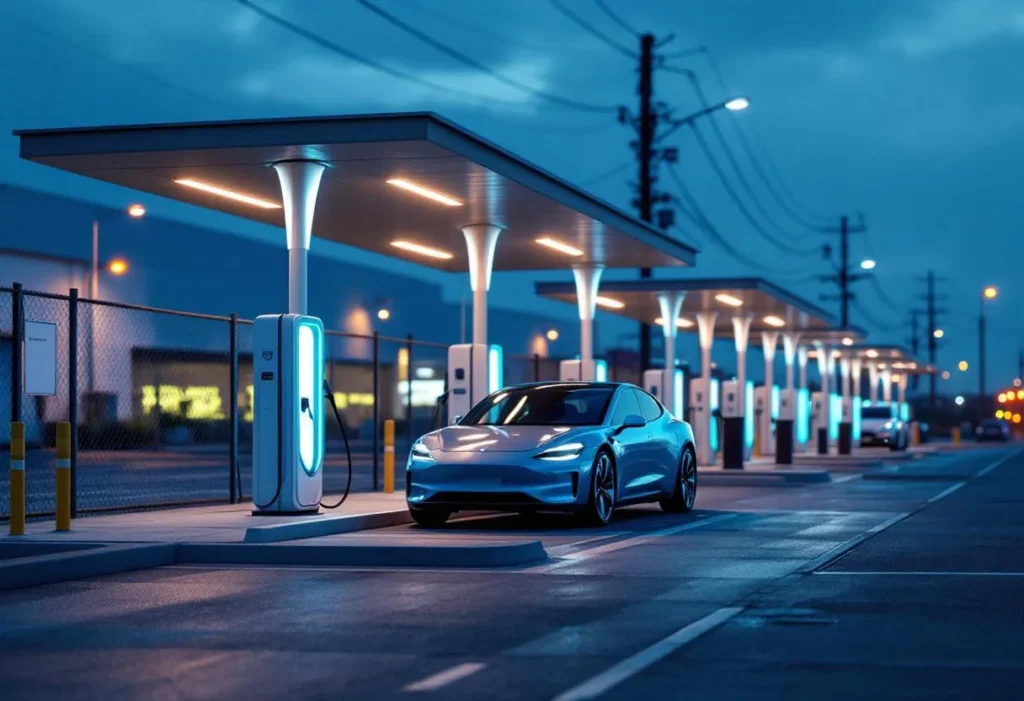
At the center of the effort are DC fast charging stations built at Uber’s autonomous depots and placed at key locations across targeted cities. The idea is straightforward: if robotaxi fleets are going to expand, charging logistics need to be predictable and fast.
- $100 million+ earmarked for autonomous vehicle charging hubs
- DC fast chargers planned for autonomous depots used in fleet operations
- Additional charging “pit stops” across priority cities
Where The Buildout Starts
The charging expansion is set to begin in the U.S., starting with the Bay Area, Los Angeles, and Dallas. Uber said the rollout will move to additional cities over time.
These initial markets matter because they combine large ride-hailing demand with existing EV and autonomy ecosystems. For U.S. investors, the early-city list also provides a clear set of geographies to track as deployments ramp.
- Bay Area
- Los Angeles
- Dallas
Partnership Model: Guarantees To Add More Chargers
Uber is also partnering with chargepoint operators in global markets to set up “utilization guarantee agreements”. Those agreements are expected to support the rollout of hundreds of new chargers across the named cities, focusing on areas where charging is needed most.
The partners Uber named span multiple regions, including EVgo (EVGO) in several U.S. cities, along with operators in Europe and the U.K. This approach signals Uber is leaning on third-party charging networks alongside its own depot buildout.
- EVgo (EVGO) in New York, Los Angeles, San Francisco, and Boston
- Electra in Paris and Madrid
- Hubber and Ionity in London
Why It Matters For Uber’s Robotaxi Strategy
Uber has made autonomous vehicles a strategic priority and said it partners with more than 20 firms globally across self-driving freight, delivery, and taxi services. The company is looking to secure market share as competition heats up, including from Tesla (TSLA).
Uber currently offers robotaxis on its ride-hailing platform in four U.S. cities, and also in Dubai, Abu Dhabi, and Riyadh. It has partnered with robotaxi firms including Alphabet’s (GOOGL) Waymo and WeRide for autonomous fleet operations.
Earlier this month, Uber said it was committing capital to vehicle partners to secure early supply and speed deployments, framing its platform as having a structural advantage. Investors will watch how quickly new charging capacity and vehicle supply translate into broader geographic coverage and steadier unit economics for autonomous trips.
- Robotaxis available via Uber in four U.S. cities
- International robotaxi availability in Dubai, Abu Dhabi, and Riyadh
- Robotaxi partners include Waymo (GOOGL) and WeRide
WSA Take
Uber’s $100 million+ charging commitment is a practical step: autonomous fleets can’t scale without fast, reliable charging and predictable turnaround times. The mix of depot charging plus city “pit stops” suggests Uber is planning around real-world operational bottlenecks, not just adding partnerships. The utilization guarantee structure is also notable because it aims to pull charger supply into the specific neighborhoods and corridors where robotaxi demand concentrates. The key next signal will be whether the first-city rollout expands smoothly and supports higher robotaxi availability without service disruptions.
Disclaimer
WallStAccess is a financial media platform providing market commentary and analysis for informational and educational purposes only. This content does not constitute investment advice, a recommendation, or an offer to buy or sell any securities. Readers should conduct their own research or consult a licensed financial professional before making investment decisions.