
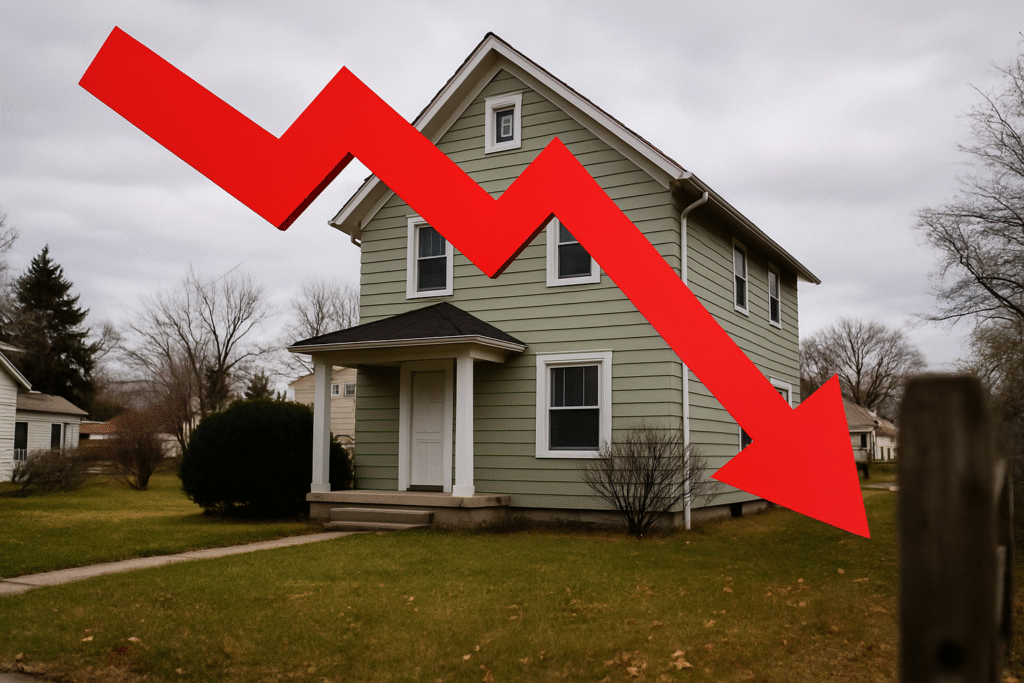
Home Prices Slip Into the Red for the First Time Since 2023
After two years of relentless affordability pressure, U.S. home prices have finally dipped below last year’s levels — if only slightly.
High-frequency data from Parcl Labs shows national prices down less than 1% year-over-year, with a deeper 1.4% drop over the past three months.
This marks the first negative reading since mid-2023, when the Federal Reserve’s aggressive rate hikes pushed mortgage rates above 7% and froze demand.
Unlike the 2006–2012 housing crash, today’s decline is mild — but the forces behind it are classic:
- A sharp affordability shock
- Rising inventory
- Softening buyer demand
- Sellers adjusting expectations
“Affordability shocks historically produce broad price declines,” said Jason Lewris of Parcl Labs.
Inventory Rising — But Not Fast Enough to Reset the Market
Housing supply is no longer at the rock-bottom levels seen in 2021–2022, but the recovery is limited:
- Active listings: +13% year-over-year
- New listings: barely +1.7%
- Seller withdrawals: unusually high
This push-and-pull has created pockets of weakness, especially in overheated Sun Belt markets.
Markets Seeing Notable Declines
- Austin: –10%
- Denver: –5%
- Tampa & Houston: –4%
- Phoenix & Atlanta: –3%
Markets Still Rising
- Cleveland: +6%
- Chicago & NYC: +5%
- Philadelphia: +3%
- Pittsburgh & Boston: +2%
The national picture is being pulled in opposite directions — Midwestern affordability remains a plus, while Western and Southern markets continue to deflate after pandemic-era surges.
Builders Say Demand Is Still Weak
With federal economic data frozen during the government shutdown, builders have become the clearest window into supply conditions — and the message is consistent:
Demand remains soft, incentives remain necessary, and sentiment remains negative.
The NAHB expects:
- A decline in single-family starts in 2025
- A slight rebound in 2026
The takeaway: Builders aren’t preparing for a surge in demand anytime soon.
Mortgage Rates Are Stuck — So Prices Likely Will Be Too
Despite recent Fed rate cuts, mortgage rates have barely budged — holding in a narrow band for three months. That stability removes both catalysts:
- No big drop to spark a buying boom
- No spike to trigger a major correction
The most likely scenario?
A long stretch of near-zero home price growth.
Lewris summed it up:
“Our base case is not a deep downturn, but a period where prices hover around zero — small gains or small declines — rather than pandemic-era surges.”
WSA Take
The housing market has finally cracked, but only slightly — and not in a way that restores affordability for most buyers. Without meaningful rate relief or a surge in supply, this is shaping up to be the most frustrating outcome of all: a stagnant market stuck between high prices and weak demand.
Flat home prices may not be a crisis, but they’re far from the reset many Americans were hoping for. The real story to watch in 2026: whether mortgage rates meaningfully break lower, or whether U.S. consumers remain locked in place.
Read our recent coverage on Disney Invests $1B in OpenAI.
Explore more market insights on the WallStreetAccess homepage.
Disclaimer
WallStAccess does not work with or receive compensation from any companies mentioned. This content is for informational and educational purposes only and should not be considered financial advice. Always conduct independent research before investing.