
What Happened
When investors talk about a future SpaceX IPO, they are increasingly talking about Starlink.
That is because the satellite internet business has grown far beyond an experimental space project. It now looks like the core commercial machine inside the broader SpaceX story. Rockets still define the brand, but Starlink appears to define more of the economics.
That distinction matters because public market investors do not just buy vision. They buy revenue quality, margins, growth durability, and business models that can scale. On those fronts, Starlink is doing much of the heavy lifting.
Starlink Changed The SpaceX Story
The reason Starlink matters so much is simple: it shifts SpaceX from being viewed mainly as a launch company into something much broader.
A launch business can be powerful, but it is still tied to cadence, contracts, and a more industrial revenue model. Starlink, by contrast, adds a recurring service layer on top of the aerospace base. That gives the company exposure to broadband subscriptions, enterprise connectivity, government contracts, and potentially mobile communications.
That is a very different public-market story.
Instead of valuing SpaceX only as an advanced aerospace company, investors would likely be evaluating a hybrid business with:
- recurring subscription revenue
- expanding global connectivity reach
- strong operating leverage
- multiple commercial verticals
- and a built-in launch advantage no competitor can easily match
What Starlink Actually Is
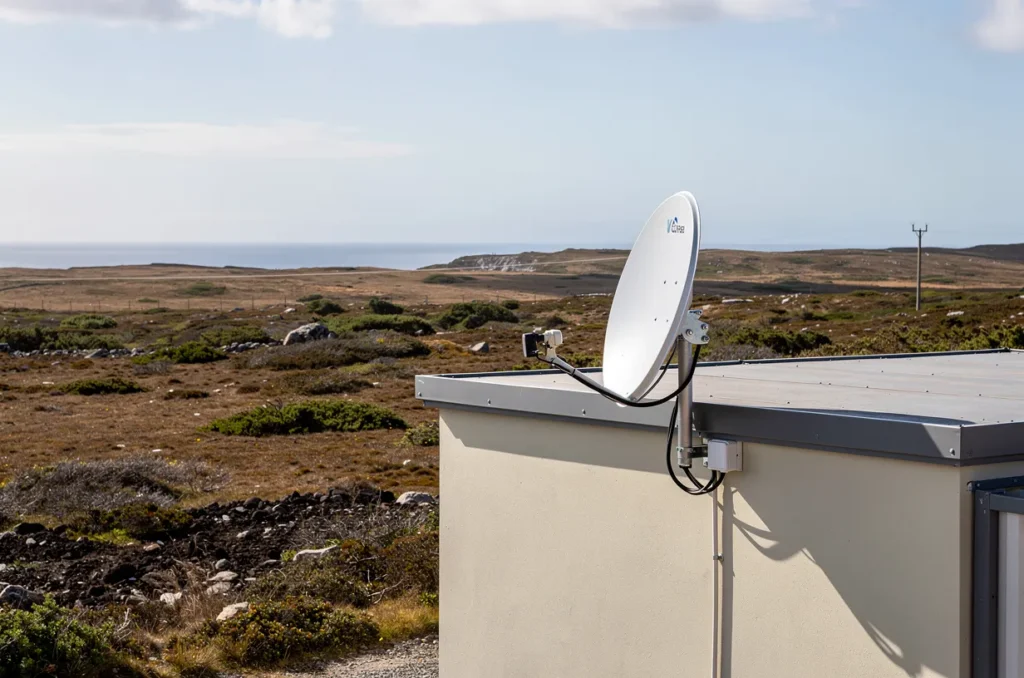
At its core, Starlink is a broadband internet service delivered through a massive network of low Earth orbit satellites.
Instead of relying on fiber, towers, or traditional geostationary satellites, the system beams internet directly from satellites to small user terminals on the ground. Because those satellites orbit much closer to Earth than legacy satellite systems, the service can offer much lower latency and a more usable broadband experience.
That is what makes the platform commercially important. It is not just “internet from space” as a concept. It is a connectivity product designed to compete more directly with practical real-world internet service in places where terrestrial infrastructure is weak, expensive, or unavailable.
Scale Is The Real Moat
A huge part of the Starlink investment case comes down to scale.
The source article describes a constellation of more than 9,600 operational satellites, with SpaceX adding roughly 70 satellites per week. That kind of pace changes the entire operating model. It looks less like a traditional aerospace program and more like industrial manufacturing at global scale.
That matters because scale creates advantages in:
- launch frequency
- network density
- customer reach
- hardware cost
- manufacturing efficiency
- replacement speed
It also reinforces a point many investors will focus on: Starlink is not just big. It is operating at a scale that rivals may struggle to match quickly, especially if they still depend on third parties for launch or production.
The Vertical Integration Matters More Than People Think
One of the most important pieces of the Starlink story is how much of the system sits under one roof.
SpaceX designs satellites, manufactures them, launches them, and operates the service. That means the company is not simply leasing access to infrastructure built by others. It controls the loop from production to orbit to subscriber.
That gives it a major edge.
For IPO investors, vertical integration can support:
- faster iteration
- lower costs
- stronger margins
- more supply chain control
- less dependency on outside partners
This is one reason Starlink looks so important inside the broader SpaceX valuation case. The business is not just growing. It is growing inside a structure that may let it scale more efficiently than competitors.
This Is No Longer Just Consumer Broadband
Another reason Starlink matters is that the product set has widened.
The source describes three broad areas of the business:
- commercial connectivity
- Starshield
- direct-to-cell
The commercial side includes residential, business, maritime, and aviation use. Starshield extends the platform into government and national security applications. Direct-to-cell opens a path toward mobile phone connectivity through carrier partnerships.
That matters because it expands the ceiling.
A company offering only residential satellite internet would still be interesting. A company that can layer consumer broadband, commercial connectivity, defense relevance, and mobile coverage onto the same network starts to look much more strategically valuable.
Direct-To-Cell Could Be One Of The Biggest Upside Pieces
The direct-to-cell business is especially important because it points to a much bigger future addressable market.
The source article says the offering already serves more than 6 million monthly subscribers and has connected 12 million people at least once, even before full commercial rollout. If that kind of adoption continues, the upside is substantial.
The reason is simple: this service can work with ordinary mobile phones rather than requiring a full traditional satellite broadband setup.
That gives Starlink a much broader potential footprint. Instead of only selling fixed broadband kits, the company can partner with carriers and become a coverage-extension layer. In that model, every mobile subscriber in a weak-coverage zone becomes part of the opportunity set.
That is a much bigger story than home internet alone.
The Subscriber Growth Is What Public Investors Will Notice
The source article points to more than 9 million subscribers across more than 155 countries by the end of 2025, with 4.6 million added in the prior year.
That type of growth matters because it gives the IPO story one of the things public investors prize most: visible expansion in a recurring revenue base.
Businesses that attract premium market attention often have some combination of:
- recurring customer payments
- strong subscriber growth
- expanding margins
- international scale
- multiple paths to upsell or extend service
Starlink appears to offer all of those in some form. That makes the business much easier to frame as a long-term compounding story rather than a one-dimensional aerospace bet.
The Margins Change The Equation
The economics in the source article are one of the clearest reasons Starlink matters to any future IPO.
The article cites estimated 2025 revenue of $10.6 billion for Starlink, with EBITDA of $5.8 billion and an EBITDA margin of 54%. It also notes that Starlink made up roughly 67% of SpaceX’s total revenue.
Those are the kinds of numbers that shift perception fast.
Why? Because they suggest Starlink may behave less like a typical hardware-heavy communications business and more like a scaled subscription platform once the network is already in orbit. If the infrastructure is largely built, each added subscriber can become increasingly attractive from a margin standpoint.
That is a powerful IPO ingredient.
Competition Still Looks Limited
The source article also points out that competitors in satellite internet still appear well behind, or are focused on narrower use cases like aviation and commercial connectivity.
That matters because market leadership becomes more important when a company is about to be judged by public investors. A fast-growing category is good. A fast-growing category where one player has meaningful lead, manufacturing depth, and launch control is even better.
The more Starlink looks like the dominant early winner in satellite broadband, the easier it becomes to argue that a future SpaceX IPO would not just be large, but uniquely important.
What The Market Would Really Be Buying
This is the core point.
A future SpaceX IPO would not simply be an offering of rockets, launches, and long-term space ambition. In practical financial terms, it would likely be a chance to buy into the largest and fastest-growing piece of the business: Starlink.
That means the market would likely be buying exposure to:
- global satellite broadband
- recurring connectivity revenue
- defense and government applications
- direct-to-cell expansion
- vertically integrated hardware and launch economics
- a business with much stronger margin potential than many people associate with aerospace
That is why Starlink sits at the center of the IPO debate.
WSA Take
The easiest way to think about a future SpaceX IPO is this: the rockets may get the headlines, but Starlink is what gives the story public-market gravity.
For investors, that matters because Starlink brings the kind of traits that can support a premium valuation — recurring revenue, scale, high margins, global reach, and multiple growth verticals. In that sense, a future SpaceX IPO would likely feel less like a pure space offering and more like a Starlink-led infrastructure and connectivity platform with a launch business attached.
Disclaimer
WallStAccess is a financial media platform providing market commentary and analysis for informational and educational purposes only. This content does not constitute investment advice, a recommendation, or an offer to buy or sell any securities. Readers should conduct their own research or consult a licensed financial professional before making investment decisions.