Blue Origin Expands Beyond Rockets Into Satellite Internet
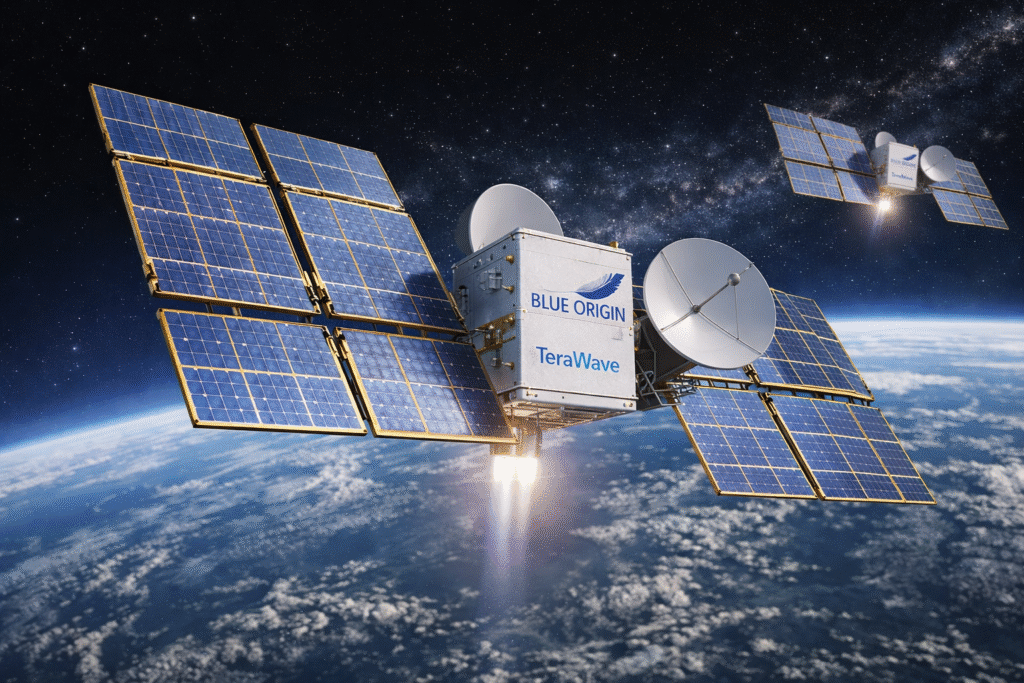
Blue Origin, backed by Jeff Bezos, is officially entering the satellite internet market, announcing plans for a new communications network designed to rival industry leaders.
The service, called TeraWave, will focus on enterprise, data center, and government customers, rather than consumer broadband. The company said the network will deliver data speeds of up to six terabits per second, using satellites deployed across both low Earth orbit (LEO) and medium Earth orbit (MEO).
Blue Origin expects to begin deploying the first satellites in the fourth quarter of 2027, with a full constellation totaling 5,408 satellites.
A Crowded but Strategic Market
Satellite internet is already dominated by SpaceX’s Starlink, which has deployed more than 9,000 satellites and serves millions of customers worldwide. But the market is expanding rapidly as governments, cloud providers, and enterprises look for resilient, high-bandwidth connectivity outside traditional fiber networks.
At the same time, Amazon has accelerated its own push. Its satellite service, recently rebranded as Leo, has already launched 180 satellites, with a target constellation of 3,236 satellites. Amazon opened an early enterprise preview last year ahead of a broader rollout.
Blue Origin’s TeraWave will compete directly with both offerings, particularly in high-value enterprise and government contracts where reliability, security, and scale matter more than consumer pricing.
Why TeraWave Matters for Blue Origin
Until now, Blue Origin has been best known as a launch provider, flying tourists and research payloads to the edge of space and developing heavy-lift rockets.
Recent milestones include:
- The first successful launch of the New Glenn rocket
- A later mission that successfully landed a New Glenn booster after deploying NASA spacecraft
TeraWave represents a strategic shift from launch-only services toward recurring, infrastructure-based revenue, similar to how Starlink has transformed SpaceX’s business model.
Bezos’ Long-Term Bet
Bezos has repeatedly signaled that Blue Origin is a multi-decade project, not a short-term commercial play. He founded the company in 2000 and has said publicly that it could eventually surpass Amazon in scale.
Blue Origin is currently led by former Amazon executive Dave Limp, reinforcing the company’s ambition to blend aerospace engineering with large-scale commercial services.
Competitive Landscape Ahead
With Starlink already entrenched and Amazon racing to deploy its own network, Blue Origin enters the market later — but with some advantages:
- Vertical integration through its own launch capabilities
- Focus on enterprise and government use cases rather than mass consumers
- Growing credibility following recent rocket successes
Still, execution risk remains high, and the capital requirements for deploying thousands of satellites are substantial.
WSA Take
TeraWave signals that Blue Origin is no longer content being “just” a launch company. Satellite internet is becoming core infrastructure for cloud computing, defense, and global data flows — and Bezos wants Blue Origin positioned as a serious player.
For investors, this move highlights a broader trend: space companies are evolving into platform businesses, where launch, connectivity, and data services converge. The race is crowded, but the prize is massive — and Blue Origin is finally stepping onto the battlefield.
Read our recent coverage on Alibaba Weighs IPO for AI Chip Unit T-Head.
Explore more market insights on the WallStreetAccess homepage.
Disclaimer
WallStAccess does not work with or receive compensation from any companies mentioned. This content is for informational and educational purposes only and should not be considered financial advice. Always conduct independent research before investing.