Rare earths are back at the center of the US-China economic fight
Rare earths are likely to be one of the most important strategic topics hanging over the latest Trump-Xi discussions, and for good reason. These materials sit inside some of the most important products in the global economy: electric vehicles, wind turbines, smartphones, data centers, industrial motors, radar systems, missiles, and fighter jets.
The problem for Washington is that the United States still does not control the part of the supply chain that matters most.
China may account for about 70% of mined rare earth output, but the deeper chokepoint is processing, separation, and magnet production. That is where Beijing still holds the upper hand. China controls roughly 90% of global heavy rare earth processing and produces most of the world’s rare earth permanent magnets, the high-performance components critical to advanced manufacturing and defense systems.
That is the real source of US vulnerability.
The US did not stumble into this problem by accident
America’s rare earth dependence is not just the result of geology. It is the result of long-term policy drift.
For years, Western economies were content to let China handle the dirtiest, most difficult parts of the rare earth supply chain while they imported low-cost processed materials and finished magnet products. China absorbed the environmental burden, scaled the industrial base, and understood earlier than most that controlling the supply chain mattered more than simply owning the raw materials.
The US took the opposite path.
It treated rare earths as cheap industrial inputs rather than as strategically sensitive materials. That mindset helped create the current system: extract, manufacture, consume, discard. Valuable materials are pulled from the ground, built into products with short life cycles, and then mostly lost into waste streams instead of being recovered.
That is not just an environmental failure. It is a strategic one.
The scale of future demand is getting harder to ignore
The urgency is only increasing because demand is rising fast.
The US Department of Energy projects that US demand for neodymium permanent magnets could reach around 37,000 tonnes per year by 2030, and as much as 68,600 tonnes annually by 2050 in a higher-growth scenario. That demand is being driven by exactly the industries Washington says it wants to lead: electrification, clean energy, industrial automation, and advanced manufacturing.
Now compare that with domestic production.
MP Materials, which operates the country’s only active rare earth mine, only began domestic neodymium magnet production in 2025. Its current capacity is around 1,000 tonnes, with a target of 10,000 tonnes once a second facility comes online in 2028.
That is real progress, but it still leaves a large gap.
America may already be throwing away one of its best rare earth supply sources
This is where the article makes its strongest point: the US is sitting on a large domestic rare earth resource, and much of it is already above ground.
That source is electronic waste.
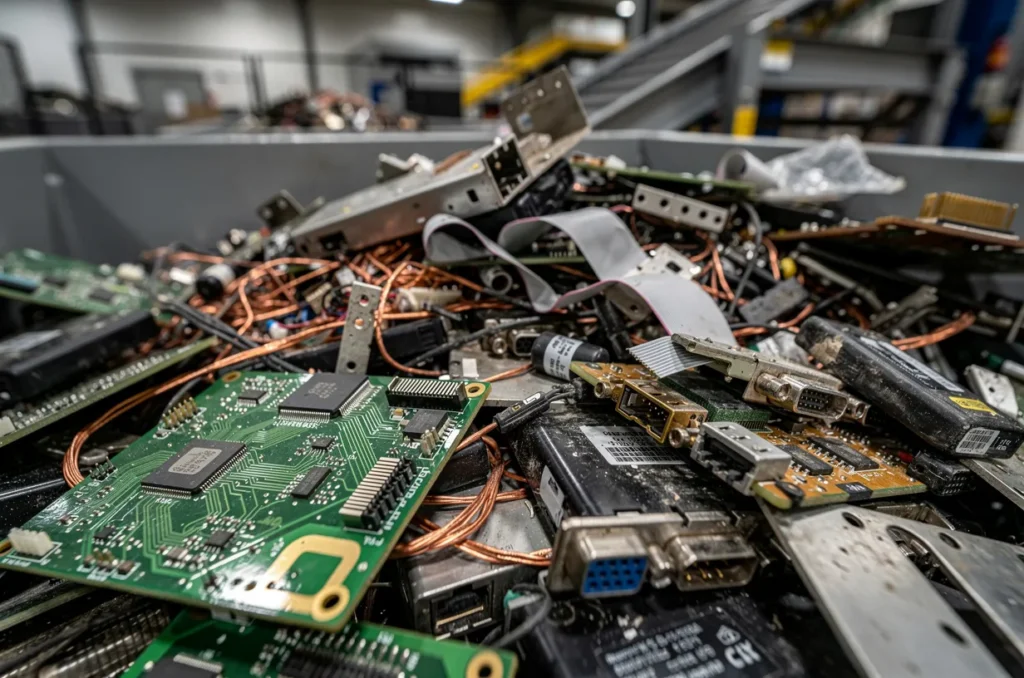
Discarded electronics, hard drives, motors, appliances, and industrial equipment contain significant quantities of rare earth magnets that can potentially be recovered and reused. According to the UN Global E-waste Monitor, the US generated about 7.2 million tonnes of e-waste in 2022. Using a reasonable estimate that about 0.25% of that waste consists of neodymium magnets, the US may be discarding roughly 18,000 tonnes of magnets per year.
That is a striking number.
It suggests annual US e-waste could contain enough magnet material to cover nearly two-thirds of projected 2030 neodymium magnet demand.
In other words, one of the country’s most significant domestic rare earth opportunities may already be sitting in junk drawers, data centers, scrapyards, discarded appliances, and landfills.
The resource exists, but the system to recover it does not
The challenge is not whether the material is there. It is whether the US has built a system capable of getting it back.
Right now, it largely has not.
E-waste recycling rules vary widely by state, there is no uniform federal framework, and existing collection systems are not designed specifically to recover rare earth magnets at scale. That means high-value materials continue to disappear into landfill or leave the country altogether through waste exports.
This is where the problem becomes especially frustrating from a policy perspective.
Washington is rightly concerned about China’s dominance over rare earths, but at the same time, the US continues to leak valuable magnet material out of its own economy through inadequate collection, disassembly, and recovery infrastructure.
That is a fixable problem. It just has not yet been treated like a national priority.
Coal ash and industrial waste add another layer of upside
E-waste is not the only overlooked domestic source.
The article also points to coal ash, mine waste, and industrial residues as additional US reservoirs of rare earth material. Some research suggests there may be as much as 11 million tonnes of rare earth elements in accessible US coal ash, a figure far larger than currently recognized domestic reserves.
That does not mean the resource is easy or cheap to extract.
But it does mean the US has more optionality than standard supply-chain discussions often suggest. The country is not limited to opening new mines. It can also build around waste recovery, residue extraction, and industrial circularity if policymakers decide to treat those areas seriously.
This is becoming industrial policy, not just recycling policy
That is the broader investment takeaway.
Rare earth recycling and recovery should not be viewed as a soft environmental side project. It is increasingly becoming a form of industrial policy. A country that can recover strategic materials from its own waste streams gains supply resilience, lowers exposure to geopolitical shocks, and reduces the need to depend entirely on new mining.
Some major technology companies already seem to understand this.
The article notes that Apple reported in April 2026 that several product lines now use 100% recycled rare earth elements in all magnets, while Dell has built closed-loop processes to recover magnets from hard drives and reuse them in new products.
That is an important signal. It shows circularity is already moving from concept to practice in parts of the corporate world.
The longer-term answer is not one more truce with China
The immediate question around Trump’s talks with Xi may be whether China keeps rare earth exports flowing.
But that is only the short-term question.
The bigger question is whether the US finally decides to build a domestic system that treats rare earths as strategic assets rather than disposable inputs. That means more than just new mining. It means:
- designing products for disassembly and recovery
- building collection systems that actually target magnets
- scaling separation and recycling capacity
- using procurement standards and tax incentives
- and treating waste streams as part of national resource security
That kind of shift will take time. But it is also the kind of shift that could matter much more than one more temporary trade truce.
WSA Take
Washington is right to worry about China’s rare earth leverage. But the smarter long-term answer is not simply demanding more exports from Beijing. It is building a domestic system that stops throwing away the very materials the US says it needs to secure.
That is why this story matters. Rare earth security is not just a mining story anymore. It is also a recycling, waste recovery, and industrial design story. If the US wants real resilience, it will have to start treating its own discarded electronics and industrial waste as strategic resources — because in practical terms, that is exactly what they are.
Explore More Stories in Commodities
Disclaimer
WallStAccess is a financial media platform providing market commentary and analysis for informational and educational purposes only. This content does not constitute investment advice, a recommendation, or an offer to buy or sell any securities. Readers should conduct their own research or consult a licensed financial professional before making investment decisions.