
The AI trade may be about to get even more concentrated
The artificial intelligence trade is already dominating the market, but the next phase could make that concentration even more extreme.
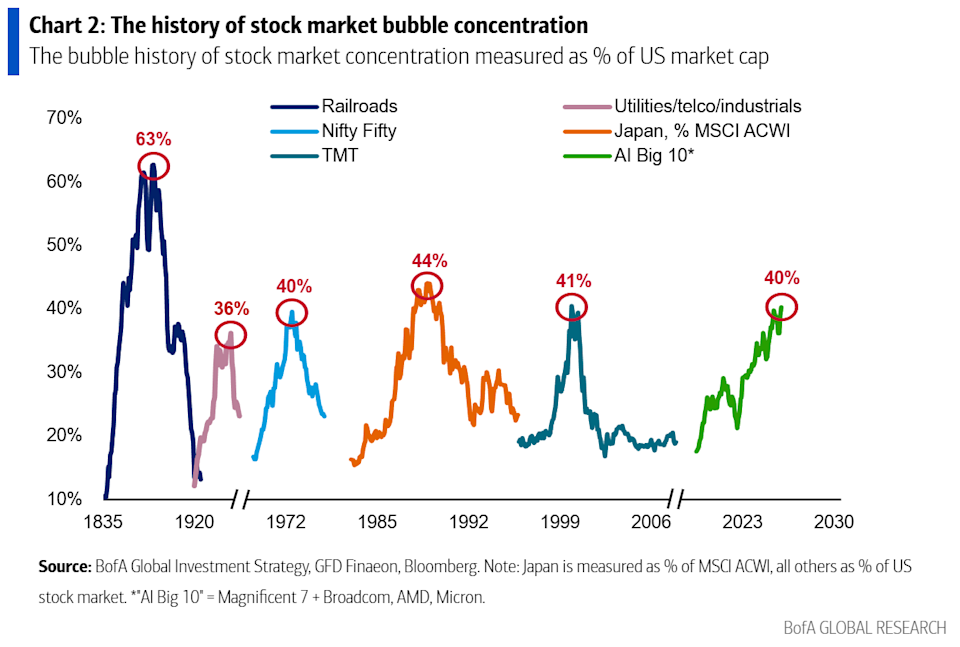
According to Bank of America’s Michael Hartnett, adding IPOs as large as SpaceX and OpenAI to today’s AI leaders could push market concentration from roughly 40% of US market capitalization toward 48%. That would take the market above the concentration peaks seen during the Roaring ’20s, the Nifty Fifty, Japan in the 1980s, and the dot-com era, though still below the old railroad boom of the 1880s.
That is a serious warning sign.
It does not mean the trade ends the moment those companies list. But it does mean investors would be pushing even more capital into a smaller group of names at a time when the market backdrop is becoming less forgiving.
The IPO issue is not just hype — it is timing
The bigger problem is not simply that these offerings would be huge. It is that they would ask investors to pay aggressively for growth that may take years to fully arrive.
That is where the bond market becomes critical.
When long-term yields are low, investors are usually more willing to stretch into companies whose biggest payoffs sit far out in the future. But when yields rise, the value of those distant future cash flows becomes harder to justify. The wait becomes more expensive.
That is exactly the environment the market is dealing with now.
The inflation backdrop is getting close to the danger zone
That makes the timing much more complicated than a simple “AI is hot” story.
Headline CPI rose 3.8% in April, putting inflation close to the 4% threshold that Bank of America flags as historically difficult for equities. According to the bank’s work, once CPI moved above 4% in past cycles, the S&P 500 averaged a loss of roughly 4% over the next three months and nearly 7% over the next six.
That does not mean history has to repeat perfectly here.
But it does mean the macro backdrop is becoming less supportive just as the market prepares for what could be two of the most aggressively watched IPOs in years.
The bond market is the real test
This is the piece that matters most.
The 30-year Treasury yield has pushed back toward the 5% zone, a level that has repeatedly created problems for equities. That level matters because it affects how investors think about everything from housing and corporate borrowing to stock valuations and the price they are willing to pay for long-duration growth.
That is the real test for SpaceX and OpenAI.
A hot debut is easy to imagine. Demand for both would likely be enormous. But strong first-day pricing is not the same thing as a supportive environment for sustaining premium valuations over time.
If yields keep climbing, the market will likely start asking a much harder question: how much is future growth worth when the discount rate keeps rising?
The IPO itself is not the signal — the setup around it is
That distinction matters.
Big IPOs do not automatically mark the top. Some arrive into strong markets and extend the rally. Some show up near fragile peaks. Some barely matter at all in the bigger index picture.
The offering itself is not the clean signal.
The real signal is what kind of market exists when it happens. If inflation stays sticky, yields stay elevated, and concentration keeps climbing, then the AI trade becomes much more vulnerable to the argument that too much money is chasing too few stories at too high a price.
That is how bubbles usually get described in real time: not because the companies are fake, but because the valuations become increasingly detached from the environment around them.
WSA Take
The risk here is not that SpaceX or OpenAI are weak businesses. The risk is that they may arrive at a moment when the market is already overcrowded, inflation is still running hot, and long-term yields are making investors less patient.
That is what makes this setup so interesting.
These IPOs could absolutely push the AI trade higher in the short term. But they could also deepen one of the market’s biggest existing problems: extreme concentration in a rate environment that is getting tougher, not easier.
Disclaimer
WallStAccess is a financial media platform providing market commentary and analysis for informational and educational purposes only. This content does not constitute investment advice, a recommendation, or an offer to buy or sell any securities. Readers should conduct their own research or consult a licensed financial professional before making investment decisions.