
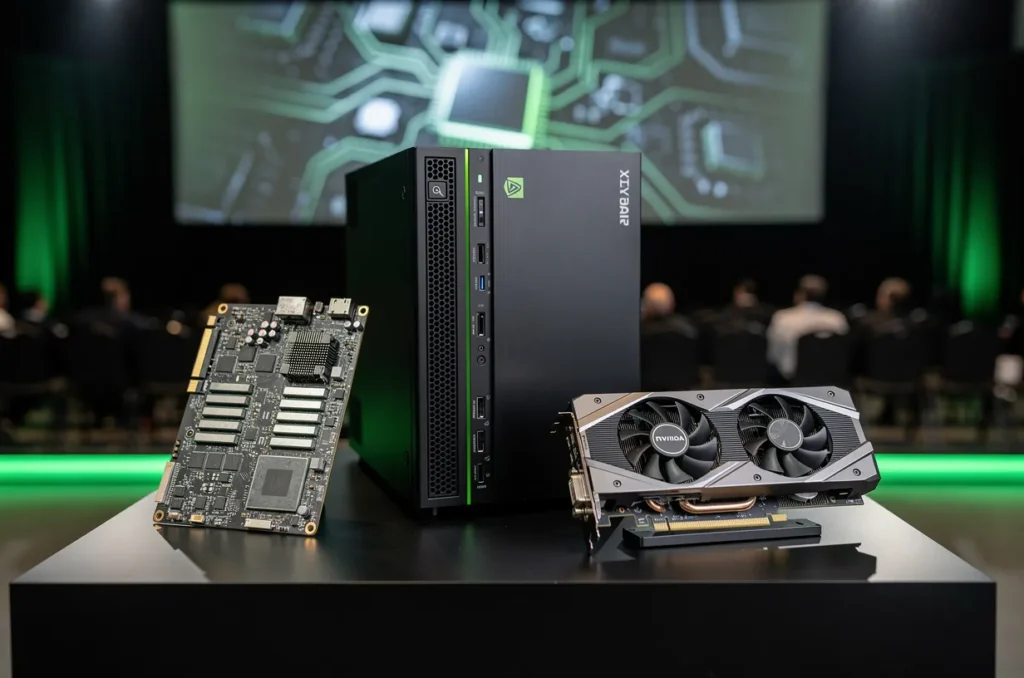
Nvidia is making a more serious move into the PC market
Nvidia’s latest product launch is not just another chip announcement. It is a direct push into territory long controlled by Intel and AMD.
At its GTC Taipei event, Nvidia introduced the RTX Spark superchip for Windows laptops and compact desktops. The design pairs a Grace Arm-based CPU with a Blackwell GPU, creating a system aimed squarely at high-end AI PCs rather than conventional consumer notebooks. Systems using the chip are expected from ASUS, Dell, HP, and Microsoft later this fall.
Markets immediately understood the competitive angle. Intel and AMD shares fell on the news, while Nvidia moved higher.
This is less about replacing a standard laptop and more about redefining what a premium AI PC is
RTX Spark is being positioned as a new category product.
Nvidia is targeting users who want to run AI agents, generate content locally, handle heavier creative workloads, and still get premium gaming performance. That matters because the company is not simply trying to win share in everyday laptops. It is trying to define the upper end of the next PC cycle, where memory, AI compute, and software acceleration matter much more than they used to.
One of the headline specs says a lot: Nvidia says RTX Spark systems will support up to 128GB of memory. In the laptop market, that is an unusually aggressive configuration and a clear signal that these machines are being built for more demanding local workloads.
Nvidia is betting that AI agents will change what buyers want from a laptop
This is the more important strategic point.
The PC industry has spent the last year talking about “AI PCs,” but a lot of that branding has felt vague. Nvidia is trying to make the category more concrete. Its argument is that future notebooks will not just run office apps and browsers more efficiently. They will increasingly act as local compute machines capable of supporting semiautonomous and autonomous digital assistants.
That is a meaningful change in positioning.
If buyers start to believe their laptop needs to handle agent-driven workflows, local inference, content generation, and heavier AI applications, the hardware requirements rise fast. More memory matters. Better GPU performance matters. Efficient system-level integration matters. Those are areas where Nvidia believes it can take share.
The Arm transition is still the biggest practical hurdle
Still, the product is not without risk.
Because Grace is an Arm-based CPU, Nvidia faces the same challenge every Arm Windows vendor has had to confront: software compatibility. Most PC applications were originally built for x86 processors from Intel and AMD, and while that problem has improved, it has not disappeared.
Nvidia says it has been working with Microsoft and software developers to smooth compatibility, and the broader market has already seen progress here thanks to Arm-based Windows systems from Qualcomm. Battery life and efficiency gains have helped legitimize that direction.
Even so, this remains one of the main questions around RTX Spark adoption. Premium buyers may love the AI pitch, but only if the software experience holds up cleanly in the real world.
Gaming credibility matters more than Nvidia would probably like to admit
There is another important test here: games.
Nvidia built its name in gaming before it became the defining company of the AI boom. That history matters. A premium laptop carrying Nvidia silicon will naturally be judged not just as an AI machine, but as a gaming machine too.
Management is clearly aware of that. The company says RTX Spark laptops will support technologies like DLSS, and it is working with major developers to ensure game compatibility and anti-cheat support. Nvidia also said the Blackwell GPU inside RTX Spark sits roughly in the same performance class as an RTX 5070 laptop GPU.
That is encouraging, but it is not the same as published benchmarks. Until actual performance numbers and game support are visible in shipping products, some skepticism is reasonable.
Vera may be just as important as Spark
Alongside the PC announcement, Nvidia also said its Vera data-center CPU is now in full production, with Vera-only rack servers due this fall.
That matters because it shows Nvidia is attacking the market from both ends at once. On one side, it wants to define the next premium AI laptop. On the other, it wants to take CPU share in AI data centers, where Intel and AMD have historically held stronger positions.
The customer list exploring Vera is notable: Anthropic, OpenAI, ByteDance, CoreWeave, Oracle Cloud Infrastructure, and SpaceXAI were all mentioned. That does not mean large deployments are guaranteed, but it does show Nvidia is being taken seriously beyond GPUs alone.
This is what the company is really trying to do
Stepping back, the pattern is obvious.
Nvidia no longer wants to be seen as just the dominant GPU supplier. It wants control over more of the compute stack:
- GPUs
- CPUs
- networking
- rack systems
- AI PCs
RTX Spark fits that strategy perfectly. Vera does too.
If those bets work, Nvidia becomes even harder to displace because it is no longer winning one category. It is expanding across the whole system.
WSA Take
RTX Spark is a serious product because it shows Nvidia is not content to dominate only in data centers. It wants a much bigger role in the next PC cycle, especially if that cycle becomes centered on AI agents, higher local compute, and memory-heavy workloads.
The opportunity is real, but so is the execution risk. Arm compatibility, real-world gaming support, pricing, and battery performance will all matter. Still, the direction is unmistakable. Nvidia is extending the AI trade from the cloud straight onto the desk — and doing it in a way that puts direct pressure on Intel and AMD.
Disclaimer
WallStAccess is a financial media platform providing market commentary and analysis for informational and educational purposes only. This content does not constitute investment advice, a recommendation, or an offer to buy or sell any securities. Readers should conduct their own research or consult a licensed financial professional before making investment decisions.