
Broadcom cracked the mood around AI
Wall Street spent most of the year rewarding almost any company tied closely enough to the AI buildout. Broadcom reminded the market that the trade still has valuation limits.
The stock dropped more than 14% after the company reported quarterly revenue of $22.19 billion and forecast $16 billion in current-quarter AI chip sales. Those numbers were strong in isolation. They were not strong enough for a stock that had become one of the market’s cleanest AI proxies. The bigger disappointment was that management reiterated — rather than raised — its $100 billion fiscal 2027 AI revenue target.
Broadcom did not kill the bull market. It changed the leadership for a day
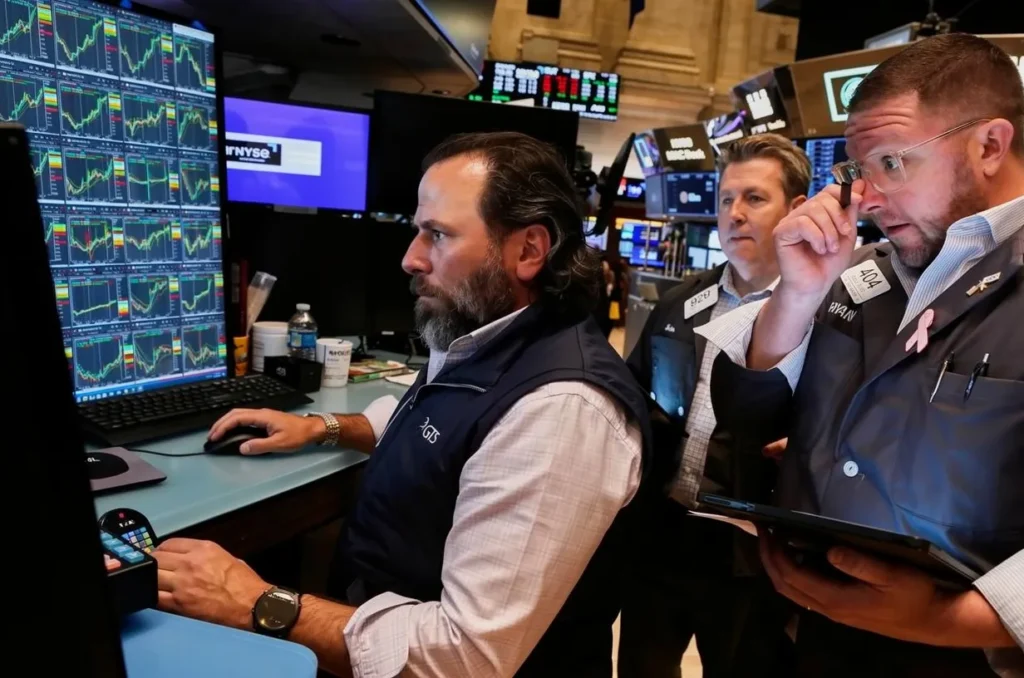
The reaction inside tech was sharp. The Nasdaq slipped about 0.2%, and the Philadelphia Semiconductor Index dropped 2.8% as investors cut exposure across the chip complex.
The rest of the market did something very different.
The Dow rose roughly 1.7% to a record high, while the S&P 500 still managed a modest gain. Nine of the 11 major S&P sectors finished higher. The buying moved into healthcare and financials, where investors found a cleaner mix of earnings, lower expectations, and less crowding than they have in semis. Reuters noted that UnitedHealth jumped 5.7% and the healthcare sector rose 3.1%, while financials added 1.8%.
This looked like rotation, not panic
That distinction matters.
Thursday was not a broad risk-off washout. It was a fast repricing inside a crowded trade. Money came out of one of the market’s most extended AI names and moved into large-cap financials and healthcare. That kind of tape usually says the market still wants equity exposure, but no longer wants to pay any price for the same handful of stories.
That is a healthier signal than a broad breakdown. It is also a more demanding one.
Oil and the Middle East still sat behind the session
The market was not trading in a vacuum. Reuters said rising geopolitical tensions with Iran and the inflation risk tied to higher oil prices were still in the background as investors weighed whether a larger energy shock could complicate the macro picture.
That backdrop matters because it limits how much breathing room the market gets when a big AI name stumbles. If oil is high and inflation risk remains live, the market has less tolerance for any disappointment in the sectors that have been carrying performance.
Labor data kept the Fed problem alive
The labor market did not offer much relief.
Initial jobless claims rose by 13,000 to 225,000 for the week ended May 30, above expectations and the highest level since the first week of February. Even so, the broader labor backdrop still looks stable rather than weak. Reuters noted that continuing claims edged down to 1.77 million, while seasonal effects likely played some role in the weekly increase.
Friday’s payrolls report now matters more. A strong number keeps growth intact, but it also keeps pressure on rates if inflation and oil remain difficult.
SpaceX is already shaping the tape before it lists
The other story hanging over the market is SpaceX.
Reuters reported that the company has started its roadshow for a planned $75 billion IPO at $135 per share, with listing expected on June 12 and major banks led by Goldman Sachs involved in the underwriting.
That kind of deal pulls attention and eventually capital toward the same parts of the market already benefiting from the AI and infrastructure trade. It also gives investors another reason to rotate selectively rather than chase every existing winner.
WSA Take
Broadcom’s selloff did not prove the AI trade is broken. It proved the market is no longer willing to ignore the difference between strong numbers and numbers strong enough to justify extreme expectations.
The Dow’s rally made the more important point. Investors did not run from stocks. They simply moved into parts of the market where the setup looked cleaner.
That is usually what happens when a bull market matures. Leadership narrows, then rotates, then gets tested. Thursday looked like one of those tests.
Explore More Stories in Markets
Disclaimer
WallStAccess is a financial media platform providing market commentary and analysis for informational and educational purposes only. This content does not constitute investment advice, a recommendation, or an offer to buy or sell any securities. Readers should conduct their own research or consult a licensed financial professional before making investment decisions.