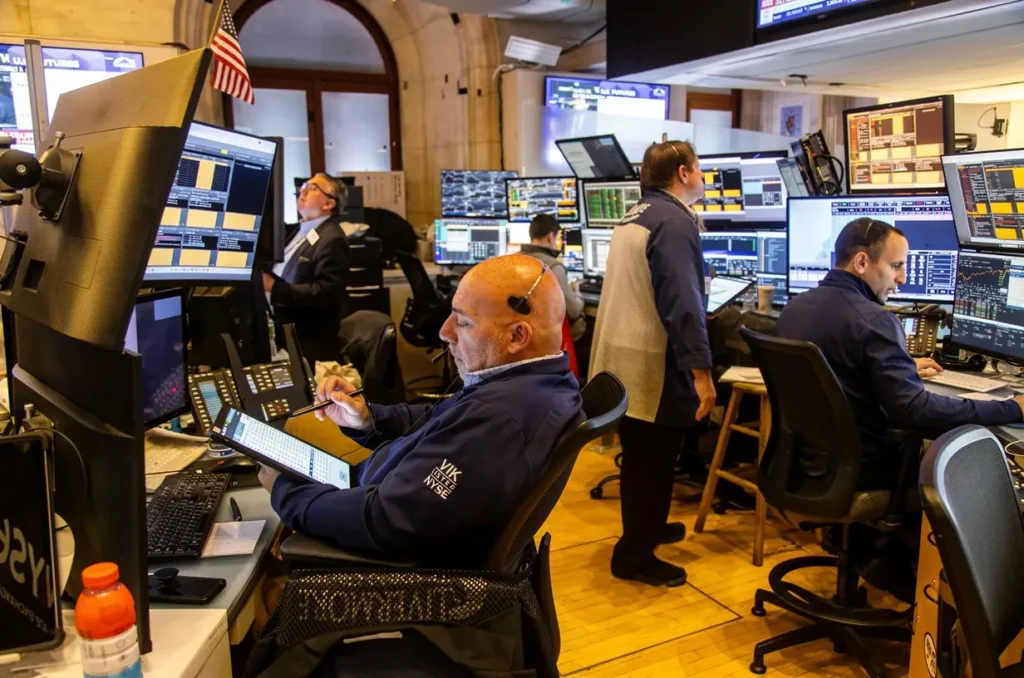
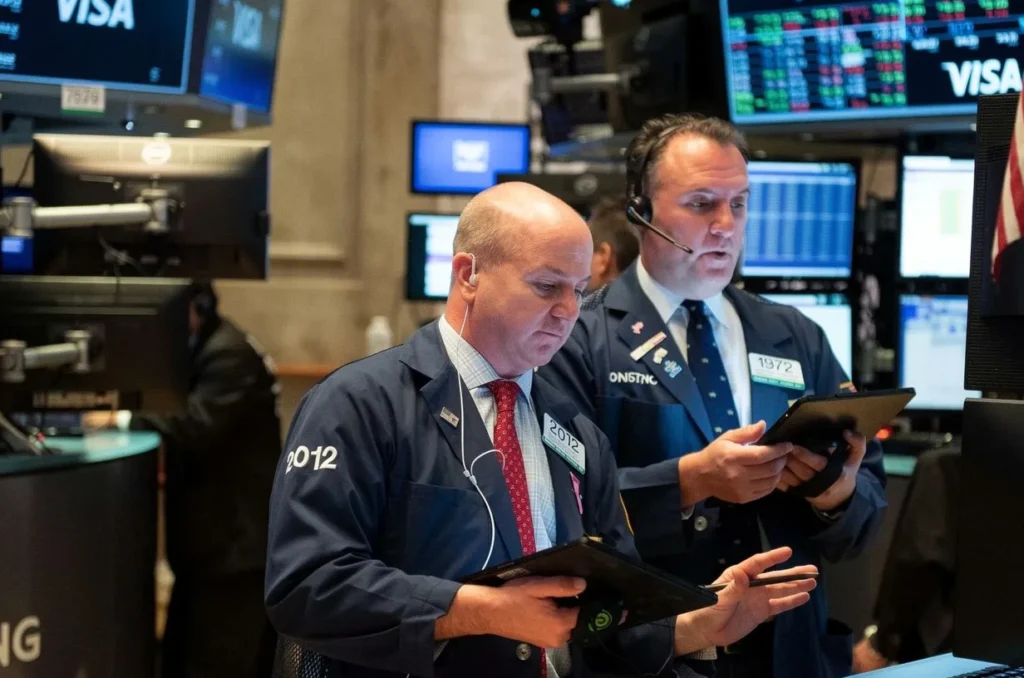
Wall Street returned from the holiday to a divided market
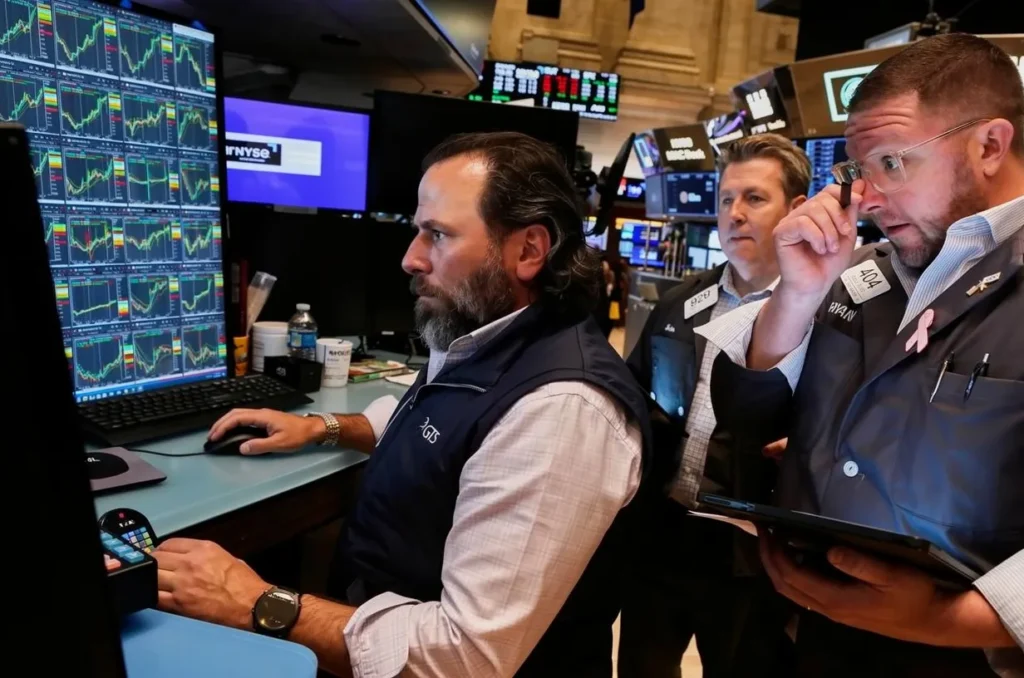
US stocks traded mixed Monday as investors balanced improving signals from US-Iran peace negotiations against heavy selling in several of the market’s largest technology companies.
The Dow Jones Industrial Average rose about 0.3%, supported by a more resilient group of financial, industrial, and value-oriented stocks. The S&P 500 fell roughly 0.3%, while the technology-heavy Nasdaq Composite dropped around 1%.
The split reflected a market in which easing geopolitical risk helped the broader economic outlook, but could not offset sharp losses in SpaceX, Alphabet, Amazon, Meta, and Microsoft.
Iran talks helped pull oil prices lower
Negotiators from Washington and Tehran reported encouraging progress following talks in Switzerland and agreed to a roadmap aimed at reaching a final agreement within 60 days.
The discussions reduced some of the immediate concern surrounding renewed military action and commercial access through the Strait of Hormuz, one of the world’s most important energy corridors.
Oil prices moved lower as the talks progressed. Brent crude fell about 3% to just above $77 a barrel, while West Texas Intermediate retreated toward $73.
Lower crude prices ease some of the inflation pressure created by the conflict, but the market remains sensitive to any sign that negotiations could break down. The strait may be open to traffic, yet normal oil flows and shipping confidence have not fully returned.
Big Tech weakness pulled the Nasdaq lower
Five of the seven largest US technology companies traded in negative territory.
Alphabet fell nearly 7%, Amazon dropped about 4%, and Meta and Microsoft declined roughly 2%. Nvidia was modestly lower, while Apple and Tesla were the only two members of the group trading higher.
Those moves were large enough to outweigh strength elsewhere in the market because of the companies’ heavy weightings in the S&P 500 and Nasdaq.
Monday’s session was therefore less a broad market selloff than a concentrated retreat in several of the stocks that had previously driven index gains.
SpaceX’s post-IPO surge continues to unwind
SpaceX fell nearly 10%, putting the stock on course for a third consecutive decline following its powerful public-market debut.
The shares had climbed sharply after the company began trading on June 12, briefly pushing its market value above several of the world’s largest technology companies. That momentum has since reversed as investors reassess the company’s valuation, limited public float, and enormous capital requirements.
SpaceX also confirmed its first bond offering as a public company. The company did not disclose the final size of the sale but said the proceeds would be used primarily to repay borrowings under its bridge loan facility and cover related expenses.
Bankers had reportedly been preparing a transaction of approximately $20 billion. The financing follows SpaceX’s record IPO and comes as the company increases spending on Starship, artificial intelligence infrastructure, and the integration of xAI.
The debt sale does not necessarily indicate financial stress. It does, however, remind investors that the company’s growth strategy will require substantial and sustained capital investment.
Alphabet was hit by another major AI departure
Alphabet’s decline followed news that John Jumper, a senior Google DeepMind researcher and co-recipient of the 2024 Nobel Prize in Chemistry, is leaving the company to join Anthropic.
Jumper spent nearly nine years at DeepMind and helped lead the development of AlphaFold, the AI system used to predict protein structures.
His departure adds to concern over competition for elite AI researchers as Alphabet, OpenAI, Anthropic, Meta, and other technology companies spend heavily to secure scarce technical talent.
Google also reportedly agreed to invest approximately $75 million in independent film studio A24. The companies plan to develop AI tools for film production and distribution through a partnership involving Google DeepMind.
The A24 investment expands Google’s AI ambitions into entertainment, but it was overshadowed Monday by the loss of one of DeepMind’s most prominent researchers.
AI demand remains strong beneath the technology selloff
The weakness in US technology shares did not signal a broader collapse in AI investment.
South Korean memory-chip producer SK Hynix recently overtook Samsung Electronics as the country’s most valuable listed company, reflecting surging demand for the high-bandwidth memory used in advanced AI accelerators.
The shift shows how the AI trade is becoming more selective. Companies with direct exposure to critical infrastructure and supply constraints continue to attract capital, while highly valued public-market leaders face greater scrutiny over spending, talent retention, and expected returns.
Inflation returns to the centre of the market debate
Investors are now preparing for the release of the Federal Reserve’s preferred inflation measure, the Personal Consumption Expenditures price index.
The May report will arrive after the Fed adopted a more hawkish tone at its latest meeting and removed some of the language that had supported expectations for eventual easing. Several policymakers now see the possibility of another rate increase before the end of the year.
Falling oil prices may eventually ease headline inflation, but the Fed is also watching services prices, wage growth, consumer demand, and the inflationary effects of trade and AI-related investment.
A stronger-than-expected PCE reading would reinforce the argument that rates may remain elevated for longer. A softer report could reduce some of the pressure that has recently built in bond yields and rate expectations.
Markets mark the death of Alan Greenspan
Investors also absorbed news that former Federal Reserve Chair Alan Greenspan died Monday at the age of 100.
Greenspan led the central bank from 1987 to 2006, overseeing periods that included the 1987 market crash, the technology boom, and nearly two decades of major economic and financial change.
His death came as the Fed entered a new era under Kevin Warsh and markets again debated the balance between inflation control and economic growth.
WSA Take
Monday’s mixed session reflected two competing forces.
Progress in US-Iran talks lowered oil prices and reduced some of the immediate geopolitical pressure on the market. At the same time, sharp declines in SpaceX, Alphabet, and other megacap technology stocks exposed how dependent the major indexes remain on a small group of companies.
The Dow’s resilience suggests investors were not broadly abandoning risk. The Nasdaq’s decline showed that valuations and company-specific developments still matter, even when the macro backdrop improves.
Attention now shifts to inflation. The next major move will depend on whether lower energy prices begin easing the policy outlook—or whether the PCE report reinforces the Fed’s more hawkish position.
Explore More Stories in Markets
Disclaimer
WallStAccess is a financial media platform providing market commentary and analysis for informational and educational purposes only. This content does not constitute investment advice, a recommendation, or an offer to buy or sell any securities. Readers should conduct their own research or consult a licensed financial professional before making investment decisions.