Canada and Japan are moving beyond broad supply-chain pledges
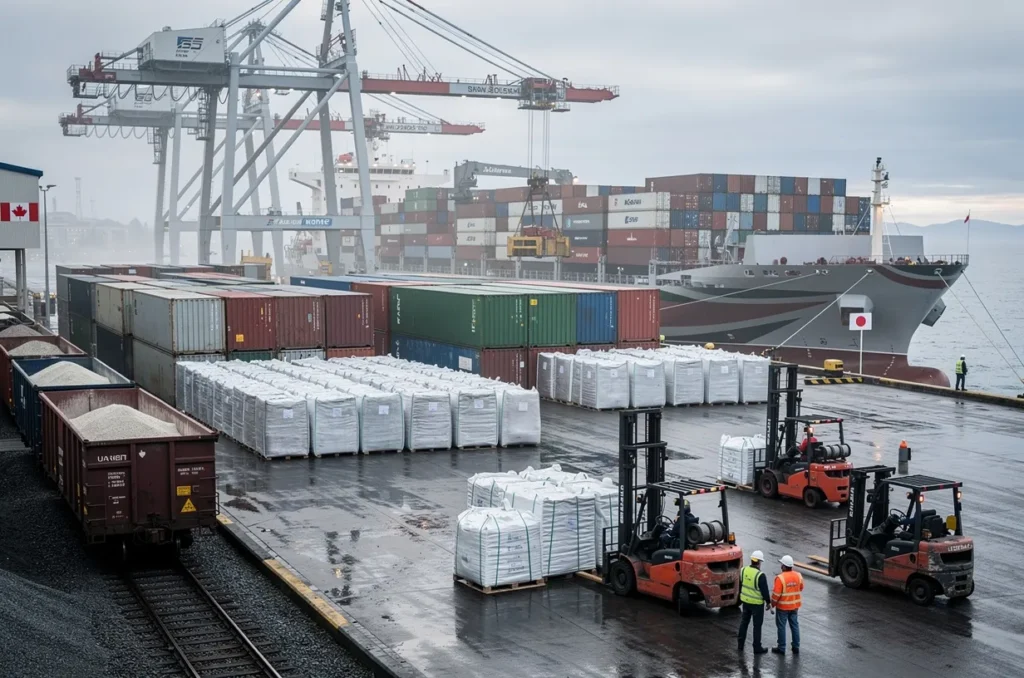
Canada and Japan are considering a more direct partnership covering the production, purchase and storage of critical minerals used in batteries, advanced manufacturing and defence.
The discussions include potential joint mining projects, long-term offtake agreements and coordinated stockpiling arrangements for materials such as graphite and gallium.
No final stockpile structure or investment amount has been announced. The negotiations nonetheless show how quickly critical-mineral policy is moving from diplomatic statements toward commercial and strategic agreements.
For Canada, the opportunity is to convert a large mineral resource base into funded mines, processing facilities and long-term export relationships.
For Japan, the priority is securing dependable access to materials concentrated in Chinese supply chains.
Stockpiling would add a new layer to the partnership
A joint stockpile would allow the two countries to build inventories of strategically important materials before an export disruption or industrial shortage occurs.
Governments have traditionally maintained reserves of commodities such as oil. Growing trade restrictions and geopolitical tensions are now pushing minerals closer to the same national-security framework.
Gallium is used in advanced semiconductors, telecommunications equipment, radar systems and defence electronics. Graphite is a critical input for lithium-ion battery anodes and is required in large volumes for electric vehicles and energy-storage systems.
Both materials have supply chains that remain heavily influenced by China.
A coordinated reserve could give Japanese manufacturers short-term protection during a disruption while providing Canadian producers with a predictable source of demand.
Offtake agreements may be more important than the stockpile itself
The most immediate commercial value may come from long-term purchase contracts.
An offtake agreement commits a buyer to purchase future production from a mine or processing facility. Those contracts can give lenders and investors greater confidence that a project will have customers once construction is complete.
Canada’s trade minister pointed to the agreement between Nouveau Monde Graphite and Panasonic Energy as an example of the model the two countries could expand.
Under that partnership, Panasonic is positioned to purchase active anode material from Nouveau Monde’s planned integrated graphite operation in Quebec.
The arrangement connects Canadian production directly with a major Japanese battery manufacturer and gives the project a commercial foundation that may support financing and development.
Similar agreements could be used for gallium, rare earths and other minerals required by Japan’s automotive, electronics and defence industries.
Japan has a clear reason to diversify
Japan remains one of the world’s largest advanced manufacturing economies, but it lacks sufficient domestic reserves of many critical minerals.
Its automotive, battery, robotics, semiconductor and electronics industries depend on imported raw materials and processed components. Concentration in one country creates a vulnerability that becomes more serious when minerals are subject to export licences or political restrictions.
China recently restricted exports of dual-use goods to several Japanese entities it said were connected to the country’s military sector.
The action reinforced the risk that access to strategic materials can be used as leverage during a political dispute.
Japan does not need to replace every Chinese shipment. It needs enough alternative production, inventory and processing capacity to prevent one supplier from controlling whether its factories can continue operating.
Canada offers resources, stability and Pacific access
Canada is positioning itself as a politically reliable source of minerals for allied economies.
The country has deposits of graphite, nickel, lithium, copper, rare earths, gallium-bearing materials and other strategic commodities. It also has established mining expertise and direct access to Pacific trade routes.
Those advantages do not automatically produce functioning supply chains.
Many Canadian projects remain years from production and require substantial investment in roads, power, processing, permitting and Indigenous partnerships. Canada also has less midstream refining and processing capacity than China.
Japanese capital and long-term purchase commitments could help close that gap.
Canada can supply the resource base and project pipeline. Japan can provide industrial demand, technical expertise and financing from companies that need the resulting materials.
Graphite illustrates both the opportunity and the challenge
Graphite is an especially important test case.
Every conventional lithium-ion battery requires graphite in the anode, generally in greater quantities by weight than lithium. China dominates the processing of natural and synthetic graphite into battery-grade active anode material.
Canada holds substantial natural graphite resources and has several developers attempting to build integrated mine-to-anode operations.
The opportunity is therefore larger than exporting raw concentrate. Canadian projects could potentially mine, purify, coat and process graphite before shipping a higher-value battery material to Japanese manufacturers.
That would create more economic value in Canada while giving Japan access to a supply chain located largely outside China.
Execution remains difficult. Graphite projects must compete with established Chinese producers that benefit from scale, infrastructure and lower processing costs.
Long-term contracts and government-supported stockpiles could make Canadian production more financially viable even when open-market prices are weak.
Gallium brings the semiconductor and defence sectors into the discussion
Gallium is produced primarily as a by-product of processing other metals rather than through standalone mines.
Its compounds are used in power electronics, radio-frequency chips, satellite communications, radar and other high-performance technologies.
China dominates refined gallium supply and has already demonstrated its willingness to impose export controls on the material.
Developing alternatives will require more than identifying mineral resources. Canada and its partners would need to recover gallium from existing operations, construct refining capacity and establish customers willing to support production.
A stockpile could provide an early buyer while the wider commercial market develops.
The talks fit the G7’s broader mineral strategy
Canada and Japan are not working in isolation.
G7 governments have agreed to coordinate more closely on critical-mineral stockpiles, project financing and supply-chain diversification. The group is also developing mechanisms intended to prevent strategic projects from being undermined by market concentration or deliberately low prices.
Canada has promoted a buyers’ alliance in which allied governments and manufacturers provide capital and long-term demand for qualifying projects.
Japan is a natural partner because it combines large industrial demand with limited domestic mineral production.
A bilateral Canada–Japan agreement could serve as one practical part of that wider strategy, linking a resource-producing country directly with an advanced manufacturing economy.
The challenge is turning cooperation into operating projects
Critical-mineral partnerships are frequently announced years before meaningful production begins.
New mines require permitting, environmental assessment, infrastructure, financing and community support. Processing facilities need specialized technology, large amounts of energy and customers willing to accept potentially higher costs than those available from established Chinese suppliers.
Stockpiling can reduce some market risk, but it cannot solve every development constraint.
The value of the Canada–Japan discussions will ultimately depend on whether they produce binding contracts, committed capital and construction decisions rather than another general memorandum of cooperation.
Nouveau Monde’s Panasonic agreement provides a useful template because it connects a defined Canadian project with a specific industrial buyer.
Replicating that structure across additional minerals would represent more meaningful progress than stockpile discussions alone.
The trade mission extends beyond minerals
Canada is also using the talks to deepen its wider energy and investment relationship with Japan.
The Canadian delegation included roughly 300 representatives from nearly 180 businesses and organizations, making it the country’s largest trade mission to the Asia-Pacific region.
Discussions have included companies such as Mitsubishi, a major investor in the LNG Canada project in Kitimat, British Columbia.
LNG Canada gives Canadian natural gas direct access to Pacific markets and already demonstrates the potential scale of Japanese investment in Canadian resource infrastructure.
Ottawa is now attempting to broaden that model from liquefied natural gas into critical minerals, processing and advanced manufacturing.
WSA Take
A Canada–Japan critical-minerals stockpile would be strategically useful, but the larger opportunity lies in the commercial agreements surrounding it.
Canadian mineral projects often need long-term customers and financing before construction can proceed. Japanese manufacturers need reliable supplies of graphite, gallium and other materials outside China. Offtake agreements and direct investment can address both problems.
The Nouveau Monde–Panasonic partnership shows how that alignment can work in practice. A Canadian project gains a major customer, while a Japanese battery manufacturer secures future material from an allied jurisdiction.
Stockpiles can provide short-term insurance against disruptions. Operating mines, processing plants and binding purchase agreements create lasting supply-chain resilience.
The success of the partnership will be measured by how many projects move from negotiation into financing and production.
Explore More Stories in Commodities
Disclaimer
WallStAccess is a financial media platform providing market commentary and analysis for informational and educational purposes only. This content does not constitute investment advice, a recommendation, or an offer to buy or sell any securities. Readers should conduct their own research or consult a licensed financial professional before making investment decisions.