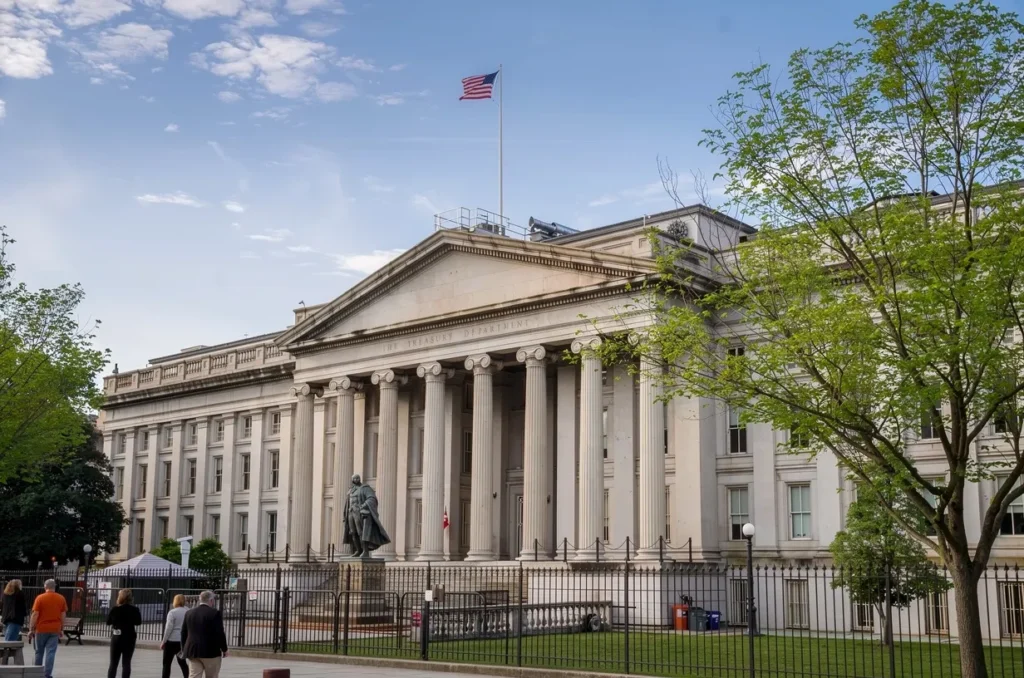
Washington is stepping deeper into a stressed bond market
The Treasury Department is increasing the size of its bond buybacks at a moment when the long end of the U.S. debt market is under serious pressure.
Thursday’s operation will allow Treasury to repurchase up to $6 billion of 10- and 20-year securities, compared with the normal $2 billion amount. Future operations will be at least $4 billion.
The official goal is to improve liquidity in older, less actively traded Treasury securities.
But the timing is impossible to ignore.
The 10-year Treasury yield recently reached 4.84%, while 20- and 30-year yields pushed above 5.3% — levels not seen in years.
If the market hoped a larger buyback would immediately pull those yields lower, it didn’t happen.
They rose.
The bond market is telling Treasury the problem is bigger than liquidity
Buybacks can help make older securities easier to trade, but they don’t make the forces pushing yields higher disappear.
Those forces are becoming difficult to ignore:
- U.S. government debt has moved above $40 trillion
- Treasury issuance is up 11.8% from last year
- Inflation concerns remain elevated
- Energy prices have climbed again
- Markets are pricing the possibility of another Federal Reserve rate hike
That creates a tough backdrop for long-duration bonds.
Treasury can improve how smoothly the market trades, but it cannot force investors to accept lower yields if they want more compensation for inflation, fiscal risk and an enormous pipeline of new government borrowing.
The market reaction on Wednesday was a reminder of that limit.
This is not 2008-style intervention
The size of the operation matters, but so does the scale of the market.
Treasury has roughly $31.8 trillion of publicly held debt outstanding. Against that backdrop, a $6 billion buyback is still small.
That is why some traders had expected an even larger announcement, potentially in the $8 billion to $10 billion range.
Instead, Treasury chose a meaningful increase without going far enough to suggest it was trying to overwhelm the market.
That distinction matters.
If Treasury starts repeatedly increasing buybacks every time long-term yields rise, traders may begin testing how far officials are willing to go. Stanley Druckenmiller warned about exactly that risk, arguing that markets can turn every rise in yields into a test of government resolve once they believe policymakers are defending a particular price.
For now, Treasury still appears focused on market functioning rather than explicitly targeting a yield.
The bond market will decide whether that line holds.
Higher long-term yields could become the bigger market story
The equity market has spent much of the year focused on AI earnings, trade policy and the next Fed decision.
Long-term Treasury yields may quietly become just as important.
A sustained move above 5% raises financing costs across the economy and makes government bonds more competitive with stocks. It can pressure richly valued growth companies, commercial real estate, housing and businesses carrying large amounts of debt.
It also feeds directly into the government’s own interest expense as more debt gets refinanced at higher rates.
That feedback loop is the part worth watching.
The Treasury is now trying to make the market function more smoothly at the same time that the fundamental pressure behind higher yields is getting stronger.
The next move probably won’t be decided by another buyback
Thursday’s operation may improve liquidity at the margins.
It probably won’t settle the bigger debate.
The long end of the Treasury market needs either softer inflation, slower economic growth, lower Fed expectations or some sign that future government borrowing will become easier to absorb.
Without one of those changes, larger buybacks may keep treating the symptom rather than the cause.
We’re watching 10- and 30-year yields closely from here.
If they continue climbing despite Treasury intervention, the bond market may be sending Washington a message it cannot fix with another few billion dollars of buybacks.
The question is no longer whether Treasury can support liquidity. It is whether investors are starting to demand a permanently higher price for lending money to the U.S. government.
Explore More Stories in Markets
Disclaimer
Wall Street Access is an independent financial publisher. Wall Street Access is not a financial advisor. No company mentioned has compensated Wall Street Access for the preparation, publication or distribution of this article. This content is provided for informational and educational purposes only and is not investment advice or a recommendation to buy, sell or hold any security. Investing involves risk, including the possible loss of principal.
Prices, market capitalizations, financial figures and other market data are based on information available as of the date and time of publication and may change without notice. Information is drawn from public sources believed to be reliable but is not guaranteed to be complete or accurate. Opinions and expectations expressed are our own and may change as new information becomes available.
Readers should conduct their own due diligence and contact a licensed financial professional before making any investment decision. Past performance does not guarantee future results. Any material ownership interest or conflict of interest, where applicable, will be disclosed separately.