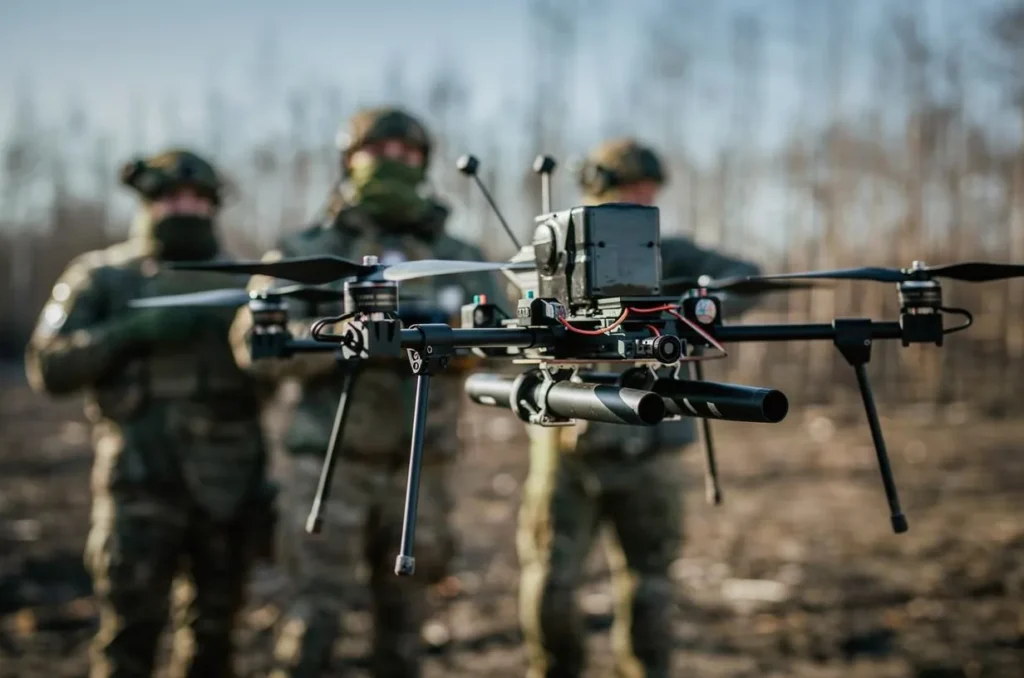
A cheap drone can destroy a million-dollar target. But it still needs the right materials to fly.
Modern warfare has discovered an uncomfortable economic truth.
A drone costing a few hundred or a few thousand dollars can destroy equipment worth millions. Deploy enough of them and suddenly the economics of warfare look very different.
BMO expects roughly 15 million drones to be deployed in the Russia-Ukraine conflict this year alone. Governments have responded by committing around $150 billion since 2025 to drone and counterdrone capabilities.
But behind the cameras, motors and guidance systems is a supply-chain weakness the West hasn’t solved.
Drones need rare-earth magnets. Advanced electronics need gallium. Thermal imaging and infrared systems rely on germanium.
And China remains deeply embedded in the production and processing of all three.
That turns the drone boom into something larger than a defense-equipment story. It becomes a race to secure the materials that make those weapons possible.
The bottleneck could become more valuable than the drone itself
The raw volume of minerals consumed by drones is still relatively small in some markets.
BMO estimates current drone demand barely moves global gallium or NdFeB magnet consumption. Germanium is already different: the Russia-Ukraine war alone may be consuming roughly 4% of global supply.
But tonnage misses the point.
Governments don’t need a commodity to be scarce globally before they start worrying about who controls it.
If a country cannot source the magnet inside a drone motor, the semiconductor inside a radar system or the germanium needed for thermal imaging, having the money to build more weapons doesn’t help much.
And counterdrone systems could tighten the loop even further. Advanced radar, electronic warfare and directed-energy systems require many of the same strategic materials.
The more drones proliferate, the more governments need both the drones and the systems built to stop them.
That is where the opportunity starts getting interesting.
A new opportunity just hit our radar. Get the latest WSA research straight to your inbox.
Pick #1: MP Materials — the magnet bottleneck
MP Materials (NYSE: MP) is the cleanest way to play the Western push for rare-earth magnets.
The company operates Mountain Pass in California and is building out the ability to turn mined rare earths into finished magnets inside the United States.
That distinction is crucial.
Mining rare earths is only part of the problem. The more difficult strategic challenge is processing those materials and manufacturing NdFeB magnets without relying on China.
Those magnets sit inside drone motors, missiles, aircraft, robotics and a growing list of defense systems.
BMO carries a $75 price target on MP, compared with the $54 area cited in its report.
MP has already become one of Washington’s most visible critical-mineral bets. If Western governments keep treating permanent magnets as defense infrastructure rather than another commodity, the company’s strategic value becomes much easier to understand.
Pick #2: Neo Performance Materials — the sleeper of the group
Neo Performance Materials (TSX: NEO) may be the name we find most interesting.
Neo doesn’t rely on one mineral. It operates across rare-earth processing, magnet production and gallium products, putting it directly across several of the weak points BMO identified.
That gives the company exposure to both sides of the drone race: the magnets required inside drones and the advanced materials needed across electronics and counterdrone systems.
BMO’s $60 price target compares with a share price around $31.81 in the report.
That gap caught our attention, but the business mix matters more.
A Western company already operating further down the critical-minerals supply chain can be much harder to replace than another early-stage deposit hoping to reach production years from now.
Pick #3: Teck Resources — follow the germanium
The third pick is less obvious.
Teck Resources (NYSE: TECK / TSX: TECK.B) is a diversified miner, so nobody is buying the company solely for drone exposure.
But Teck is already an important non-Chinese producer of germanium, and BMO says it is evaluating additional capacity.
Germanium may be where the immediate scarcity story is strongest.
Thermal imaging, infrared optics and other defense technologies rely heavily on it, and BMO’s estimate that the Ukraine conflict is already consuming around 4% of world supply makes germanium difficult to dismiss as a niche side story.
Teck offers exposure to that market without depending entirely on one emerging technology or one critical mineral.
Our watchlist just changed. Yours might too. See what we’re following →
This trade isn’t really about drones
Drones are simply exposing the weakness.
The deeper story is that Western militaries spent decades building increasingly sophisticated weapons while allowing parts of the raw-material supply chain to concentrate elsewhere.
Now governments are trying to reverse that.
Our three picks attack the problem from different directions:
- MP Materials: rare-earth magnets
- Neo Performance Materials: magnets, gallium and processing
- Teck Resources: established germanium supply
Right now, we are starting with companies that already sit somewhere meaningful in the supply chain.
The next catalyst isn’t another viral drone video from a battlefield.
It is government funding, long-term offtake agreements and new Western processing capacity turning strategic concern into actual revenue.
That transition is already beginning.
Disclaimer
Wall Street Access is an independent financial publisher. Wall Street Access is not a financial advisor. No company mentioned has compensated Wall Street Access for the preparation, publication or distribution of this article. This content is provided for informational and educational purposes only and is not investment advice or a recommendation to buy, sell or hold any security. Investing involves risk, including the possible loss of principal.
Prices, market capitalizations, financial figures and other market data are based on information available as of the date and time of publication and may change without notice. Information is drawn from public sources believed to be reliable but is not guaranteed to be complete or accurate. Opinions and expectations expressed are our own and may change as new information becomes available.
Readers should conduct their own due diligence and contact a licensed financial professional before making any investment decision. Past performance does not guarantee future results. Any material ownership interest or conflict of interest, where applicable, will be disclosed separately.