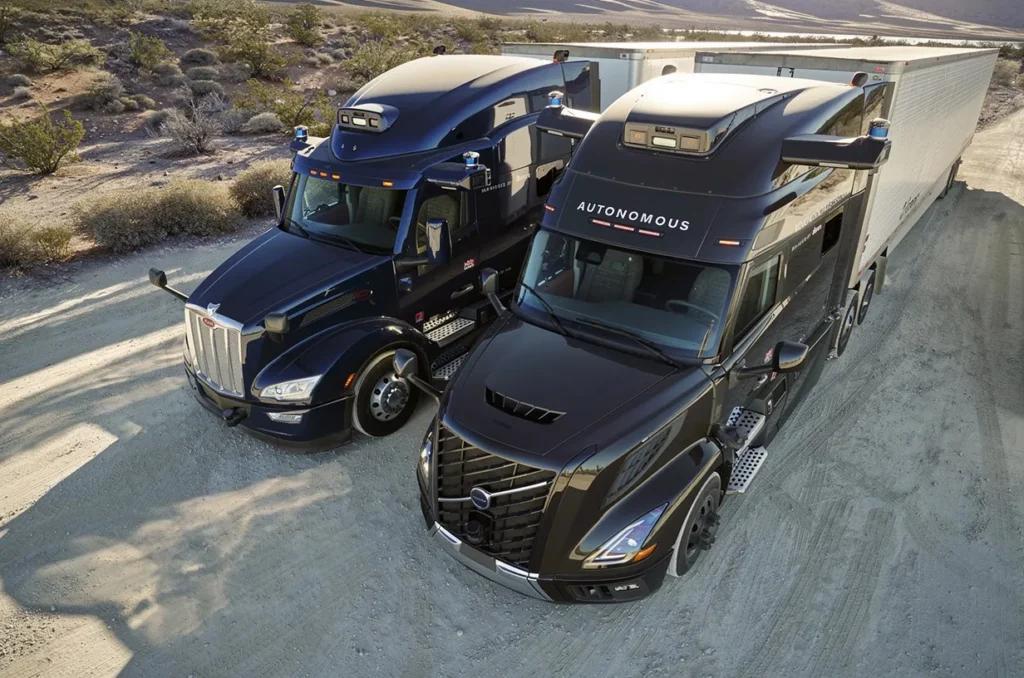
The autonomous trucking story is moving past the demo stage
Aurora Innovation (NASDAQ: AUR) already has fully driverless semitrucks hauling freight on major Texas highways. The next challenge is far more important than proving one truck can drive safely from Houston to Dallas.
Aurora needs to show it can turn autonomous driving into a scalable transportation business.
The company currently has 20 driverless trucks operating commercially and plans to reach 200 by the end of this year. Its business model is built around “driver as a service,” with freight customers paying Aurora based on the miles its technology drives.
That fleet expansion is the foundation of management’s goal to reach positive free cash flow by 2028.
The economics are what make autonomous trucking interesting
A human-driven truck comes with limitations that software does not. Federal rules restrict how many hours a driver can remain behind the wheel, while autonomous trucks could potentially operate for as much as 20 hours per day.
The cost gap could also become meaningful:
- Bank of America estimates Aurora’s service at roughly $0.85 per mile
- Human driver wages and benefits cost approximately $1.30 per mile
- Morgan Stanley estimates an autonomous fleet could eventually be 7.5 times as profitable as a traditional human-driven fleet
Higher utilization matters just as much as lower labor costs. A truck that spends more hours carrying freight can generate more revenue from the same physical asset, while better fuel efficiency could add another layer of savings.
If those economics hold at scale, autonomous trucking stops being primarily a technology story and starts becoming a freight-margin story.
Going from 20 trucks to thousands is where Aurora gets tested
There are roughly 3.5 million Class 8 trucks operating in the U.S., leaving autonomous vehicles with an enormous addressable market. Aurora is not alone. Kodiak AI, Gatik and Tesla (NASDAQ: TSLA) are also developing autonomous trucking technology.
The opportunity is large enough for several companies, but Aurora still has to bridge a significant financial gap. The company lost more than $800 million last year, making fleet growth, utilization and customer adoption increasingly important as 2028 approaches.
Drivers also do more than steer. They deal with customers, inspect equipment, protect freight and make judgment calls when something unexpected happens. Some routes and freight categories may therefore automate much faster than others.
Aurora’s Texas operations offer an early look at where the technology fits best: long highway routes with predictable freight movement and plenty of miles available to spread the economics across.
The next milestone is not another successful driverless trip. It is proving that each new truck makes Aurora meaningfully closer to a self-sustaining business.
Disclaimer
Wall Street Access is an independent financial publisher. Wall Street Access is not a financial advisor. No company mentioned has compensated Wall Street Access for the preparation, publication or distribution of this article. This content is provided for informational and educational purposes only and is not investment advice or a recommendation to buy, sell or hold any security. Investing involves risk, including the possible loss of principal.
Prices, market capitalizations, financial figures and other market data are based on information available as of the date and time of publication and may change without notice. Information is drawn from public sources believed to be reliable but is not guaranteed to be complete or accurate. Opinions and expectations expressed are our own and may change as new information becomes available.
Readers should conduct their own due diligence and contact a licensed financial professional before making any investment decision. Past performance does not guarantee future results. Any material ownership interest or conflict of interest, where applicable, will be disclosed separately.