Copper is getting very close to record territory again.
Three-month copper futures on the London Metal Exchange recently traded as high as $14,396 per metric ton, putting them within reach of the $14,500-plus peak reached earlier this year.
But the headline price isn’t the most interesting number.
Copper buyers were recently willing to pay as much as $545 more per ton for metal today than for delivery three months from now.
That is a huge premium.
And it tells us something important: copper exists, but the metal that buyers can actually get their hands on right now is becoming harder to find.
Buyers are paying up for copper right now
Commodity markets have a simple way of telling you when something is tight.
The price for immediate delivery starts moving above the price for future delivery.
That is exactly what is happening in copper.
The gap between spot copper and the three-month contract recently reached $545 per ton, the widest since the major copper squeeze of 2021.
You don’t need to understand every part of futures trading to see the message.
Someone wants copper now, and they’re willing to pay for it.
Part of Monday’s move was amplified by traders covering short positions ahead of an important LME contract date. That can make an already tight market look even tighter for a short period.
So we wouldn’t assume a $545 premium is the new normal.
But we also wouldn’t ignore it.
Copper inventories across the LME warehouse system have fallen by almost half since mid-May. Stockpiles are now sitting just above 200,000 tons, their lowest level since February.
Before a small increase Monday, inventories had declined for 42 straight trading days.
That was the longest stretch of declines since 2014.
There is copper. It just isn’t where the market wants it
This is not a classic story where the world has simply run out of metal.
Global copper inventories aren’t especially low.
They are badly distributed.
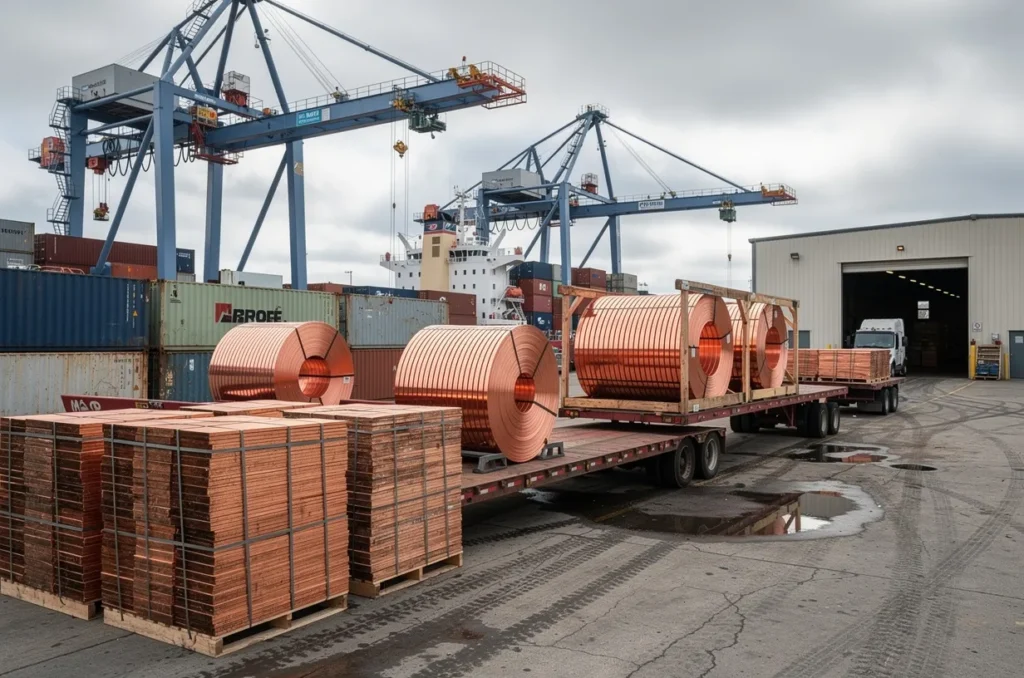
Large amounts of refined copper have been moving toward the United States because traders are betting that President Donald Trump could impose tariffs on copper imports.
The logic is straightforward.
If tariffs are introduced, copper already sitting inside the U.S. could become more valuable than copper that still needs to cross the border.
That has given traders a reason to move metal into the country before Washington makes a decision.
At the same time, China has also been pulling in cargoes as its smelters deal with tighter supplies of the raw materials they need to produce refined copper.
So copper is being pulled in two directions.
The U.S. wants metal because of tariff speculation.
China needs additional supply because of tight feedstock.
And the LME warehouse system is getting drained in the middle.
That is why today’s copper squeeze is a little unusual.
The problem isn’t only how much copper exists. It’s where the copper is sitting.
Tariffs could cool the squeeze quickly
This is also the biggest reason we wouldn’t simply chase copper after a seven-week rally.
A meaningful part of today’s tightness is being created by U.S. tariff expectations.
The White House has kept traders guessing about whether refined copper imports will face new levies. No decision has arrived even though the Commerce Department’s recommendation deadline passed roughly seven weeks ago.
As long as that uncertainty remains, traders have an incentive to keep sending copper into the U.S.
But markets can reverse quickly.
If Washington decides against tariffs, some of the incentive to hoard metal in the U.S. disappears.
More copper could also emerge from China if the premium for immediate metal becomes attractive enough.
Either development could take some heat out of the current squeeze.
That is an important distinction.
Copper can have a strong long-term story and still be overheated in the short term.
Both things can be true.
The bigger copper problem will take years to solve
The reason we’re still constructive on copper goes beyond this latest squeeze.
Copper sits at the center of several of the biggest infrastructure buildouts happening today.
Electrical grids require huge amounts of it.
Electrification requires more wiring.
AI data centers don’t just need chips—they need power, substations, transmission equipment and entirely new electrical infrastructure behind them.
Copper runs through all of it.
Supply is much harder to expand.
A technology company can build another data center relatively quickly. A mining company can’t simply decide it wants another world-class copper mine next year.
Large deposits need to be discovered, drilled, permitted, financed and constructed. That process can take many years.
That is the part of the copper story we think deserves the most attention.
Not whether today’s squeeze pushes copper another few hundred dollars higher.
The more important question is what happens when structurally rising electricity demand keeps meeting a mining industry that struggles to bring large new sources of supply online quickly enough.
For existing copper producers, higher prices can translate into stronger margins and cash flow.
For developers, a stronger copper price can make undeveloped projects much more valuable—but only if those projects can eventually be financed and built.
And that distinction matters.
A giant copper resource sitting ten years away from production does nothing to relieve a shortage today.
Copper could easily cool if the tariff trade unwinds and inventories begin moving back toward the LME.
But the longer-term issue remains.
The world keeps finding new uses for electricity.
Electricity keeps requiring more copper.
And new copper mines remain very difficult to build.
That is a setup we think is worth watching well beyond the latest price spike.
Explore More Stories in Commodities
Disclaimer
Wall Street Access is an independent financial publisher. Wall Street Access is not a financial advisor. No company mentioned has compensated Wall Street Access for the preparation, publication or distribution of this article. This content is provided for informational and educational purposes only and is not investment advice or a recommendation to buy, sell or hold any security. Investing involves risk, including the possible loss of principal. Prices, market capitalizations, financial figures and other market data are based on information available as of the date and time of publication and may change without notice. Information is drawn from public sources believed to be reliable but is not guaranteed to be complete or accurate. Opinions and expectations expressed are our own and may change as new information becomes available. Readers should conduct their own due diligence and contact a licensed financial professional before making any investment decision. Past performance does not guarantee future results. Any material ownership interest or conflict of interest, where applicable, will be disclosed separately.