What Happens Monday at GTC
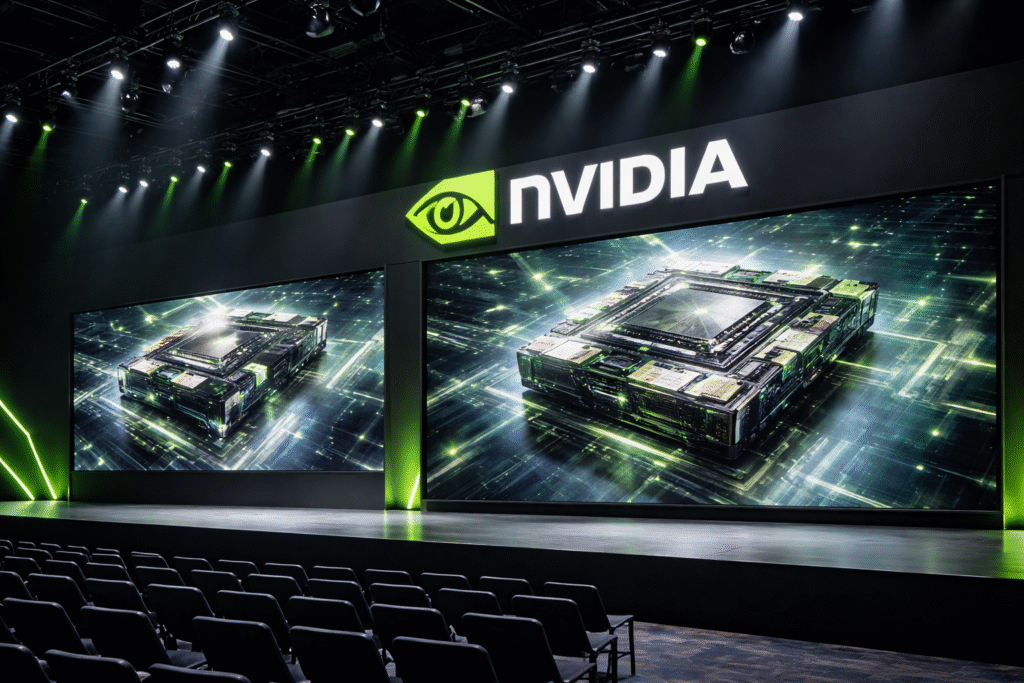
Nvidia (NVDA) CEO Jensen Huang is set to lay out the company’s hardware and software roadmap at its annual developer conference, GTC, in San Jose, California. The keynote is scheduled for 11 a.m. Pacific (2 p.m. Eastern) and is expected to draw a large crowd, with the venue described as a hockey arena that can hold more than 18,000 people.
In morning trading, Nvidia shares were up more than 2% as investors positioned ahead of what the company says next about its AI platform direction.
- Keynote timing: 11 a.m. PT (2 p.m. ET)
- Setting: San Jose, at an arena with capacity of 18,000+
- Event length: four days
Why This GTC Carries Extra Weight
This year’s event is landing at a moment when the AI market is shifting quickly. After years of massive spending to train large AI models, the spotlight is moving toward delivering AI to users at scale—work commonly described as inference, where models respond in real time to questions and tasks.
That shift matters because Nvidia faces more competition in inference-focused chips than it does in AI training hardware. Analysts expect the company to use GTC to show how it plans to defend share as rivals push to regain ground they lost in recent years, and as some customers design their own chips.
- Training spend has been heavy; attention is moving toward serving hundreds of millions of users
- Inference is a more contested segment than Nvidia’s training stronghold
- Competitive pressure also comes from customers building in-house chips
What Nvidia Is Likely to Put on the Roadmap
Huang is expected to address both hardware and software priorities, and how Nvidia plans to adapt as the AI landscape evolves. Nvidia, described as the world’s most valuable listed company with a market capitalization of more than $4.3 trillion, is likely to detail a next-generation AI chip called Feynman, named after physicist Richard Feynman.
Beyond chips, Nvidia is also likely to spend time on its broader AI stack—spanning data centers, software, and emerging product categories that pull more of the ecosystem onto Nvidia’s platform.
- Next-generation chip: Feynman
- Data centers and platform direction
- Chip programming software: CUDA
- Digital assistants: AI agents
- “Physical AI” such as robots
Inference Competition and the Groq Focus
A separate spotlight at this GTC is likely to be Groq, a chip startup from which Nvidia licensed technology for $17 billion in December. Groq specializes in fast and low-cost inference computing—exactly where the industry’s demand is building as more services reach large user bases.
That tie-in is notable because it directly intersects with the market segment where Nvidia’s competitive moat is perceived to be less absolute. For U.S. investors, the core question is whether Nvidia can keep turning rapid demand shifts into platform expansion—without losing pricing power or developer mindshare.
Optical Interconnects: Why Lumentum and Coherent Matter
Analysts also expect Nvidia to elaborate on why it invested $2 billion each in Lumentum and Coherent. Both companies make lasers used to transmit information between chips using beams of light—components that can matter as AI systems scale and internal data movement becomes a key bottleneck.
Investors will listen for how Nvidia frames these investments within the company’s data center vision, and whether they are positioned as enabling faster, denser, or more efficient AI infrastructure.
Nvidia’s Broader Role in the Global AI Buildout
Despite intensifying competition—including from its own customer base—Nvidia remains central to much of the AI ecosystem. The company’s chips are being used in custom AI systems built by nations such as Saudi Arabia for domestic deployments. Nvidia is also described as one of the only large U.S. companies continuing to release open-source AI software, in a field that is becoming a larger competitive arena between the U.S. and China.
WSA Take
GTC is increasingly a platform strategy event, not just a product showcase, and this year’s shift toward inference raises the stakes. Investors will focus on whether Nvidia can present a clear path to defend its position as AI usage scales from training labs to mass-market deployment. Updates around Feynman, CUDA, and “AI agents” will signal how Nvidia plans to keep developers and data centers anchored to its stack. The discussion around Groq and the laser investments in Lumentum and Coherent should help frame how Nvidia is preparing for the next infrastructure constraints inside AI factories.
Explore More Stories in AI
Back to WallStAccess Homepage
Disclaimer
WallStAccess is a financial media platform providing market commentary and analysis for informational and educational purposes only. This content does not constitute investment advice, a recommendation, or an offer to buy or sell any securities. Readers should conduct their own research or consult a licensed financial professional before making investment decisions.