
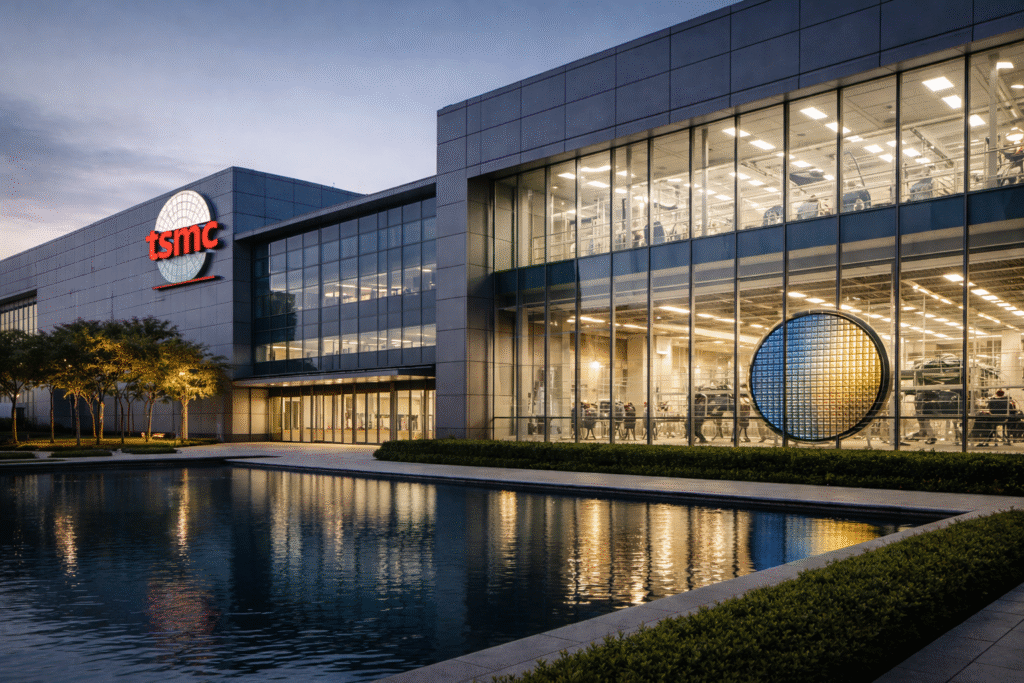
Nvidia is moving to secure additional manufacturing capacity for its H200 artificial intelligence chips, sounding out Taiwan Semiconductor Manufacturing Company about expanding production as demand from Chinese technology firms sharply accelerates, according to multiple sources familiar with the matter.
Chinese customers have reportedly placed orders exceeding 2 million H200 chips for delivery in 2026, far outstripping Nvidia’s current inventory of roughly 700,000 units, sources said. Nvidia has asked TSMC to begin production of additional chips, with work expected to start in the second quarter of 2026.
Supply Tightness Meets Rising China Demand
The potential expansion highlights growing strain across the global AI chip supply chain. Nvidia now faces a delicate balancing act:
- Meeting accelerating Chinese demand
- Maintaining supply for U.S. and allied markets
- Managing regulatory uncertainty tied to exports
Nvidia said it is continuously managing its supply chain and emphasized that licensed H200 sales to China would not impact its ability to serve U.S. customers.
“China is a highly competitive market with rapidly growing local chip suppliers,” a Nvidia spokesperson said. “Blocking all U.S. exports would only benefit foreign competition.”
TSMC declined to comment, and China’s Ministry of Industry and Information Technology did not respond to requests for comment.
Pricing and Product Mix
Sources said Nvidia has finalized which H200 variants will be offered to Chinese customers, pricing them at roughly $27,000 per chip, though final pricing will vary by volume and customer.
Key details include:
- An eight-chip H200 module is expected to cost around 1.5 million yuan
- This is modestly higher than the now-unavailable H20 module
- Pricing represents a ~15% discount versus grey-market alternatives
Despite the higher price, Chinese internet firms reportedly view the H200 as attractive due to its ~6x performance improvement over the restricted H20 chips previously available in China.
Inventory Breakdown
Of Nvidia’s current inventory:
- Approximately 100,000 units are GH200 Grace Hopper superchips
- The remainder are standalone H200 GPUs
- Both variants are expected to be offered to Chinese customers, pending approvals
Initial shipments are expected to be fulfilled from existing stock, with the first deliveries anticipated before the Lunar New Year in mid-February.
Major Chinese Buyers Drive Orders
Demand is being led by China’s largest internet and technology companies, which see the H200 as a major step up from domestically available alternatives.
According to regional reporting, ByteDance alone may spend roughly 100 billion yuan on Nvidia chips in 2026, up from an estimated 85 billion yuan in 2025, if H200 sales are approved.
Regulatory Uncertainty Remains
While the U.S. administration recently allowed H200 exports to China with a 25% fee, Chinese authorities have yet to formally approve large-scale imports.
Concerns inside China include:
- Dependence on foreign advanced chips
- Slowing development of domestic AI semiconductor capabilities
One proposal reportedly under review would require bundling H200 purchases with domestically produced chips, though no final decision has been announced.
WSA Take
Nvidia’s outreach to TSMC is a clear signal that AI demand — especially from China — remains far stronger than supply. Even as Nvidia prioritizes newer platforms like Blackwell and Rubin, legacy Hopper chips are becoming strategically critical. The risk isn’t demand destruction — it’s regulatory friction and supply bottlenecks. For investors, the story remains unchanged: AI compute is scarce, expensive, and geopolitically sensitive — and Nvidia still sits at the center of it.
Read our recent coverage on SoftBank Completing $40B OpenAI Investment.
Explore more market insights on the WallStreetAccess homepage.
Disclaimer
WallStAccess does not work with or receive compensation from any companies mentioned. This content is for informational and educational purposes only and should not be considered financial advice. Always conduct independent research before investing.