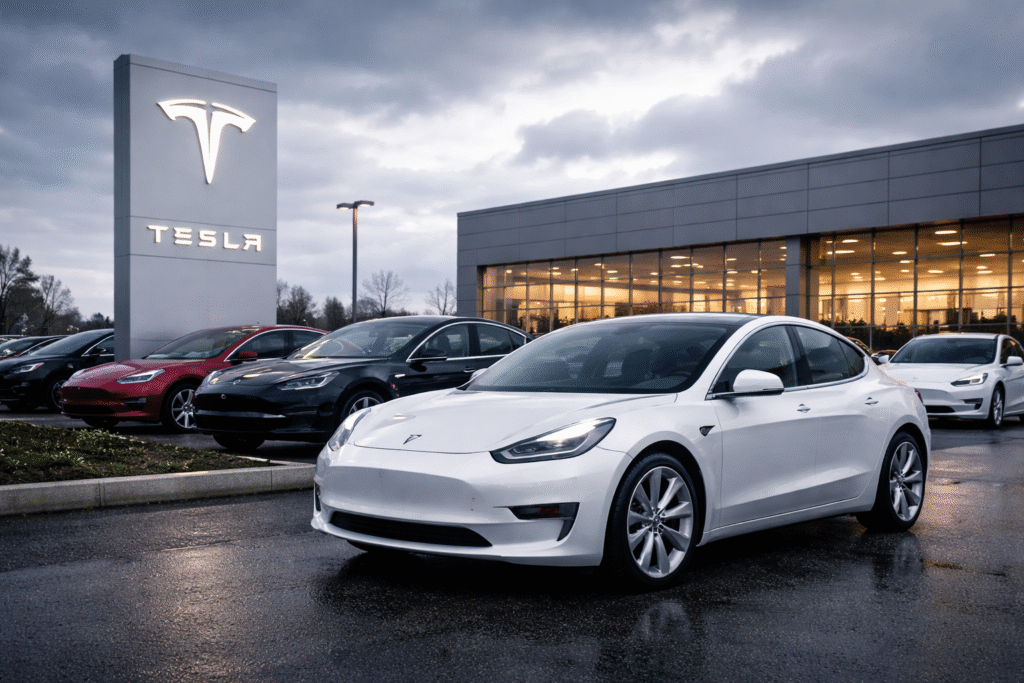
Tesla took the rare step of previewing expectations for its upcoming fourth-quarter deliveries, hinting that results may come in weaker than investors have grown accustomed to.
In a first for the company, Tesla posted compiled Wall Street consensus estimates directly on its investor relations website, effectively signaling what the market should expect ahead of its official Q4 delivery release.
Q4 Deliveries Expected to Fall Year Over Year
According to Tesla’s own published figures, the company-compiled delivery consensus for Q4 stands at 422,850 vehicles globally, which would mark a 15% decline from the same quarter last year.
That estimate is notably below broader third-party expectations:
- Bloomberg consensus: ~445,000 deliveries (roughly a 10% decline)
- Median estimate cited by Tesla: 420,399 deliveries
Tesla shares were little changed in early trading following the disclosure, though some investors viewed the move as an effort to manage expectations ahead of a potentially weak report.
Tax Credit Loss Weighs on U.S. Demand
A Q4 slowdown was not entirely unexpected. The loss of the $7,500 U.S. EV tax credit at the start of the quarter created a difficult comparison, particularly for domestic sales.
According to Cox Automotive’s Kelley Blue Book:
- Tesla’s U.S. sales fell to approximately 125,900 units in Q4
- That represents a 22.4% year-over-year decline
International markets were expected to offset some of the U.S. weakness, but current estimates suggest that was not enough to prevent an overall decline.
Full-Year Deliveries Also Under Pressure
For the full year, Tesla’s compiled consensus points to 1.64 million total deliveries, down roughly 8% from 2024. If confirmed, that would mark Tesla’s second consecutive year of declining deliveries.
Some analysts believe even that figure may prove optimistic.
- Deutsche Bank estimates closer to 1.62 million deliveries
- That would imply a 9% year-over-year decline
This softer outlook contrasts sharply with Tesla’s stock performance, which is up nearly 14% this year and trades at a forward P/E north of 200, according to market data.
Why the Market Is Still Willing to Look Past the Numbers
Despite weakening auto sales, several analysts argue that traditional vehicle fundamentals no longer define Tesla’s valuation.
Instead, the bull case continues to center on:
- Autonomous driving and robotaxi expansion
- AI-driven software and full self-driving adoption
- Robotics and long-term mobility platforms
Analysts at both Deutsche Bank and Wedbush maintain bullish stances, pointing to ongoing progress in Tesla’s autonomous testing efforts.
Recent developments include the removal of safety drivers in limited Austin testing, signaling a possible step toward broader robotaxi deployment, even if fleet size targets have come in lower than earlier commentary suggested.
Looking Ahead to 2026
Some analysts now frame 2026 as a pivotal year for Tesla’s next phase.
- Full self-driving penetration across Tesla’s installed base
- Expansion of autonomous ride-hailing concepts
- AI-driven valuation re-rating
From this perspective, delivery softness in the near term is viewed as secondary to Tesla’s longer-term technology roadmap.
WSA Take
Tesla’s decision to publish delivery expectations ahead of its Q4 report is telling. Auto demand is clearly under pressure, particularly in the U.S., and the company appears intent on resetting expectations. That said, Tesla’s stock remains less about car deliveries and more about what investors believe the company could become. As long as the AI, autonomy, and robotics narrative stays intact, the market may continue to look past near-term delivery declines.
Read our recent coverage on Indexes Sliding as Nvidia and Tesla Weigh on Markets.
Explore more market insights on the WallStreetAccess homepage.
Disclaimer
WallStAccess does not work with or receive compensation from any companies mentioned. This content is for informational and educational purposes only and should not be considered financial advice. Always conduct independent research before investing.