
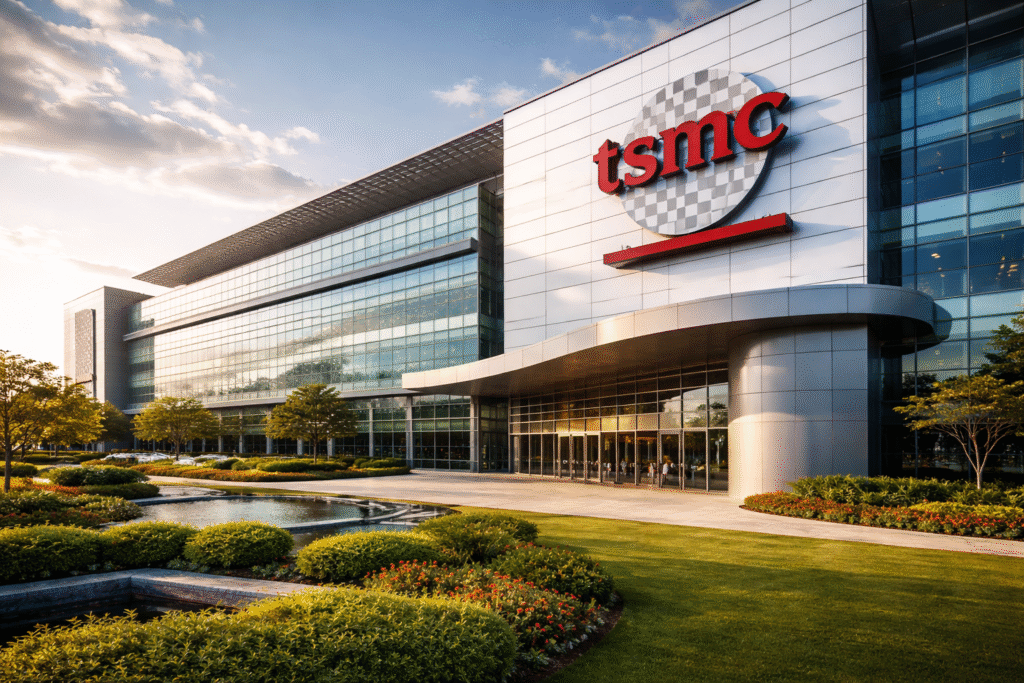
Another milestone quarter
Taiwan Semiconductor Manufacturing Company reported a blowout fourth quarter, with profit jumping 35% year over year as demand for artificial intelligence chips continued to surge.
Revenue reached NT$1.046 trillion ($33.7 billion), while net income climbed to NT$505.7 billion — both comfortably ahead of expectations. The results mark TSMC’s eighth consecutive quarter of year-over-year profit growth, underscoring the durability of its AI-driven expansion.
Management also delivered an upbeat outlook, guiding current-quarter revenue to between $34.6 billion and $35.8 billion — a 38% increase year over year at the midpoint.
Advanced chips now dominate the business
The engine behind TSMC’s growth is clear: advanced manufacturing.
Chips built on 7-nanometer and smaller process nodes accounted for 77% of wafer revenue during the quarter, up sharply from prior years. For full-year 2025, advanced chips made up 74% of total revenue, compared with 69% in 2024.
High-performance computing — a category that includes AI and data-center processors — represented 55% of quarterly sales. Smartphones accounted for another 32%, reflecting resilience in premium mobile demand.
TSMC manufactures cutting-edge processors for leading AI customers including Nvidia and Advanced Micro Devices, placing it at the center of the AI infrastructure buildout.
2nm ramp and capital spending surge
TSMC is already leaning into its next growth phase.
The company began mass production of its 2-nanometer technology last quarter and plans to ramp capacity aggressively in 2026. Capital expenditures are expected to rise to $52 billion–$56 billion next year, up from $40.9 billion in 2025.
Management said continued strength in AI servers is driving demand across the entire server ecosystem, with advanced packaging also contributing meaningfully to growth.
Risks remain, but high-end demand holds
While the broader semiconductor industry faces a memory shortage and rising component costs, TSMC leadership emphasized its focus on high-end devices, which are less sensitive to memory pricing volatility.
That said, management flagged global tariff policies as a potential headwind heading into 2026 — particularly as geopolitical tensions reshape supply chains.
Global expansion continues
TSMC is accelerating its global manufacturing footprint, with major projects underway in Japan, Europe, and the United States.
In Arizona, the company has acquired additional land to support further expansion. Executives described plans to build a large-scale “gigafab” cluster designed to improve productivity, lower costs, and better serve U.S.-based customers.
However, TSMC reiterated that overseas fabs will likely operate at lower margins than its core Taiwan operations — a strategic trade-off as governments push for localized chip production.
Why this matters for investors
TSMC’s latest results reinforce a powerful thesis:
- AI demand is not slowing — it’s accelerating
- Advanced-node manufacturing is becoming structurally dominant
- Capital intensity is rising, but so are competitive barriers
As the AI boom drives unprecedented demand for data-center and server chips, TSMC remains the irreplaceable backbone of the global semiconductor ecosystem.
WSA Take
TSMC isn’t just riding the AI wave — it’s enabling it. With advanced chips now dominating revenue, 2nm production coming online, and capital spending surging, the company is entrenching its position as the most strategically important manufacturer in tech. In an AI-driven world, TSMC doesn’t follow demand — it defines what’s possible.
Read our recent coverage on Dow, S&P 500, Nasdaq Slide as Bank Earnings Disappoint.
Explore more market insights on the WallStreetAccess homepage.
Disclaimer
WallStAccess does not work with or receive compensation from any companies mentioned. This content is for informational and educational purposes only and should not be considered financial advice. Always conduct independent research before investing.