What Happened
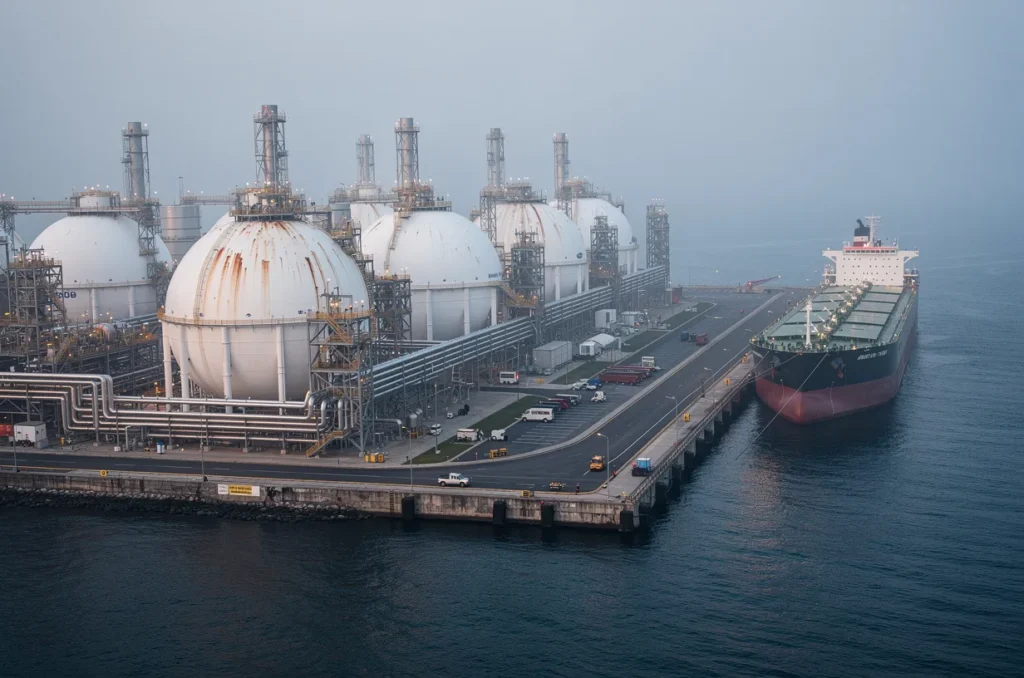
Qatar’s state-owned QatarEnergy said Iranian attacks damaged key export infrastructure and will sideline a meaningful slice of the country’s liquefied natural gas supply for years. The company’s CEO and state minister for energy affairs, Saad al-Kaabi, said the strikes knocked out 17% of Qatar’s LNG export capacity, with repairs expected to take three to five years.
Kaabi said the damage affected two of Qatar’s 14 LNG trains and one of its two gas-to-liquids (GTL) facilities. He also said QatarEnergy had declared force majeure on its entire LNG output after earlier attacks on the Ras Laffan production hub, which came under fire again on Wednesday, and that restarting production requires hostilities to cease.
- Estimated LNG volume sidelined: 12.8 million tons per year
- Assets damaged: 2 LNG trains and 1 GTL facility
- Estimated lost annual revenue: $20 billion (QatarEnergy CEO estimate)
Why It Matters for Global Gas and Energy Pricing
Qatar is a cornerstone supplier to both Europe and Asia, and a multi-year loss of capacity is the kind of shock that can tighten balances across LNG spot and contract markets. The issue isn’t only immediate supply; it’s duration. A three-to-five-year repair timeline forces buyers to plan around a structural gap rather than a short disruption.
Kaabi said QatarEnergy will need to declare force majeure on long-term LNG contracts for up to five years for cargoes bound for Italy, Belgium, South Korea, and China due to the two damaged trains.
- Long-term LNG contracts cited: destinations include Italy, Belgium, South Korea, and China
- Constraint length: up to five years tied to repair duration
- Restart condition highlighted: hostilities must cease
Company Exposure: Exxon Mobil and Shell
Kaabi said Exxon Mobil (XOM) is a partner in the damaged LNG facilities, while Shell (SHEL) is a partner in the damaged GTL facility, which he said will take up to one year to repair.
He also specified Exxon Mobil’s stakes in the two affected trains: 34% in LNG train S4 and 30% in train S6. Kaabi said Train S4 impacts supplies to Italy’s Edison and EDFT in Belgium, while Train S6 impacts South Korea’s KOGAS, EDFT, and Shell in China.
- Exxon Mobil (XOM) stakes: 34% (S4) and 30% (S6)
- Shell (SHEL): partner in damaged GTL facility
- GTL repair timeline stated: up to one year
Beyond LNG: Condensate, LPG, Helium, and More
Kaabi said the fallout extends beyond LNG. He said Qatar’s exports of condensate will drop around 24%, LPG will fall 13%, helium output will fall 14%, and naphtha and sulphur will both drop 6%. He pointed to downstream implications ranging from LPG used in restaurants in India to South Korea’s chipmakers that use helium.
Kaabi also said the damaged units cost approximately $26 billion to build.
What Changes Next
Kaabi said no work is currently taking place on Qatar’s North Field expansion project and that it could be delayed by more than a year. Investors will watch for updates on the duration of force majeure, any changes to contract delivery schedules, and how quickly alternative LNG supplies can be secured—especially as the market digests the possibility of a multi-year shortfall for some buyers.
WSA Take
A multi-year outage of 12.8 million tons per year from Qatar is less about a one-week spike and more about reshaping medium-term LNG availability. The immediate market sensitivity sits in contract performance—force majeure can push buyers toward replacements that ripple into spot pricing and shipping demand. The additional cuts to condensate, LPG, and helium broaden the impact beyond power and heating into industrial supply chains. For U.S. investors, the cleanest read-through may be how global LNG tightness changes the earnings backdrop for companies with flexible export capacity and exposure to LNG-linked pricing.
Explore More Stories in Commodities
Disclaimer
WallStAccess is a financial media platform providing market commentary and analysis for informational and educational purposes only. This content does not constitute investment advice, a recommendation, or an offer to buy or sell any securities. Readers should conduct their own research or consult a licensed financial professional before making investment decisions.