The filing makes one thing clear: SpaceX wants to be valued as more than a space company
SpaceX may still be best known for rockets and Starlink, but its IPO filing shows the company is trying to tell a much bigger story.
Buried inside the prospectus is a striking message: the company believes the bulk of its long-term opportunity sits not in launch or satellite connectivity, but in artificial intelligence. Out of the $28.5 trillion total addressable market SpaceX laid out in the filing, only $370 billion comes from launch and space-enabled services, while $1.6 trillion comes from Starlink-based connectivity. The remaining $26.5 trillion is tied to AI.
That framing matters.
It means SpaceX is not asking investors to think about it as a premium space company with some AI exposure on the side. It is asking to be viewed as a vertically integrated AI infrastructure platform that also happens to own launch capacity, satellite networks, and orbital ambitions.
Starlink is already the proof that the company can build a large-scale platform
The reason that argument is even possible is because Starlink has already become a serious business.
After SpaceX absorbed xAI and restated its numbers, the company reported 2025 revenue of $18.7 billion, up more than 30%, while Starlink alone generated more than $4 billion in operating income, according to the article. That is important because it shows the company is not pitching pure future optionality. It already has a large commercial platform throwing off real economic value.
That gives SpaceX a much stronger base than the typical high-concept IPO.
Starlink is not theoretical. It is the bridge between the current company and the much larger infrastructure story Musk is trying to sell.
The real pivot is in capital spending
The clearest evidence of that pivot is the spending.
SpaceX spent $20.7 billion in capital expenditures in 2025, with $12.7 billion of that going into AI, including data centers, GPUs, and the COLOSSUS and COLOSSUS II training clusters. In the first quarter of 2026 alone, AI capex totaled $7.7 billion.
That is not side-project spending.
That is the kind of capital deployment that tells you management is building a second company inside the first one. It also explains why SpaceX posted an operating loss of nearly $2.6 billion despite strong revenue growth. The company is effectively trying to scale two massive platforms at the same time: next-generation space infrastructure and large-scale AI infrastructure.
That is ambitious. It is also expensive.
The Anthropic contract shows the AI thesis is not purely speculative
One of the most important details in the filing is that Anthropic has agreed to pay SpaceX $1.25 billion per month through May 2029 for compute capacity.
At full ramp, that works out to roughly $15 billion in annualized revenue from a single customer.
That matters because it gives the AI thesis a real commercial anchor. SpaceX is not just spending heavily in the hope that demand will eventually appear. It already has a major contract that monetizes infrastructure it has built. If the company can add similar customers over time, the market will likely start taking the AI business much more seriously as a standalone growth engine.
This is one of the strongest parts of the filing because it moves the conversation from vision to monetization.
But the whole model still runs through Starship
For all the AI excitement, the article makes clear that the company’s biggest risk still comes back to Starship.
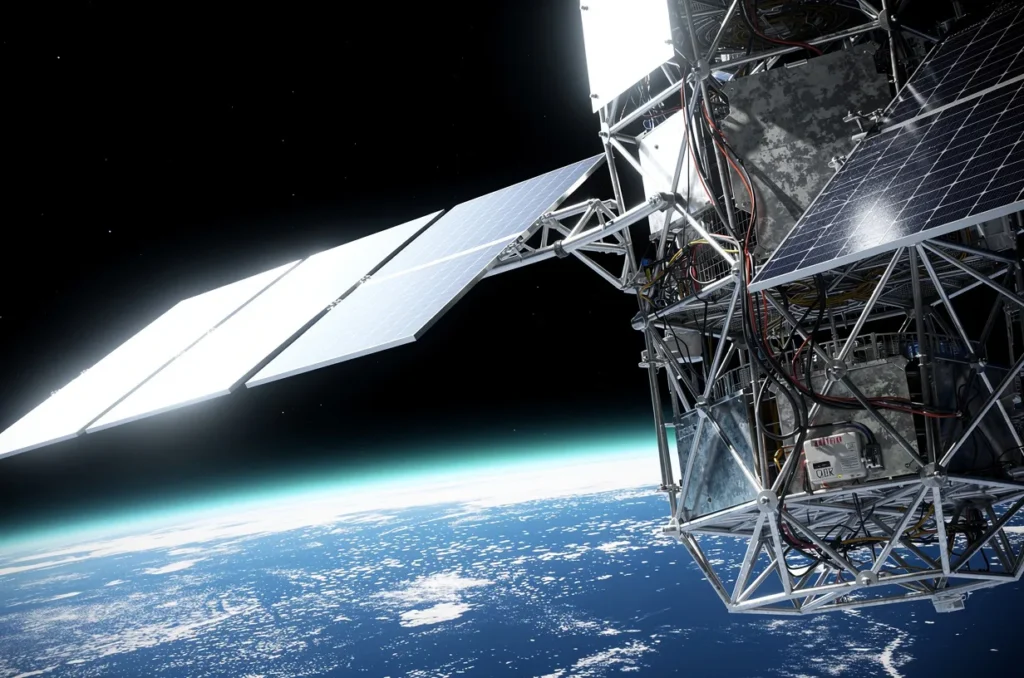
The filing reportedly lists any failure or delay in scaling Starship as the top risk factor, and that makes sense. Starship is not just a rocket program inside this model. It is the enabling layer for the next generation of Starlink satellites, direct-to-cell connectivity, and the broader long-term concept of orbital compute infrastructure.
That is the key investment tension in the SpaceX story.
The upside case is enormous because the company controls launch, satellites, connectivity, and now major AI infrastructure. But the execution risk is just as real because so much of that future platform depends on Starship operating at cadence by 2027.
That is a hard requirement, not a nice-to-have.
This is why the IPO matters
What makes this IPO so interesting is that it is not offering investors just one growth curve.
It is offering exposure to three at once:
- Launch and space services
- Starlink connectivity
- AI compute infrastructure
That is a rare setup. Most IPOs are selling one big idea. SpaceX is trying to sell a full-stack infrastructure thesis that spans terrestrial and orbital computing.
That is also why investors are likely to focus so intensely on the roadshow and any near-term Starship milestones. The company is not going public as a conventional aerospace story. It is going public trying to claim one of the biggest future infrastructure narratives in the market.
WSA Take
The most important thing in SpaceX’s filing is not the size of the AI opportunity number. It is the fact that the company is already spending and contracting like it believes that number.
This is no longer just a rocket company with a successful satellite internet business. It is increasingly being built as a capital-intensive infrastructure platform that wants a meaningful role in the future of AI compute. That makes the upside very large.
It also makes the execution bar extremely high.
The core of the bull case is easy to understand: Starlink is real, AI demand is real, and SpaceX is trying to own more of the stack than almost anyone else. The core of the risk case is just as clear: if Starship slips, the entire timeline behind the bigger vision gets harder to defend.
Disclaimer
WallStAccess is a financial media platform providing market commentary and analysis for informational and educational purposes only. This content does not constitute investment advice, a recommendation, or an offer to buy or sell any securities. Readers should conduct their own research or consult a licensed financial professional before making investment decisions.