Washington just gave quantum computing a major endorsement
The Trump administration’s decision to take $2 billion in equity stakes across nine quantum companies is one of the clearest signs yet that quantum computing is no longer being treated like a distant science experiment. It is being treated like a strategic industry. The package is designed to strengthen the domestic supply chain, reduce reliance on foreign rivals, and build US capability in a computing category Washington increasingly sees as too important to leave underfunded.
That matters because government money tends to follow technologies the state believes will shape future industrial and national-security power. Semiconductors got there first. Rare earths got there next. Quantum is now moving into the same lane.
IBM is the centerpiece of the package
The biggest winner is IBM.
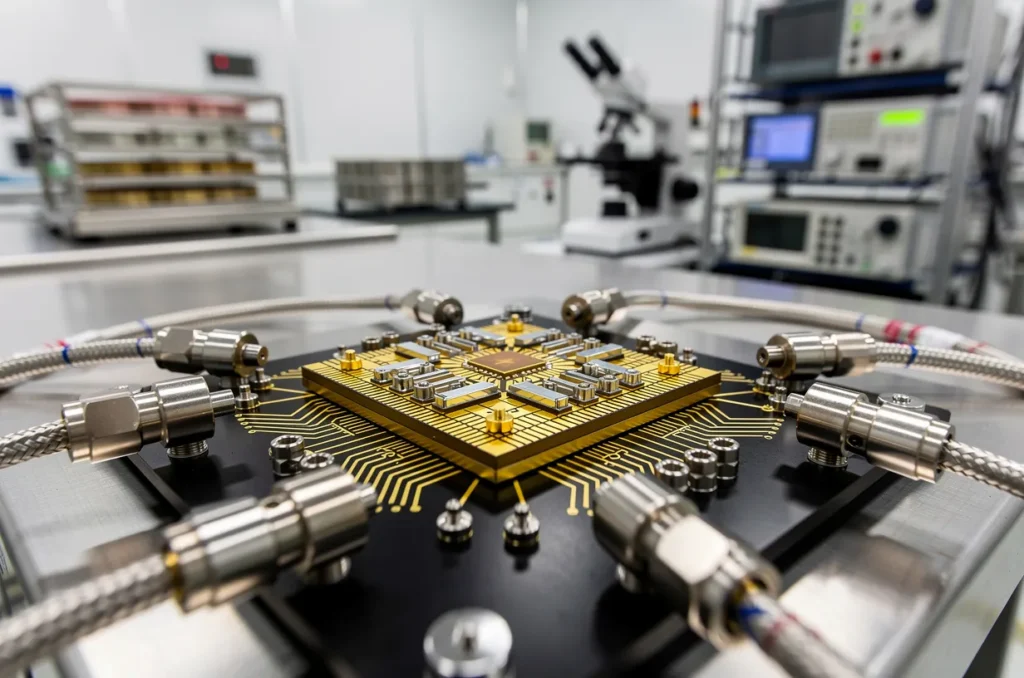
The company will receive $1 billion to launch a new venture called Anderon, which is expected to become America’s first dedicated quantum chip manufacturing facility in New Albany, New York. IBM will also contribute another $1 billion of its own capital, along with intellectual property, assets, and workforce. That is not a symbolic commitment. It is a serious industrial buildout.
For IBM, this is important for two reasons. First, it reinforces the company’s role as the most institutionally credible large-cap quantum name in the public market. Second, it gives the story a manufacturing anchor. Quantum investors have spent years debating roadmaps, architectures, and timelines. This is a reminder that if the sector is going to scale, it also needs real domestic fabrication capacity.
GlobalFoundries gives the strategy real industrial depth
The second-largest award goes to GlobalFoundries, which will receive $375 million to build a domestic facility capable of producing components for several types of quantum hardware. That may not attract as much retail attention as the IBM announcement, but it is critical to the logic of the package.
Quantum is not just a hardware race in the abstract. It is a manufacturing race. The companies that can eventually produce at repeatable quality and meaningful volume will matter far more than those that remain trapped in lab-scale demonstration mode. That is why this part of the announcement is more important than it may first appear.
The smaller public names got exactly what they needed
The other big takeaway is that smaller public quantum names were not left out.
According to Reuters, D-Wave, Rigetti, and Infleqtion are each set to receive about $100 million, while Diraq could receive up to $38 million to solve key technical bottlenecks. That matters because the market has often struggled to distinguish between the quantum companies with real staying power and those that are simply trading on future possibility. Government-backed capital does not eliminate that debate, but it does shift the conversation.
It also helps explain why the stocks moved the way they did. On Thursday, D-Wave was up roughly 25%, Rigetti was up roughly 25%, and IBM was up about 8% in afternoon trading.
The timing is notable
The timing here is hard to ignore.
Last week, we argued that quantum computing was moving out of the novelty bucket and into a more serious strategic-computing lane. This announcement does not complete that shift, but it absolutely reinforces it. Since that note, several of the more speculative names at the center of the theme have moved sharply higher, while IBM has acted more like the steadier large-cap expression of the same trend.
That kind of follow-through does not prove the thesis. But it does tell you the market is beginning to react to the sector less like a curiosity and more like an investable policy-backed trade.
Even the names outside the package are getting pulled in
That is also why this matters for Quantum Computing Inc. (QUBT), even though it was not one of the companies listed in the government package.
QUBT was also sharply higher Thursday, rising roughly 16% in afternoon trading. That tells you the market is not reading this as an isolated funding event for one or two firms. It is reading it as a broad validation of the sector.
That is often how these themes work. Once Washington gives a category this kind of strategic endorsement, investors tend to widen the basket.
This does not solve the timeline problem, but it changes the tone
None of this means commercially useful quantum systems are suddenly right around the corner.
The sector still faces the same hard questions: error rates, scaling, manufacturing complexity, software readiness, and commercial usefulness. Those problems do not disappear because the government writes checks.
But the tone does change.
Public capital, manufacturing support, and direct state ownership stakes all send the same message: Washington believes the category is important enough to build around now rather than wait until the technical race is settled. That should matter to investors because it means the sector is increasingly likely to attract more capital, more partnerships, and more long-term policy support.
WSA Take
This is one of the most important quantum announcements the market has seen in a long time. The government is not simply handing out grants. It is putting real money behind the sector, taking equity stakes, and helping build domestic manufacturing around a technology it now clearly sees as strategic.
For investors, the read-through is straightforward. IBM just strengthened its position as the most credible large-cap quantum name. D-Wave and Rigetti got exactly the kind of validation smaller public names need. And the sector as a whole just received a policy endorsement strong enough to pull in names beyond the direct recipients. That is why this matters. Quantum is still speculative, but it is starting to look a lot less fringe.
We highlighted this theme last week in our quantum computing spotlight.
Disclaimer
WallStAccess is a financial media platform providing market commentary and analysis for informational and educational purposes only. This content does not constitute investment advice, a recommendation, or an offer to buy or sell any securities. Readers should conduct their own research or consult a licensed financial professional before making investment decisions.