What Happened
Russia is facing an unusually large disruption to its oil export system, with at least 40% of crude export capacity currently halted after a wave of attacks and logistical setbacks. The outage follows intensified Ukrainian drone strikes on oil and fuel infrastructure, a disputed incident involving the Druzhba pipeline, and the seizure of Russia-related tankers in Europe that has complicated shipping flows.
The disruption hits as global oil markets have already been tight, with prices moving above $100 a barrel amid a broader geopolitical backdrop tied to an Iran war. Russia is the world’s second-largest oil exporter, and its oil revenue is central to government finances and the wider economy.
- Ukraine intensified attacks this month across Russia’s western export network.
- All three major western export ports were hit, including Novorossiysk, Primorsk, and Ust-Luga.
- Roughly 2 million barrels per day of crude export capability was assessed as offline as of Wednesday.
Where The Disruptions Are Concentrated
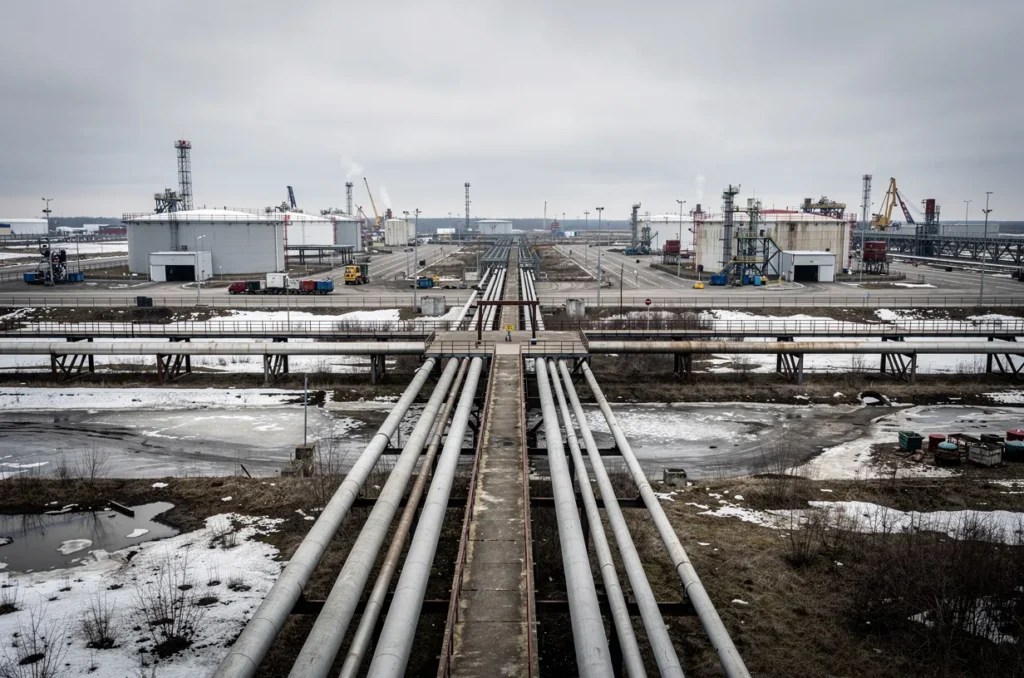
The biggest pressure point is Russia’s westward export corridor, where ports and pipeline routes normally feed large volumes into Europe-linked logistics chains. The facilities affected include the Baltic outlets Primorsk and Ust-Luga, along with the Druzhba pipeline system that runs through Ukraine toward Hungary and Slovakia.
Ukraine has said a section of Druzhba was damaged by Russian strikes at the end of January. In response, Slovakia and Hungary called for supplies to be restarted.
The Novorossiysk oil terminal on the Black Sea—capable of handling up to 700,000 bpd—has also been loading below plan since damage from a heavy drone attack earlier this month.
- Primorsk and Ust-Luga are among the key sites tied to the current halt.
- The Druzhba pipeline route to Central Europe is part of the disrupted picture.
- Novorossiysk has operated below plan following damage tied to an early-month drone strike.
Tankers And The Murmansk Bottleneck
Beyond fixed infrastructure, shipping has become another choke point. Frequent seizures of Russia-related tankers in Europe have disrupted about 300,000 bpd of Arctic oil exports that flow from the port of Murmansk, according to traders.
Taken together, port outages, pipeline constraints, and shipping interruptions are forcing Russia to lean harder on routes to Asia. But traders also flag that those alternatives are limited by capacity and logistics.
- Tanker seizures have disrupted about 300,000 bpd linked to Murmansk flows.
- With westward routes under pressure, export reliance shifts toward Asian markets.
- Traders describe the Asia-bound system as capacity-limited versus western corridors.
What Still Flows: Eastern Pipelines And Far East Loadings
Despite the strain in the west, Russia’s oil supply lines to the east are continuing. Russia is maintaining uninterrupted pipeline supplies to China via Skovorodino-Mohe and Atasu-Alashankou, and it continues seaborne exports of ESPO Blend via the port of Kozmino. Combined, these three routes account for about 1.9 million bpd.
Russia is also still loading oil from its two far eastern Sakhalin projects, shipping around 250,000 bpd from the island. Separately, traders say Russia is supplying refineries in neighboring Belarus with around 300,000 bpd of oil.
Why It Matters For Markets
A halt of this scale tightens the global supply picture at a time when crude pricing is already sensitive to geopolitics and infrastructure risk. For U.S. investors, the immediate read-through is higher volatility across WTI, Brent, refined products, and energy-linked equities as traders reassess how long the disruption lasts and how much can be rerouted.
Investors will watch the pace of further attacks, the status of western port operations, and whether shipping constraints worsen or ease—because those factors determine whether this is a short-lived shock or a sustained supply problem.
WSA Take
Russia’s export network is dealing with a broad-based hit: ports, pipelines, and shipping all face constraints at the same time. The key market variable is duration—temporary outages can be absorbed, but prolonged disruptions can tighten balances quickly when prices are already elevated. The continued flow through eastern pipelines to China and ESPO loadings via Kozmino helps, yet it does not fully replace westward capacity that is currently impaired. The next market-moving signals are operational updates at Novorossiysk, Primorsk, Ust-Luga, and any change in tanker-related disruptions around Murmansk.
Explore More Stories in Commodities
Disclaimer
WallStAccess is a financial media platform providing market commentary and analysis for informational and educational purposes only. This content does not constitute investment advice, a recommendation, or an offer to buy or sell any securities. Readers should conduct their own research or consult a licensed financial professional before making investment decisions.