
Stocks stabilized, but the rotation away from technology continued
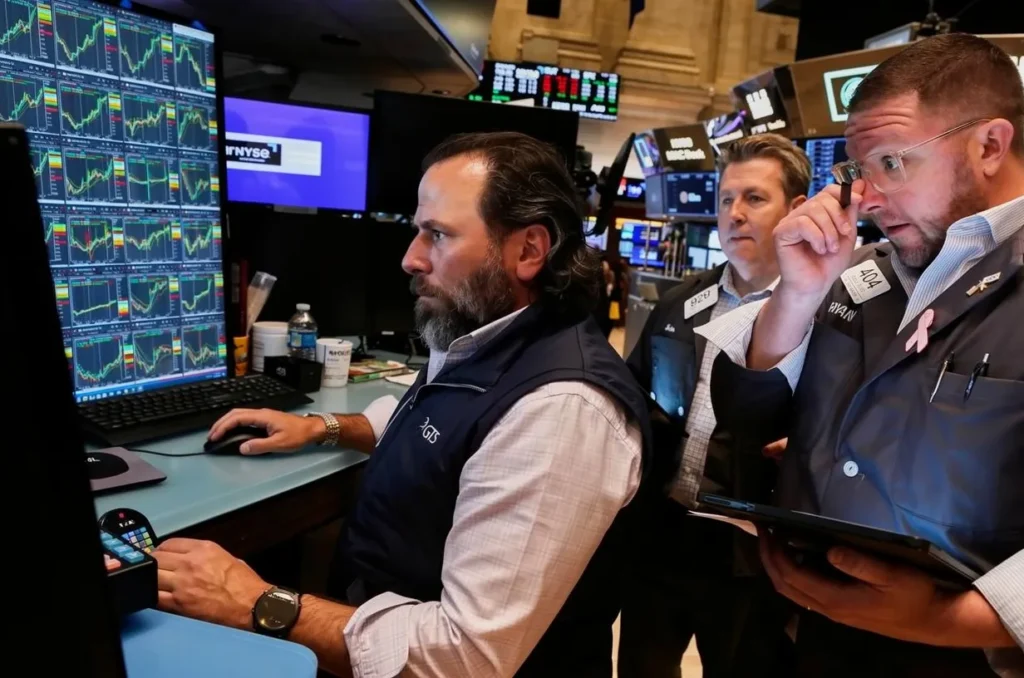
US stocks moved higher Friday as investors shifted further into defensive and economically resilient areas of the market.
The S&P 500 rose approximately 0.5%, while the Nasdaq Composite recovered by a similar amount. The Dow Jones Industrial Average gained roughly 181 points, or 0.3%.
The positive session was not enough to erase a difficult week for the broader market. The S&P 500 remained on course to lose more than 1%, while the Nasdaq was tracking toward a decline of roughly 4%.
The Dow was the clear relative outperformer, rising about 1% for the week as capital moved toward companies less exposed to the recent volatility in artificial intelligence and semiconductor stocks.
Healthcare became the centre of the defensive trade
Healthcare stocks extended their recent strength and provided much of Friday’s support.
Eli Lilly climbed nearly 6%, Johnson & Johnson advanced more than 3%, and AbbVie gained over 2%. The broader healthcare sector approached a record high as investors sought companies with durable demand, predictable cash flows and less sensitivity to technology valuations.
Medical treatments and pharmaceuticals are generally less exposed to economic cycles than discretionary products. That makes healthcare a common destination when investors want to remain in equities while lowering portfolio risk.
Recent performance also reflects company-specific strength, particularly around obesity treatments, pharmaceuticals and medical devices.
Staples, financials and utilities also attracted buyers
The rotation extended beyond healthcare.
Consumer staples gained more than 1%, while financials rose approximately 0.8% and utilities added about 0.4%.
Staples and utilities typically benefit during periods of uncertainty because demand for food, household products and electricity tends to remain relatively stable. Financial stocks have gained from the prospect that interest rates could remain elevated, supporting lending margins for some banks and insurers.
Friday’s sector performance showed that investors were not broadly leaving the market. They were reallocating toward businesses with clearer near-term earnings support and less dependence on continued enthusiasm around AI.
Technology remained the weak point
Information technology fell nearly 1%, extending a difficult stretch for the sector.
Micron Technology, Advanced Micro Devices and Intel each declined around 2%, while weakness spread through memory, storage and semiconductor-equipment companies.
The retreat followed several weeks of debate over chip valuations, rising memory prices and the scale of planned infrastructure spending. Strong operating results from companies such as Micron have confirmed that AI demand remains healthy, but investors are becoming less willing to assume every company connected to the buildout will earn equally strong returns.
The distinction between demand and valuation is becoming more important. AI investment can continue growing while individual stocks decline because expectations had already moved too far ahead of current earnings.
OpenAI’s reported IPO delay added a new funding concern
Sentiment weakened after a report that OpenAI may wait until 2027 to complete its initial public offering.
The company has reportedly considered either delaying the listing and preserving its targeted valuation or moving sooner at a lower valuation. Recent volatility in SpaceX and other AI-related shares has made the public-market environment less favourable for another exceptionally large technology offering.
A delay would not directly reduce demand for AI models or computing capacity. It could complicate the financing structure supporting the wider infrastructure boom.
OpenAI and other private AI developers require enormous amounts of capital to fund model development, cloud contracts, chips and data centres. Public equity markets were expected to provide another source of financing for that expansion.
If access to those markets becomes slower or more expensive, some infrastructure commitments could also proceed more gradually.
The issue extends beyond one prospective IPO
The market’s concern is not simply whether OpenAI lists this year or next.
AI infrastructure is increasingly being financed through a combination of private equity, debt, equipment leases, cloud contracts and long-term purchase agreements. Much of the spending is being committed before the associated revenue and cash flow have fully developed.
As long as capital remains widely available, companies can continue expanding capacity ahead of demand. A less receptive IPO market would place more pressure on private investors, lenders and strategic partners to fund that growth.
OpenAI’s possible delay therefore became another reason to examine the financial foundation beneath the data-centre buildout.
The technology selloff spread across Asia
The weakness in AI-linked stocks was global.
SoftBank Group fell more than 12% in Japan. The company is one of OpenAI’s most important financial backers, giving it significant exposure to the AI developer’s valuation and eventual public-market debut.
Japan’s Nikkei 225 declined more than 4%, while the broader Topix lost about 1.3%.
South Korean markets were hit even harder. The Kospi fell 5.8%, while the Kosdaq declined approximately 4.1% as investors sold semiconductor and technology shares.
SK Hynix and Samsung have been major beneficiaries of growing demand for advanced memory. Their earlier gains also left them vulnerable to a sharp correction as investors reduced exposure to the most crowded parts of the AI trade.
European stocks followed technology lower
European markets also ended the session in negative territory.
The pan-European Stoxx 600 fell approximately 0.7%, with technology, retail, and oil and gas shares among the weakest groups.
Germany’s DAX declined about 1.3%, while Italy’s FTSE MIB lost roughly 1%. France’s CAC 40 and the UK’s FTSE 100 posted more moderate losses.
The decline reinforced the global nature of the technology pullback. Investors across regions are reassessing companies that benefited from rapid AI investment, rising semiconductor prices and expectations for continued access to inexpensive capital.
Consumer sentiment provided some support
Improving consumer data helped prevent the broader US market from falling further.
The University of Michigan’s final June consumer sentiment index rose to 49.5, up from 44.8 in May. Expectations for inflation over the next year also eased to 4.6%, although they remained elevated.
The improvement suggests lower energy prices and a reduction in immediate geopolitical stress are beginning to influence household expectations.
Sentiment remains weak by historical standards, and consumers continue to report concern over the cost of living. Still, the rebound provided evidence that the sharp deterioration seen during the oil shock may be starting to reverse.
Kashkari moved from expecting a cut to expecting a hike
Monetary-policy concerns remained a constraint on the market.
Minneapolis Federal Reserve President Neel Kashkari said he now expects one interest-rate increase before the end of the year. In March, he had projected one cut.
The reversal illustrates how quickly the policy outlook has changed following stronger inflation readings and the recent energy shock.
Kashkari emphasized that his forecast could change as new data arrives. His remarks nevertheless reinforced the broader message from the Fed’s latest projections: policymakers are increasingly prepared to keep rates restrictive or tighten further if inflation does not improve.
That environment creates a higher hurdle for expensive technology shares while offering some support to financial companies and other businesses that can perform under higher rates.
The weekly performance shows how sharply leadership has changed
The Dow’s weekly gain and the Nasdaq’s projected 4% loss illustrate a meaningful shift in market leadership.
For much of the AI rally, the largest technology and semiconductor companies carried the major indexes higher. This week, healthcare, staples, utilities and selected financial companies provided stability while those former leaders declined.
A rotation can broaden the market and reduce dependence on a small group of megacap stocks. It can also signal that investors are becoming more cautious about growth expectations and valuations.
So far, the evidence points more toward repositioning than a broad withdrawal from equities. Defensive sectors are rising rather than simply falling less, and the Dow continues to outperform.
WSA Take
Friday’s rebound did not repair the damage across technology, but it showed that the wider market remains more resilient than the Nasdaq’s weekly decline suggests.
Investors are rotating into healthcare, consumer staples, financials and utilities as questions grow around AI valuations, infrastructure financing and the timing of OpenAI’s public offering. The shift is creating a more balanced market, although it is also exposing how much previous index performance depended on a narrow group of technology leaders.
Improving consumer sentiment offered some support, but the rate outlook remains difficult. With another Fed hike now part of the discussion, companies will need stronger current earnings to justify premium valuations.
The AI trade is not disappearing. It is facing a more demanding market—one that increasingly requires financial results, durable funding and clearer returns on capital.
Explore More Stories in Markets
Disclaimer
WallStAccess is a financial media platform providing market commentary and analysis for informational and educational purposes only. This content does not constitute investment advice, a recommendation, or an offer to buy or sell any securities. Readers should conduct their own research or consult a licensed financial professional before making investment decisions.