AMD is finally moving from chip supplier to AI systems rival
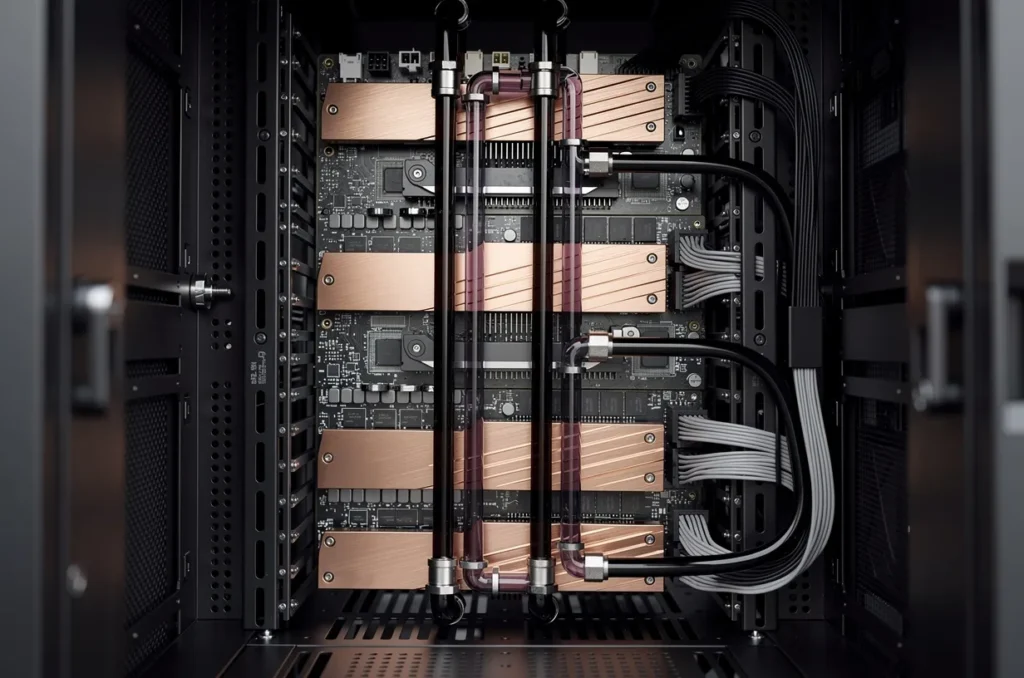
Advanced Micro Devices is preparing to ship Helios, its first rack-scale artificial intelligence system, in what may be the company’s most direct challenge yet to Nvidia’s dominance in the AI data-centre market.
Microsoft said Monday that it will deploy AMD Helios racks in its Azure data centres, joining a growing list of early customers that already includes Meta, OpenAI, Oracle and Tata Consultancy Services. AMD plans to begin shipping Helios to customers later this year, though financial terms and compute-capacity details were not disclosed.
The announcement matters because AMD is no longer competing only at the chip level. With Helios, the company is trying to sell a complete AI rack system that combines GPUs, CPUs, networking and software, moving closer to the model that made Nvidia’s Grace Blackwell and Vera Rubin systems so powerful.
That shift could make AMD a more serious competitor in AI infrastructure, especially as hyperscalers look for more supply, more pricing leverage and more choice outside Nvidia.
Microsoft adds credibility to the Helios rollout
Microsoft’s decision to deploy Helios gives AMD a major validation point. Azure is one of the world’s most important cloud platforms, and Microsoft needs enormous amounts of compute as it expands internal model development, AI services and customer workloads.
Microsoft CEO Satya Nadella said the company is expanding its Azure infrastructure portfolio with AMD Helios to give customers the “performance, scale and choice” needed to build and run next-generation AI applications.
The system will power frontier model inference for Microsoft, its AI customers and Azure AI services. Microsoft will also add two new computing instances based on AMD’s latest Venice CPUs, with one focused on agentic AI and data pipelines, and another aimed at semiconductor design.
This builds on a long relationship between the two companies. AMD chips have powered Microsoft’s Surface PCs and Xbox consoles for years. In 2023, Microsoft was also the first major customer to adopt AMD’s MI300X GPU, which was designed to compete with Nvidia’s AI accelerators.
Microsoft needs more compute after mixed AI results
Microsoft’s involvement also reflects a broader reality across Big Tech: the AI race is demanding more infrastructure than companies can comfortably source from one supplier.
Microsoft has been ramping up its own AI model development and dedicating more computing capacity to research and development. In June, the company announced seven models built in-house, adding to its existing AI investments across Azure, GitHub, Office and enterprise software.
The results have been mixed. Products such as Microsoft 365 Copilot and GitHub Copilot remain strategically important, but Microsoft has also been the weakest-performing Magnificent Seven stock so far this year. That makes infrastructure efficiency more important. If AI spending remains high, investors will care not only about growth, but also about the cost of delivering that growth.
AMD’s pitch is therefore not just about availability. It is about lowering the cost of AI computing, especially for inference workloads where cost per token can become a major driver of profitability.
Helios is AMD’s full-stack answer to Nvidia
Helios brings together four major AMD capabilities inside one rack-scale system: GPUs, CPUs, networking and software.
That matters because Nvidia’s advantage has not come only from having the best AI chips. Nvidia has built a full platform around hardware, networking, rack architecture and software, making it easier for customers to deploy large clusters and scale AI workloads.
AMD is now trying to close that gap.
Each Helios system includes 18 compute trays, with each tray containing four Instinct GPUs powered by one EPYC CPU. The system also uses networking chips built with technology AMD gained through its 2022 acquisition of Pensando.
The strategy is clear. AMD wants customers to see it not as a second-source GPU vendor, but as a full AI infrastructure provider.
AMD is targeting the cost side of AI
AMD data-centre head Forrest Norrod said the company is focused on offering the best total cost of ownership and the “lowest cost per token.”
That phrase is important.
AI inference is becoming one of the biggest cost battlegrounds in technology. Training a model requires enormous upfront compute, but inference happens every time a user sends a prompt, runs an agent, generates code or uses an AI feature inside a software product. The more AI becomes part of daily workflows, the more inference cost matters.
AMD CEO Lisa Su has argued that Helios has meaningful advantages for inference, memory bandwidth and memory capabilities compared with Nvidia’s rack-scale systems.
That is the opening AMD is trying to exploit. Nvidia still dominates the market, but hyperscalers are increasingly focused on efficiency, memory, power consumption and cost per workload. If AMD can deliver competitive performance at a better economic profile, it can win share even without fully displacing Nvidia.
The price comparison is not simple
AMD has not disclosed Helios pricing, but Futurum Group estimates the system will cost between $5 million and $5.5 million. That compares with Futurum’s estimated $3.5 million to $4 million range for Nvidia’s second-generation Vera Rubin rack-scale system.
At up to 7,000 pounds, Helios is also wider and heavier than Nvidia’s Vera Rubin.
Those differences matter, but they do not tell the full story. AI infrastructure buyers are not judging systems only by sticker price. They are evaluating performance, availability, power efficiency, memory capacity, software maturity, workload suitability and total cost per token.
The key variables for AMD will likely be:
- Inference performance on real customer workloads
- Memory bandwidth and capacity for large models
- Power efficiency inside hyperscale data centres
- Software maturity through ROCm
- Supply availability as Nvidia demand remains constrained
That is where early deployments at Microsoft, Meta, OpenAI and Oracle become important. If the systems perform well at scale, AMD’s credibility could improve quickly.
Nvidia still controls the AI GPU market
Nvidia remains the clear leader in data-centre GPUs. According to Futurum Group, Nvidia controls more than 95% of the market, while AMD holds roughly 4.5%.
That gap is enormous.
But AMD does not need to overtake Nvidia to build a much larger AI business. Futurum CEO Daniel Newman said there is a serious case that AMD could reach 20% to 25% share, which would represent hundreds of billions of dollars in revenue opportunity across the AI infrastructure cycle.
AMD is already seeing the data-centre business become more important. In the first quarter of 2026, data centres made up the majority of AMD’s revenue, rising 57% year over year. The company told CNBC it expects to book tens of billions of dollars in data-centre AI revenue starting in 2027, with most of that coming from Helios.
That is the market’s focus now. AMD is still far behind Nvidia, but the size of the AI infrastructure market means even modest share gains could be material.
AMD’s comeback story is now entering a new phase
Helios also represents the next stage in AMD’s long turnaround under CEO Lisa Su.
The company regained credibility in the data-centre market through EPYC server CPUs, which helped AMD take share from Intel after years of setbacks. AMD first unveiled EPYC in 2017, laying out a multi-generation roadmap and delivering against it.
That execution record matters because AI customers are making long-term infrastructure decisions. Hyperscalers need confidence that AMD can ship systems on time, support future generations and keep improving performance across GPUs, CPUs, networking and software.
The company has also used acquisitions to fill gaps. Xilinx gave AMD programmable chip technology. Pensando added networking capabilities. ZT Systems, acquired in 2025, strengthened AMD’s server and rack-scale system expertise. A series of software acquisitions also helped AMD build ROCm, its open-source alternative to Nvidia’s CUDA ecosystem.
Those pieces are now coming together in Helios.
Software remains the biggest question
The main challenge is not whether AMD can build powerful chips. The bigger question is whether its software ecosystem can match the convenience and maturity of Nvidia’s platform.
Nvidia’s CUDA software ecosystem remains one of its strongest moats. Developers, cloud customers and AI companies have spent years building around Nvidia hardware and tools. That creates switching costs that are difficult for competitors to overcome.
Counterpoint Research analyst Neil Shah said AMD’s Helios chips are “on par” with Nvidia GPUs and CPUs, but the “secret sauce” is software and optimization. That is where Nvidia still has the lead.
This is the central issue for Helios. AMD can win customers that need more supply or better economics, but long-term share gains will depend on whether developers and enterprise customers can run workloads smoothly on AMD systems without sacrificing performance, stability or productivity.
Capacity shortages may help AMD get in the door
The AI market is still constrained by demand for compute. That gives AMD a window.
Newman framed the question directly: is AMD winning because it is technologically superior, or because capacity is so tight that buyers will purchase anything credible?
The answer may be both. Hyperscalers need alternatives because Nvidia supply remains in high demand, and they also want bargaining power in a market where one supplier has dominated pricing and availability.
AMD’s opportunity is to use that demand imbalance to get Helios into major data centres, prove performance at scale and then turn early deployments into recurring customer commitments.
That is how the company can move from being an alternative supplier to becoming a true platform competitor.
WSA Take
Helios is AMD’s most serious attempt yet to challenge Nvidia where it matters most: full AI infrastructure systems, not just individual chips. Microsoft’s decision to deploy Helios in Azure gives AMD an important customer win and makes the rollout harder for the market to ignore.
Nvidia still has the dominant share, stronger software ecosystem and deeper AI platform advantage. But hyperscalers want more compute, more supply and more choice. If AMD can prove Helios delivers on performance and cost per token, even a small shift in market share could become a major revenue opportunity.
Disclaimer
WallStAccess is a financial media platform providing market commentary and analysis for informational and educational purposes only. This content does not constitute investment advice, a recommendation, or an offer to buy or sell any securities. Readers should conduct their own research or consult a licensed financial professional before making investment decisions.