IBM’s recovery now depends on mainframe demand coming back
IBM is trying to rebuild investor confidence after a sharp second-quarter warning raised questions about demand, spending priorities and the company’s near-term growth path.
The company reported second-quarter revenue of $17.2 billion, up 1% from a year earlier and in line with its lowered expectations. Diluted earnings per share rose 5% to $2.93, also matching the figure IBM had preannounced after warning that results would fall short of Wall Street’s earlier estimates.
The bigger issue is what happens next. IBM did not fully reset its full-year outlook after the warning. Instead, it only trimmed guidance, now expecting full-year constant-currency revenue growth of 4% to 5%, down from its prior forecast of more than 5%.
That leaves the stock tied to one main question: can IBM’s mainframe business rebound quickly enough to support the second half of the year?
AI infrastructure spending disrupted the quarter
IBM’s warning was driven by a shift in client spending toward AI-centric infrastructure, including servers, chips and storage.
That is the same spending cycle lifting parts of the semiconductor and data-centre market, but it created pressure for IBM. Enterprise customers appear to have redirected capital toward securing AI hardware and infrastructure, leaving less room for other purchases in the quarter.
That is the difficult part of IBM’s setup. The company wants to be viewed as an enterprise AI beneficiary, but the near-term dollars are flowing first into the physical layer of AI: compute, memory, servers and storage.
IBM is betting that this is a timing issue, not a structural shift away from its platform.
Management still sees strength in mainframes
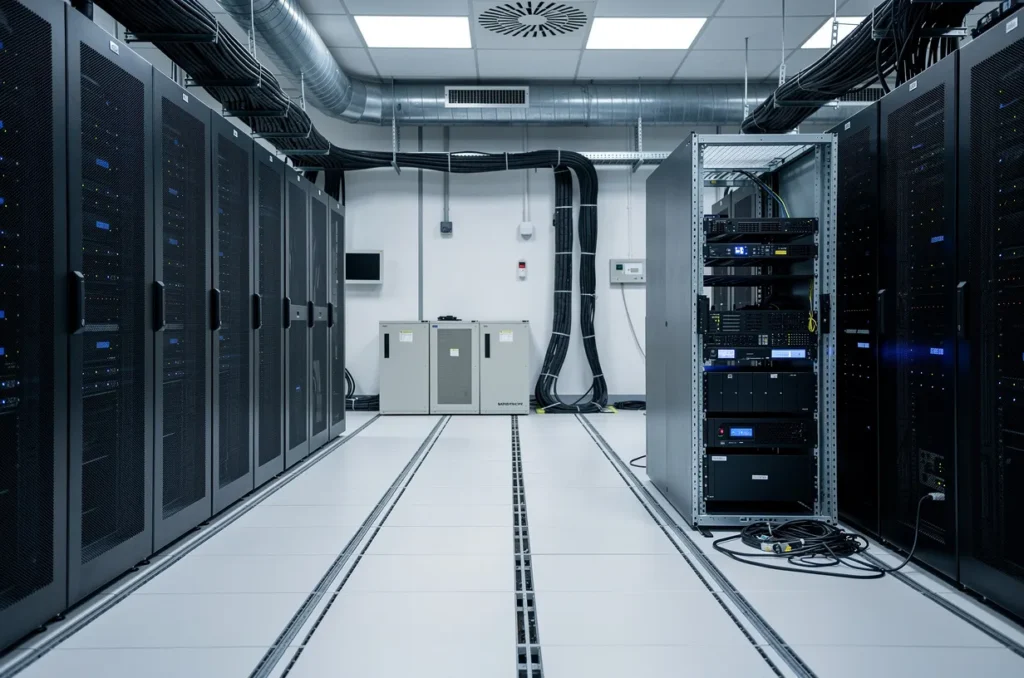
IBM CFO Jim Kavanaugh said the company does not see evidence that clients are moving away from mainframes. He pointed to capacity growth, AI inferencing and the economics of mainframe computing as reasons the company remains confident.
That confidence is central to IBM’s outlook. Kavanaugh said IBM expects a record year compared with prior mainframe programs, with demand supported by the role mainframes can play in high-value enterprise workloads.
The argument is straightforward. If customers are investing heavily in AI infrastructure now, they may still need secure, reliable computing platforms to support enterprise workloads later. IBM believes mainframes can remain relevant as AI inferencing, data security and transaction-heavy applications become more important.
The market is not rejecting that argument outright. It is asking for evidence.
Guidance avoided the worst-case reset
The modest guidance cut helped avoid a deeper reset, but it also raised the stakes for the next update.
IBM had already lowered expectations when it preannounced results on July 14. At that time, analysts had been looking for roughly $17.85 billion in second-quarter revenue and $3.02 in non-GAAP EPS. IBM instead pointed to $17.2 billion in sales and $2.93 in EPS.
The latest report confirmed those weaker numbers, but management’s full-year guidance still assumes enough improvement to keep growth within reach.
Key figures from the quarter include:
- Q2 revenue: $17.2 billion, up 1% year over year
- Q2 diluted EPS: $2.93, up 5% year over year
- 2026 revenue outlook: 4% to 5% constant-currency growth
- Prior outlook: more than 5% constant-currency growth
That is not a collapse in guidance. It is a narrower path.
Wall Street still wants more visibility
Analysts have already cut IBM earnings estimates for 2026 and 2027 since the warning, according to Yahoo Finance AlphaSpace data. That shows the market is not fully convinced the weakness is temporary.
Stifel analyst David Grossman said the stock remains range-bound with a slight downward bias because of limited near-term visibility and seasonal dynamics.
That is the challenge for IBM over the next 90 days. The company does not need to completely change the story, but it does need to show that the June spending shift was not the start of a longer demand problem.
A midquarter signal that mainframe demand is improving would matter. It would give investors something more concrete than management confidence and help restore trust after the surprise warning.
The opportunity is in proving the disruption was temporary
IBM’s setup is now cleaner, but more demanding. Expectations have been lowered, the stock has already absorbed a major confidence hit, and the next catalyst is easy to understand.
The company needs to show that AI infrastructure spending did not permanently crowd out demand for its mainframe and enterprise computing products. If mainframe demand recovers, the stock can begin rebuilding credibility. If it does not, investors may question whether IBM’s AI story is being outpaced by the infrastructure layer of the market.
That makes the next 90 days important. IBM does not have to deliver a perfect rebound, but it does need to prove that customer spending is coming back to the parts of the business management is counting on.
WSA Take
IBM’s quarter was not disastrous, but the guidance now depends heavily on a mainframe rebound. The company is arguing that clients temporarily redirected capital toward scarce AI infrastructure, not away from IBM’s core platform. That is a reasonable case, but the stock needs evidence quickly. A stronger mainframe signal before the next quarter would go a long way toward repairing investor confidence.
Disclaimer
WallStAccess is a financial media platform providing market commentary and analysis for informational and educational purposes only. This content does not constitute investment advice, a recommendation, or an offer to buy or sell any securities. Readers should conduct their own research or consult a licensed financial professional before making investment decisions.