Nike missed China’s sports boom
Nike should be winning in China right now.
Sports participation is rising, health and fitness spending is growing, and China’s sportswear market has expanded sharply over the past five years. But instead of capturing that momentum, Nike’s China business has moved in the opposite direction.
Sales in the region have declined from the prior year for eight consecutive quarters. Since 2021, Nike’s China business has shrunk 30%, with annual revenue falling to its lowest level in eight years at the end of May.
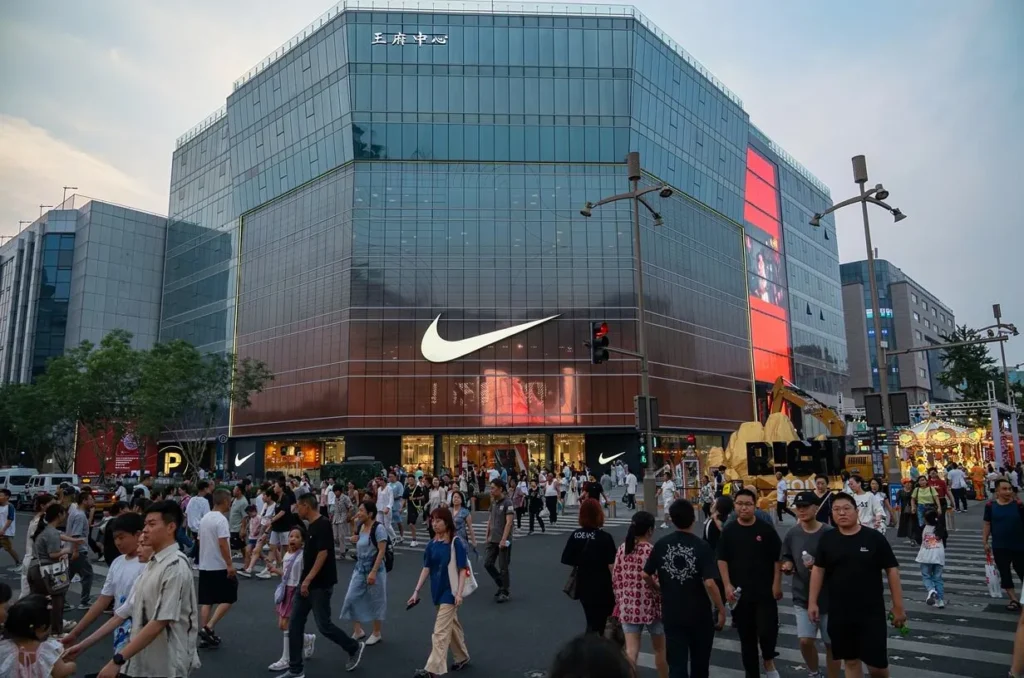
That is a major shift for a market that was once one of Nike’s strongest growth engines. China used to be prized by investors for its margin profile, brand power and long runway. Today, it is Nike’s smallest major region and one of the biggest questions hanging over the company’s global turnaround.
The problem is deeper than a weak cycle
Some Wall Street analysts believe Nike’s China business can recover once North America stabilizes. That may be true to a point, but the China issue looks more structural than cyclical.
Nike is dealing with a consumer that has changed. Younger shoppers are more willing to buy domestic brands, more focused on value and more interested in products that feel locally relevant. The old strategy of selling globally popular Western products into China is no longer enough.
The pressure is coming from several directions:
- China Chic has increased pride in domestic brands
- Anta and Li-Ning have improved product quality and marketing
- Younger consumers want localized products, not global templates
- Nike’s distribution became fragmented and discount-heavy
- Local competitors are moving faster on design and cultural relevance
That combination has made Nike look less distinctive in a market it once helped define.
China Chic changed the brand equation
Nike’s rise in China was built on global prestige. In the early 2000s, Nike was seen as premium, cool and clearly ahead of local competitors. For consumers with money to spend, owning Nike carried status.
That advantage has weakened.
The shift accelerated after the 2021 Xinjiang cotton controversy, when previous statements from Western brands about forced labour concerns resurfaced and triggered backlash from Chinese consumers. Domestic brands such as Anta and Li-Ning leaned into national pride, while Nike and other Western names lost some cultural momentum.
The broader movement, often called Guochao or China Chic, has encouraged consumers to see Chinese-made and Chinese-designed products as fashionable, modern and culturally relevant.
That does not mean foreign brands cannot win in China. It means they have to work harder. Premium pricing alone is not enough when domestic brands can offer quality, local identity and sharper cultural timing.
Domestic rivals are no longer second-tier
Nike’s China challenge is also about product value.
Over the past two decades, domestic sportswear companies have become stronger at manufacturing, design, marketing and athlete-driven storytelling. Anta and Li-Ning are no longer competing only on price. They are competing on style, performance and national relevance.
Chinese consumers have also become more sophisticated. As more people participate in running, basketball, outdoor sports and niche fitness activities, they are paying closer attention to technical features, comfort, performance and product specificity.
That creates a tougher backdrop for Nike. The company is still one of the most recognizable sports brands in the world, but in China it is being judged against faster-moving local brands that understand the market more intimately.
Nike’s issue is not that the brand has disappeared. It is that its old advantage has narrowed.
Adidas shows recovery is possible
Nike’s struggles are not simply a Western-brand problem.
Adidas has managed to regain momentum in China by giving local teams more room to create products and campaigns that feel specific to Chinese consumers. Its Chinese Track Top jacket, released around Chinese New Year, sold out quickly and became a viral product.
Lululemon has also continued to grow in China, with strong comparable sales performance.
Those examples matter because they show the market is not closed to international brands. Chinese shoppers will still reward foreign companies that offer the right mix of product, local relevance and brand execution.
Nike’s challenge is to prove it can move with the same speed and specificity.
Nike is moving toward local product creation
Nike says it has not lost cultural relevance in China and is working to reconnect with younger consumers through deeper local sports communities, events and cultural moments.
The company has also made leadership changes. Cathy Sparks, a 25-year Nike veteran, became vice president and general manager of Greater China earlier this year, reporting directly to CEO Elliott Hill.
Sparks said the Chinese consumer has changed and now has higher standards for product connection and brand engagement. Nike is responding by building more footwear and apparel specifically targeted to local needs.
The company recently hired its first Greater China vice president of local product creation. Nike plans to start with two lifestyle capsules, one for Nike Sportswear and one for Jordan streetwear, in time for the holidays. Performance apparel and footwear are expected to follow.
That is the right direction. The question is whether Nike can move fast enough.
Distribution also needs a reset
Nike is also trying to clean up its China distribution model.
During the pandemic, the company allowed brick-and-mortar distributors to sell online, even though their original agreements did not include digital channels. Nike did not fully reset that structure after consumers returned to physical stores, creating what Sparks described as a fragmented marketplace.
That fragmentation made it harder for Nike to control pricing, brand presentation and product storytelling. It also contributed to a more discount-driven environment, which can damage a premium brand over time.
The company is now shutting down some of those online storefronts. That could pressure near-term revenue. BNP Paribas analyst Laurent Vasilescu estimates the change could reduce annual China revenue by as much as $1 billion, or roughly 17% of regional sales.
Nike’s argument is that the short-term pain is necessary. A cleaner marketplace, stronger full-price selling and a more premium consumer experience matter more than chasing low-quality revenue.
The turnaround is possible, but not automatic
Nike still has major strengths in China: brand awareness, athlete relationships, scale, product history and decades of market presence. The company has been in China for more than 40 years, which gives it a base that most brands cannot replicate.
But the turnaround needs proof. Nike must show that local product creation, distribution discipline and community-level marketing can reconnect with younger shoppers while protecting premium pricing.
The risk is that local competitors keep moving faster. The opportunity is that China’s sportswear market is still growing, and Nike does not need to dominate the way it once did to rebuild momentum from a lower base.
WSA Take
Nike’s China problem is not a lack of demand for sportswear. It is a brand relevance and execution problem inside a market that has become more local, more competitive and more value-conscious.
The reset makes sense: more Chinese-designed products, cleaner distribution and stronger full-price selling. But Nike now has to prove that the strategy can turn into growth after eight straight quarters of declines.
Explore More Stories in Markets
Disclaimer
WallStAccess is a financial media platform providing market commentary and analysis for informational and educational purposes only. This content does not constitute investment advice, a recommendation, or an offer to buy or sell any securities. Readers should conduct their own research or consult a licensed financial professional before making investment decisions.