C$500 billion sounds enormous. The mining number is smaller.
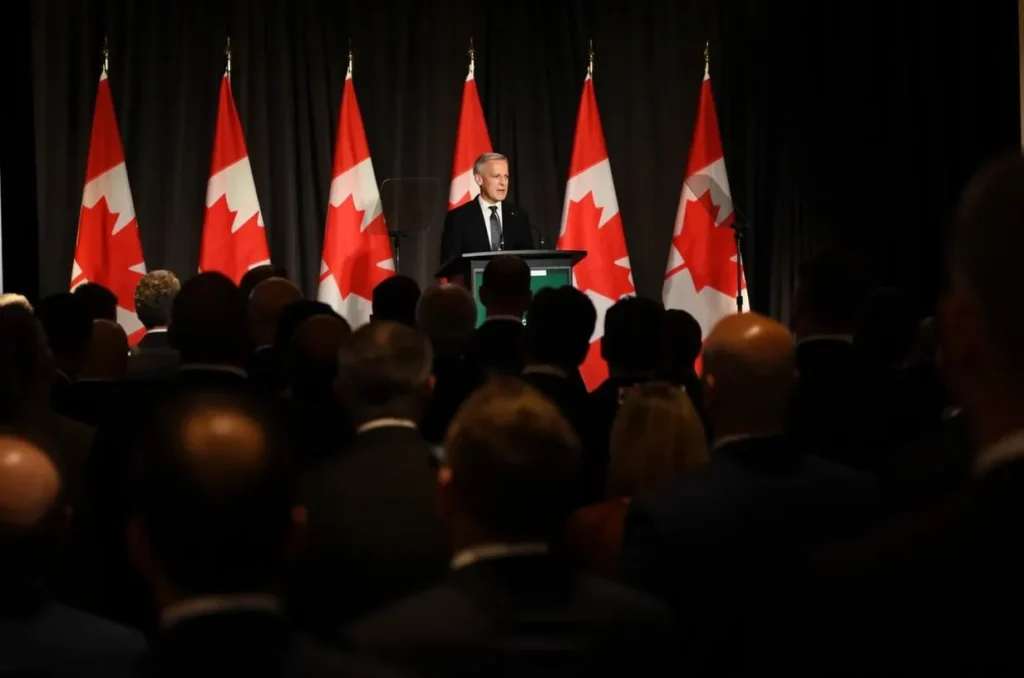
Canada came out of its first Investment Summit with a headline few countries could match: nearly C$500 billion in new investment commitments, according to the federal government. Mining and metals also represented the largest group among the projects presented to investors.
But the composition of that C$500 billion tells a more complicated story.
Roughly C$325 billion comes from bank financing commitments, nearly C$100 billion from pension funds and other institutions, and more than C$14 billion from investment funds. Bell Canada’s C$52.5 billion Saskatchewan AI infrastructure project is also included in the total. Some of the bank commitments stretch across five or even 10 years.
Mining produced one clear project-level win: about C$140 million from the Canada Growth Fund for Generation Mining’s Marathon copper-palladium project in Ontario.
Canada does not appear to have a shortage of mining projects. It has a problem matching those projects with the scale of capital sitting in the room.
Big funds need big places to put money
A mine requiring a few hundred million dollars can be transformational for a junior developer. It can still be too small to attract serious attention from institutions trying to deploy billions.
The new Maple Fund illustrates the mismatch. CPP Investments and Brookfield plan to invest as much as C$50 billion, targeting opportunities involving more than C$5 billion of project equity.
Most Canadian critical-mineral developers simply do not operate at that scale.
That helps explain why combining mines with processing plants, power infrastructure and long-term customers could become increasingly important. A lithium mine on its own may be too small. A coordinated lithium supply chain including extraction, conversion and infrastructure begins to look much more like an institutional asset.
The processing gap is becoming part of the funding gap
Lithium shows the problem clearly.
Canada has hard-rock deposits capable of producing spodumene concentrate, but much less domestic capacity to convert that material into the lithium chemicals battery manufacturers actually need. Developers can try to build those facilities themselves, but doing so adds cost, complexity and years to projects that are already difficult to finance.
Similar issues run through other critical minerals. A deposit is more valuable when there is a credible path from the ground to the customer.
Ottawa is trying to improve the economics around that path. The government announced broader immediate tax deductions for assets including mining property, pipelines and rail infrastructure, while also pushing faster project reviews. It says the new tax treatment would reduce Canada’s marginal effective tax rate on new business investment from roughly 13% to 6.4%.
Faster approvals would help, but federal action alone cannot eliminate delays where provincial reviews are also involved.
The next test is whether the money reaches actual mines
The summit succeeded in bringing enormous pools of capital into the same room as Canadian projects. That matters. Company executives also gained direct access to the government and investment teams that actually evaluate where capital gets deployed.
Now the harder part begins.
A C$500 billion headline will mean much more to the mining sector if it starts producing project financings, construction decisions and new processing capacity.
Generation Mining offers the first concrete example. The stronger signal would be seeing more advanced Canadian projects secure similar commitments, particularly from large international funds that previously viewed individual mines as too small or too complicated.
Canada has the minerals. It has interested capital. The gap between the two is still scale, infrastructure and execution.
Explore More Stories in Markets
Disclaimer
Wall Street Access is an independent financial publisher. Wall Street Access is not a financial advisor. No company mentioned has compensated Wall Street Access for the preparation, publication or distribution of this article. This content is provided for informational and educational purposes only and is not investment advice or a recommendation to buy, sell or hold any security. Investing involves risk, including the possible loss of principal.
Prices, market capitalizations, financial figures and other market data are based on information available as of the date and time of publication and may change without notice. Information is drawn from public sources believed to be reliable but is not guaranteed to be complete or accurate. Opinions and expectations expressed are our own and may change as new information becomes available.
Readers should conduct their own due diligence and contact a licensed financial professional before making any investment decision. Past performance does not guarantee future results. Any material ownership interest or conflict of interest, where applicable, will be disclosed separately.