
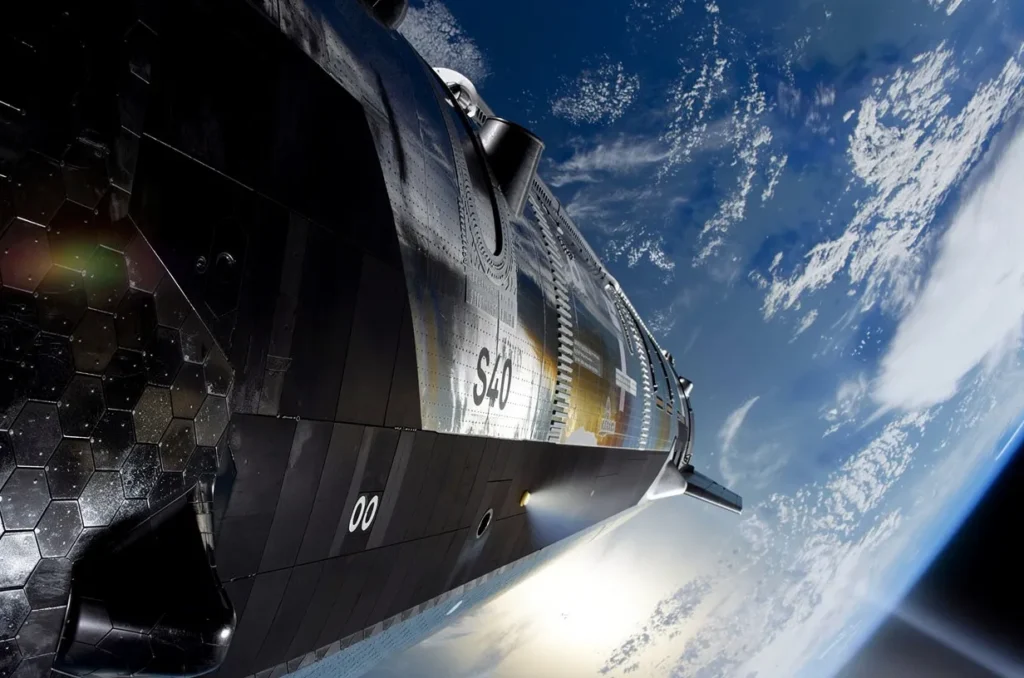
Starship finally carried a real payload to orbit
SpaceX (SPCX) just crossed a line that matters far more than another successful test flight.
Starship reached Earth orbit for the first time Monday and successfully deployed 26 operational Starlink V3 satellites, turning the vehicle from an experimental rocket program into a functioning satellite launcher.
The flight was not flawless. Ship 41 lost one of its six Raptor engines during ascent, but the remaining engines completed the burn. After engineers checked the spacecraft’s systems, SpaceX cleared Starship for orbital insertion and fired another Raptor engine to place the vehicle into its targeted orbit of roughly 275 kilometers above Earth.
Super Heavy Booster 21 also completed separation and splashed down in the Gulf of Mexico.
Every previous Starship mission had remained suborbital. Some ended in controlled splashdowns, while others resulted in the loss of the vehicle. Monday was the first time Starship reached orbit and delivered an operational payload once it got there.
That is a much more important milestone for the economics of SpaceX.
The real prize is a much bigger Starlink network
Starship was not carrying ordinary Starlink satellites.
The V3 satellites are too large to launch aboard Falcon 9, the rocket that built most of today’s Starlink network. SpaceX designed the new generation around Starship’s significantly larger payload capacity.
Each V3 satellite is expected to provide more than 1 terabit per second of downlink capacity, dramatically increasing the amount of bandwidth SpaceX can add with each successful launch.
The economics are straightforward. A larger rocket can carry larger satellites and potentially deploy substantially more network capacity per mission. If SpaceX can eventually make Starship reusable at the scale it is targeting, the cost of adding each additional unit of Starlink capacity could fall as launch frequency rises.
That matters because Starlink is SpaceX’s largest business, and the satellite network’s growth increasingly depends on a launch system capable of moving beyond the limitations of Falcon 9.
Monday’s mission was the first real demonstration of that relationship working as intended: Starship launches, reaches orbit and begins building the next version of Starlink.
An engine failure may have made the test more valuable
One of the more interesting parts of the flight was that an engine failed and the mission still worked.
Space launch systems need redundancy. A rocket capable of completing its mission after losing an engine during ascent is more useful than one that only succeeds when every component behaves perfectly.
Ship 41 continued climbing after the Raptor shutdown, completed its ascent burn and eventually performed the separate orbital insertion burn required to reach Earth orbit.
For a rocket SpaceX eventually wants to fly frequently, carrying valuable satellites and other payloads, surviving imperfect conditions is part of becoming operational rather than experimental.
There is still a large gap between one successful orbital deployment and the cadence SpaceX ultimately wants from Starship. But the program now has something it did not have before: proof that Starship can complete an actual commercial task.
SpaceX is becoming much more than a rocket company
The timing is especially important now that SpaceX is publicly traded and investors can directly judge how quickly its massive infrastructure investments translate into revenue-producing assets.
Starship sits at the center of several ambitions at once.
It is designed to expand Starlink, lower the cost of putting mass into orbit and support increasingly large pieces of infrastructure that SpaceX cannot realistically deploy using Falcon 9 alone. The company has also recently highlighted projects ranging from supercomputers and AI infrastructure to Terafab, Gigasat and a new Starbase in Louisiana.
The combination is beginning to look less like a traditional launch company and more like an integrated space infrastructure platform.
Starlink provides recurring connectivity revenue. Starship provides the transportation system needed to scale it. Larger satellites can increase network capacity, while lower launch costs could make entirely new orbital businesses economically possible.
That is what made Monday’s flight different.
SpaceX did not simply prove Starship could reach orbit.
It proved that Starship could carry a payload the company’s existing rocket cannot, survive an engine failure, reach orbit and deploy the satellites successfully.
For a company trying to build much of its future around what Starship can carry into space, that may be the point where the program starts becoming an economic asset rather than just an engineering project.
Disclaimer
Wall Street Access is an independent financial publisher. Wall Street Access is not a financial advisor. No company mentioned has compensated Wall Street Access for the preparation, publication or distribution of this article. This content is provided for informational and educational purposes only and is not investment advice or a recommendation to buy, sell or hold any security. Investing involves risk, including the possible loss of principal.
Prices, market capitalizations, financial figures and other market data are based on information available as of the date and time of publication and may change without notice. Information is drawn from public sources believed to be reliable but is not guaranteed to be complete or accurate. Opinions and expectations expressed are our own and may change as new information becomes available.
Readers should conduct their own due diligence and contact a licensed financial professional before making any investment decision. Past performance does not guarantee future results. Any material ownership interest or conflict of interest, where applicable, will be disclosed separately.