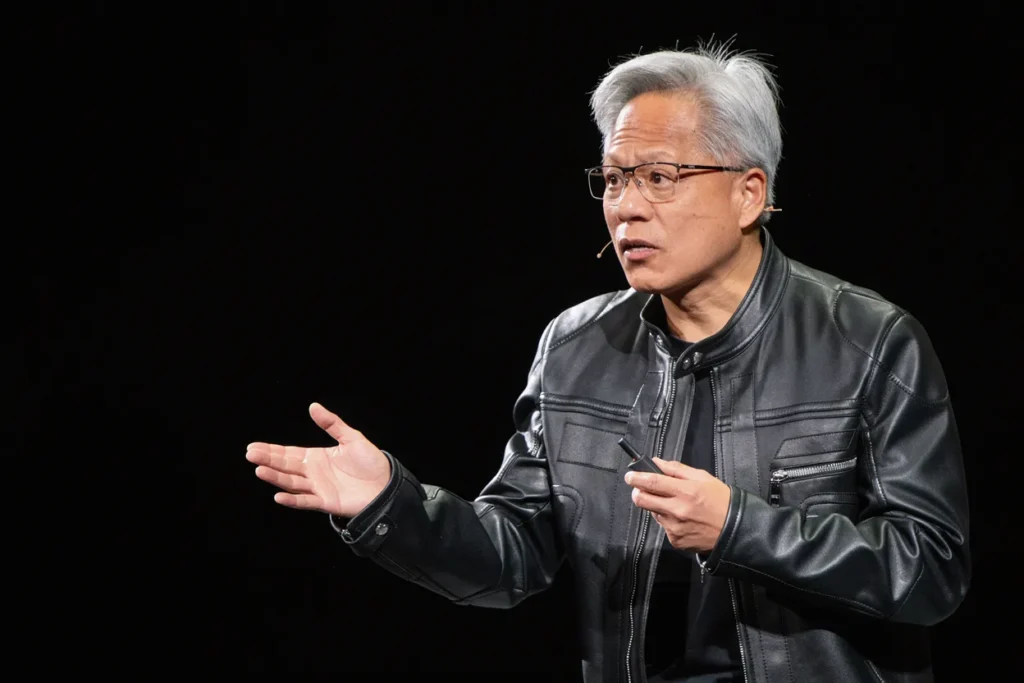
Huang is back, with unfinished business
Nvidia’s founder returned to the CEO’s office Monday, and Wall Street delivered an extraordinary welcome. By Tuesday morning, some of that enthusiasm was fading.
Shares fell more than 5% after Monday’s 31.5% surge, as attention returned to the governance and political questions surrounding his reinstatement.
The board says it is satisfied with Huang’s candor and ability to lead. After receiving input from senior US government officials, it also concluded that his return poses no national security risk.
But its own independent investigation will continue to its conclusion.
That leaves shareholders in an unusual position: Nvidia has restored the leader central to its commercial identity before completing the review prompted by reports that he was targeted by a foreign intelligence effort.
His return can reassure customers and partners about leadership continuity. It cannot yet provide the findings of an unfinished investigation.
The board now has to demonstrate its oversight
Harvey Jones remains chairman, while Colette Kress continues as CFO after serving as interim chief executive.
Alongside Huang’s reinstatement, Nvidia announced a National Security and Export Control Committee composed entirely of independent directors. It is also searching for a chief compliance officer who will report to its governance committee.
Those measures put responsibility for oversight more explicitly with directors outside management. Their effectiveness will depend on what the committees establish, how compliance is enforced and what Nvidia ultimately discloses.
That distinction matters commercially. Export restrictions can determine which customers Nvidia may serve; failures in oversight can bring investigations, disruption and additional costs. A change at the top does not remove those exposures.
For a company whose share price moved so dramatically on a personnel decision, the next disclosures deserve as much attention as the comeback itself.
The Comeback Made Headlines. Follow What Changes for AI Stocks Next—with WSA in Your Morning Inbox.
AMD’s opportunity was already taking shape
The competitive consequences will develop more slowly than the stock-market reaction.
Building AI infrastructure involves choosing processors, arranging manufacturing capacity and configuring entire systems. In a Yahoo Finance interview, analyst Patrick Moorhead argued that those existing commitments would limit near-term changes. His assessment is a forecast, rather than a guarantee that every customer’s plans are fixed.
AMD already has evidence of progress. Its third-quarter Data Center revenue reached $8.5 billion, up 97%, supported by EPYC processors and the launch of Instinct MI450 GPUs.
That total includes CPUs as well as AI accelerators, so it should not be read as a standalone measure of AMD’s GPU sales or market share.
More tellingly, AMD says Anthropic, Meta, Microsoft, OpenAI and Oracle are running workloads on its first Helios rack-scale systems. Those relationships give AMD a business case grounded in customer deployments, beyond any temporary discomfort with Nvidia’s leadership.
Huang’s return could strengthen Nvidia’s position in future negotiations and product planning. AMD’s ability to expand will still depend on its own performance, software and delivery.
The next quarter already has a demanding benchmark
Nvidia’s business continued to grow through the turmoil. Last week it reported $115.8 billion in quarterly revenue, up 103%, and said Vera Rubin systems had begun shipping.
Its $130 billion revenue outlook, plus or minus 3%, was issued before Huang’s reinstatement. The quarter includes an additional week, and the forecast assumes no Data Center compute revenue from China.
Huang therefore returns to an operating plan already in motion. Delivering those shipments and meeting that forecast will provide a clearer measure of business continuity. Completing the independent review will address a different question—whether the board’s confidence in bringing him back is supported by its findings.
Disclaimer
Wall Street Access is an independent financial publisher. Wall Street Access is not a financial advisor. No company mentioned has compensated Wall Street Access for the preparation, publication or distribution of this article. This content is provided for informational and educational purposes only and is not investment advice or a recommendation to buy, sell or hold any security. Investing involves risk, including the possible loss of principal.
Prices, market capitalizations, financial figures and other market data are based on information available as of the date and time of publication and may change without notice. Information is drawn from public sources believed to be reliable but is not guaranteed to be complete or accurate. Opinions and expectations expressed are our own and may change as new information becomes available.
Readers should conduct their own due diligence and contact a licensed financial professional before making any investment decision. Past performance does not guarantee future results. Any material ownership interest or conflict of interest, where applicable, will be disclosed separately.