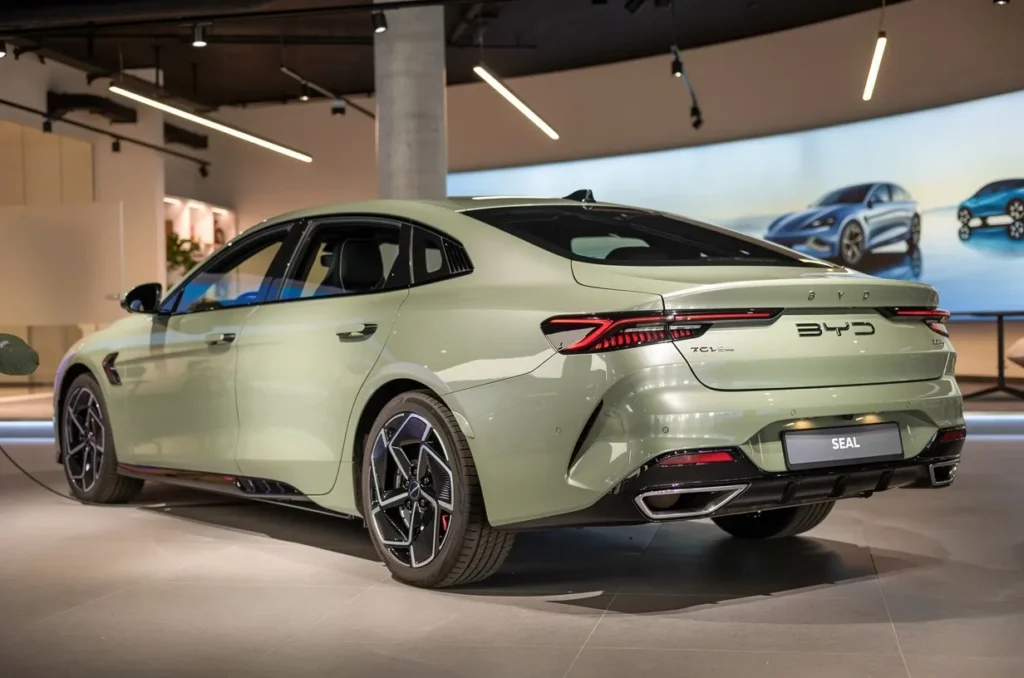
Chinese automakers found a way around Europe’s EV tariffs
Europe’s attempt to protect its auto industry produced an unintended consequence.
After Brussels imposed additional duties on Chinese battery-electric vehicles, Chinese automakers increasingly pushed plug-in hybrids instead. Hybrids were not covered by the original investigation or the resulting EV duties, a distinction the European Commission confirmed earlier this year.
The strategy worked. Chinese brands have captured more than 26% of Europe’s plug-in hybrid market, helping Chinese-made vehicles reach roughly 10.7% of the broader European market. Twenty Chinese brands are appearing at this year’s Paris Motor Show, double the number from 2024.
Europe had already been pressing Beijing to voluntarily reduce hybrid exports. After two days of negotiations, China has now agreed to cut shipments of hybrids and plug-in hybrids to the bloc by more than half. Brussels still needs to approve the arrangement.
Europe is effectively closing the loophole Chinese automakers found after the first round of EV tariffs.
For Volkswagen, BMW, Mercedes-Benz, Stellantis and other European manufacturers, fewer low-cost Chinese imports should provide some breathing room. It does not solve the larger competitive problem.
Cutting imports may simply push Chinese factories into Europe
Trade barriers can change where cars are built without changing who builds them.
BYD, Chery and other Chinese manufacturers still want access to European consumers. With the U.S. largely closed to Chinese vehicles and competition intense at home, Europe remains one of the most important overseas growth markets available to them.
Reducing exports therefore gives Chinese automakers another reason to manufacture locally.
European policymakers are already moving toward local-content requirements, while Chinese companies have been expanding manufacturing plans across the region. A vehicle produced inside Europe can create European jobs and shorten supply chains while becoming much harder to target with an import restriction.
That could produce an ironic outcome. Europe may succeed in reducing Chinese car imports while accelerating the arrival of Chinese car factories.
Rare earths show why Europe cannot push too hard
Cars were only one side of the negotiations.
China’s Commerce Ministry said the two sides reached 16 areas of consensus, including steps involving rare earth and permanent magnet export licensing. Both governments also committed to further talks, with a ministerial video meeting planned for January and another formal meeting in March.
Europe needs those materials. China supplied 46.8% of the EU’s rare earth imports by weight in 2025, according to Eurostat, and its influence is considerably greater in several downstream processing and permanent-magnet supply chains.
That dependence matters because Brussels is simultaneously trying to address a trade imbalance that has become difficult to ignore. The EU’s goods deficit with China reached roughly €360 billion in 2025, while imports from China continue rising across machinery, chemicals, metals and other industrial categories.
Europe therefore has leverage through access to one of the world’s largest consumer markets. China has leverage through manufacturing scale and control over strategic materials.
The hybrid agreement is what happens when those two forms of power collide.
Europe won a meaningful concession on cars, but the broader message is more complicated: the bloc can restrict Chinese products more easily than it can replace the Chinese supply chains its own industries still depend on.
Explore More Stories in Markets
Disclaimer
Wall Street Access is an independent financial publisher. Wall Street Access is not a financial advisor. No company mentioned has compensated Wall Street Access for the preparation, publication or distribution of this article. This content is provided for informational and educational purposes only and is not investment advice or a recommendation to buy, sell or hold any security. Investing involves risk, including the possible loss of principal.
Prices, market capitalizations, financial figures and other market data are based on information available as of the date and time of publication and may change without notice. Information is drawn from public sources believed to be reliable but is not guaranteed to be complete or accurate. Opinions and expectations expressed are our own and may change as new information becomes available.
Readers should conduct their own due diligence and contact a licensed financial professional before making any investment decision. Past performance does not guarantee future results. Any material ownership interest or conflict of interest, where applicable, will be disclosed separately.