Wall Street may be using the wrong yardstick
SpaceX (NASDAQ: SPCX) gained about 4% Monday after Morgan Stanley renewed one of the most bullish calls on the stock, arguing that the current valuation fails to capture how several very different businesses are beginning to reinforce one another.
Adam Jonas kept his $300 price target and called the shares “cheap and getting cheaper” on a growth-adjusted basis.
At first glance, that sounds aggressive. SpaceX trades at roughly 30 times Morgan Stanley’s estimate of 2028 operating profit, compared with about 16 times for other large AI-related companies. Adjust for expected growth, however, and the comparison changes. Morgan Stanley calculates SpaceX at roughly 0.3 times EV/EBIT-to-growth, versus a peer median closer to 0.5 times.
More interesting than the multiple is the reason SpaceX is difficult to value in the first place.
A traditional aerospace analyst sees launch. A telecom analyst sees Starlink. An AI analyst sees compute infrastructure. Looking at any one of those businesses in isolation can make the stock appear expensive.
SpaceX becomes much more interesting when you value what happens as those businesses start working together.
Starship changes what Starlink can become
Flight 14 may have been the clearest example yet.
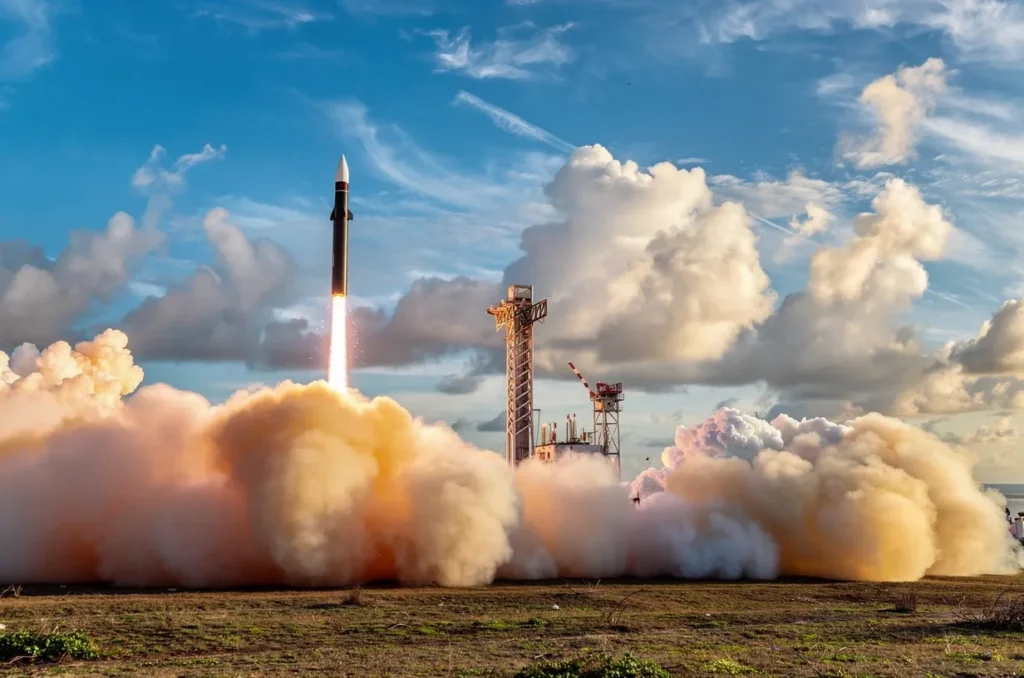
Starship reached orbit for the first time and deployed 26 Starlink V3 satellites, marking the vehicle’s first meaningful payload delivery to orbit. SpaceX’s Flight 14 mission details
Until now, Starship was largely an engineering promise. Reaching orbit with an operational payload moved it closer to becoming an economic asset.
That matters because the next generation of Starlink satellites was designed around Starship’s much larger capacity. Falcon 9 built the existing network, but scaling bandwidth dramatically from here requires bigger satellites and far more mass delivered to orbit.
A reusable Starship could eventually lower the cost of putting that capacity into space while allowing SpaceX to expand Starlink much faster.
Launch and connectivity therefore stop looking like separate businesses.
Better launch economics can improve Starlink economics. A larger Starlink network gives SpaceX more reason to launch. Each side strengthens the other.
Morgan Stanley believes Flight 15 could push that relationship another step forward, especially if SpaceX advances its efforts to recover and rapidly reuse the spacecraft.
AI may be the part investors have not figured out yet
Morgan Stanley’s more unconventional argument has little to do with rockets.
The firm believes much of SpaceX’s launch and connectivity value is already relatively well understood, while the company’s AI and compute businesses remain harder for the market to price.
That could become increasingly important.
SpaceX has been expanding into AI infrastructure, compute services and related technology while its existing businesses give it access to capabilities few companies can combine under one roof: launch systems, satellites, global communications, power-intensive infrastructure and increasingly large computing operations.
Future AI products and additional neocloud contracts are among the catalysts Morgan Stanley believes could move the stock closer to its $300 target.
The opportunity is not simply another company trying to sell AI software.
SpaceX could eventually control multiple layers required to move, process and distribute enormous amounts of data.
If the AI economy keeps demanding more compute, more power and more connectivity, SpaceX may own infrastructure on both sides of that equation.
That possibility remains much harder to model than Starlink subscriptions or rocket launches, which may be precisely why Morgan Stanley sees an opportunity.
Flight 15 could test the bull case quickly
Calling SpaceX cheap still requires accepting considerable execution risk.
Starship has now reached orbit, but one successful payload mission does not prove the fully reusable launch cadence SpaceX ultimately needs. AI infrastructure also has to become a meaningful earnings contributor rather than simply another expensive expansion project.
Those uncertainties explain why the market has not automatically awarded SpaceX Morgan Stanley’s valuation.
They also create the setup behind Monday’s call.
Flight 15 is expected within weeks. Progress toward recovering Starship would strengthen the case for dramatically lower launch costs. More AI contracts could give investors a clearer view of a business Morgan Stanley believes remains underappreciated.
SpaceX does not need every part of the story to succeed at once.
Starlink already has scale. Launch already has customers. Starship is beginning to carry real payloads. AI introduces another possible growth engine on top.
The most compelling part of the SpaceX thesis may be that none of these businesses exists in isolation anymore.
Wall Street knows how to value a rocket company. It knows how to value a telecom network. It knows how to value an AI infrastructure company. SpaceX is increasingly trying to become all three.
Disclaimer
Wall Street Access is an independent financial publisher. Wall Street Access is not a financial advisor. No company mentioned has compensated Wall Street Access for the preparation, publication or distribution of this article. This content is provided for informational and educational purposes only and is not investment advice or a recommendation to buy, sell or hold any security. Investing involves risk, including the possible loss of principal.
Prices, market capitalizations, financial figures and other market data are based on information available as of the date and time of publication and may change without notice. Information is drawn from public sources believed to be reliable but is not guaranteed to be complete or accurate. Opinions and expectations expressed are our own and may change as new information becomes available.
Readers should conduct their own due diligence and contact a licensed financial professional before making any investment decision. Past performance does not guarantee future results. Any material ownership interest or conflict of interest, where applicable, will be disclosed separately.