Wall Street is putting billions behind America’s industrial comeback
JPMorgan Chase (NYSE: JPM) is making an unusually large bet on the companies it believes will define the next generation of American manufacturing and defense.
The nation’s largest bank has already invested $5 billion in strategic U.S. industries, reaching half of its original 10-year investment target in just 12 months. Management now believes it could exceed the initial $10 billion commitment.
The money is going toward businesses developing everything from autonomous weapons and advanced manufacturing systems to critical materials and energy infrastructure.
Unlike traditional investment banking, where JPMorgan earns fees by arranging financing or advising on deals, these investments give the bank direct ownership stakes in companies it believes can become important industrial players.
Former Berkshire Hathaway investment manager Todd Combs is leading the effort. His team has already made approximately 10 investments averaging $500 million each, focusing on businesses with the technology and potential to expand domestic production.
The initiative is also much larger than those equity investments. JPMorgan says it has financed and facilitated approximately $230 billion in transactions during its first year, working toward a broader $1.5 trillion financing goal over the next decade.
Those transactions include loans, capital raising and advisory work, rather than exclusively JPMorgan’s own investment capital.
America’s push to rebuild its industrial capacity is attracting more than government funding. Some of Wall Street’s largest institutions now want direct ownership in the companies making it happen.
Robot factories and cheaper missiles are attracting serious capital
Two of JPMorgan’s disclosed investments reveal where some of that money is heading.
California-based Hadrian is developing highly automated manufacturing facilities that produce precision components for aerospace, defense and maritime industries.
Its factories combine robotics, artificial intelligence and advanced manufacturing equipment to reduce reliance on traditional production methods. One facility reportedly operates with approximately 10 robots for every human employee.
In August, Hadrian raised $1.37 billion at a valuation approaching $8 billion, with JPMorgan among its financial backers.
Meanwhile, Castelion, founded by former SpaceX engineers, is taking aim at another major defense challenge: manufacturing advanced missiles in much larger quantities at lower costs.
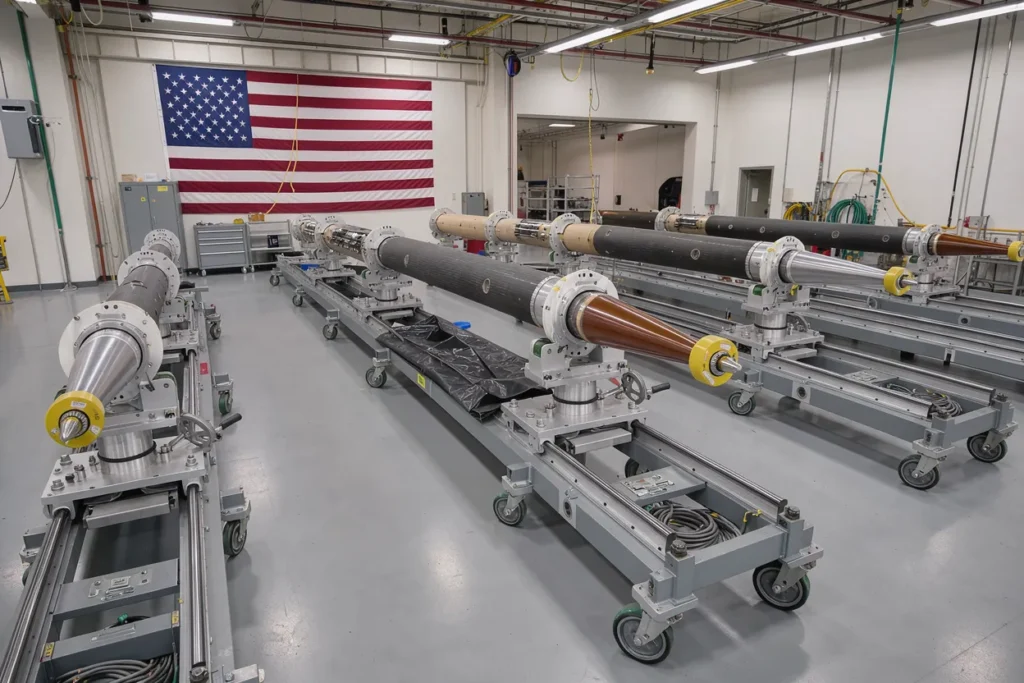
Its flagship Blackbeard system is being developed as a relatively affordable, mass-producible hypersonic strike weapon.
JPMorgan helped lead Castelion’s approximately $1 billion financing round in August, alongside Andreessen Horowitz and Carlyle. The funding is intended to expand manufacturing capacity and accelerate development of longer-range weapons.
Castelion has already secured nearly $90 million in additional U.S. Navy funding to advance Blackbeard toward early operational capability, building on an earlier production order.
Both companies are approaching defense manufacturing differently from traditional contractors. Rather than developing weapons through lengthy production cycles and highly specialized facilities, they are trying to use automation, modern software and repeatable manufacturing processes to increase output.
The opportunity is shifting from simply developing better military technology to finding ways to manufacture it faster, cheaper and at much greater scale.
The next defense opportunity may be further down the supply chain
America’s defense manufacturers have no shortage of demand. Expanding production capacity is becoming a much more difficult problem.
Submarines require thousands of specialized components. Missile manufacturers depend on precision machining, advanced electronics and critical materials. Aircraft production relies on networks of suppliers that can take years to expand.
A single missing component can delay an entire weapons system, regardless of how much money the Pentagon commits to buying it.
JPMorgan is now working to identify those bottlenecks, mapping the suppliers behind major defense programs and determining which businesses need additional financing to expand.
Its Security and Resiliency Initiative extends well beyond missiles and aerospace. Critical minerals, robotics, energy infrastructure, pharmaceuticals and advanced manufacturing are all part of the strategy.
That creates an interesting investment theme. Companies producing specialized components, processing essential metals or developing manufacturing technology could benefit from rising demand even without selling finished weapons directly to the military.
For smaller industrial businesses, access to major institutional capital could help finance new factories, increase production capacity and support larger customer contracts.
Execution remains important. Building a prototype is considerably different from operating a profitable factory at scale, and not every company attracting strategic investment will successfully make that transition.
But JPMorgan’s pace suggests the opportunities are large enough to justify serious capital commitments.
America’s next generation of defense companies may not look like traditional defense contractors. Some will build missiles, others will build robots, and many will supply the components and materials that allow both to operate.
JPMorgan has already committed $5 billion to finding those businesses. With another $5 billion potentially available under its original target, the race to finance America’s industrial expansion is gathering momentum.
Disclaimer
Wall Street Access is an independent financial publisher. Wall Street Access is not a financial advisor. No company mentioned has compensated Wall Street Access for the preparation, publication or distribution of this article. This content is provided for informational and educational purposes only and is not investment advice or a recommendation to buy, sell or hold any security. Investing involves risk, including the possible loss of principal.
Prices, market capitalizations, financial figures and other market data are based on information available as of the date and time of publication and may change without notice. Information is drawn from public sources believed to be reliable but is not guaranteed to be complete or accurate. Opinions and expectations expressed are our own and may change as new information becomes available.
Readers should conduct their own due diligence and contact a licensed financial professional before making any investment decision. Past performance does not guarantee future results. Any material ownership interest or conflict of interest, where applicable, will be disclosed separately.