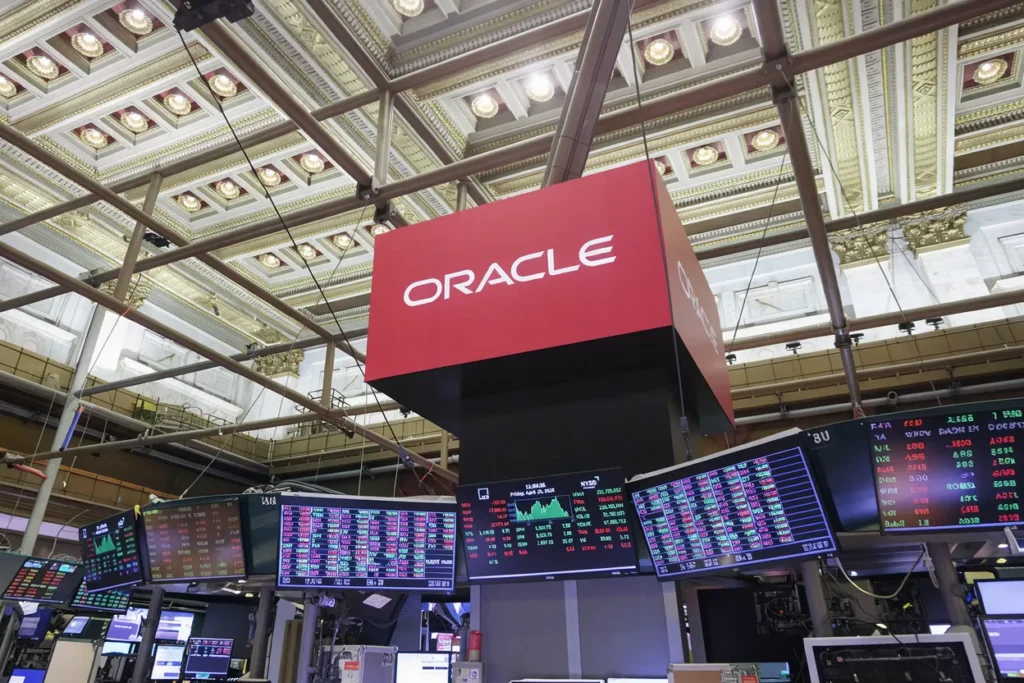
Oracle’s stock is collapsing. Its business isn’t.
A company growing cloud infrastructure revenue by 121% and sitting on hundreds of billions in future contracts would normally be one of Wall Street’s favorite investments.
Oracle (NYSE: ORCL) has somehow become one of its biggest disappointments.
Shares have lost roughly 58% of their value over the past year, as the AI selloff has hit companies making enormous investments in data centers and computing infrastructure. Yet Wall Street remains surprisingly optimistic. Roughly 80% of analysts covering Oracle still recommend buying the stock, with price targets pointing to substantial potential upside.
At first glance, the optimism makes sense.
Oracle’s latest quarterly revenue climbed 30% to $19.3 billion, while cloud infrastructure revenue more than doubled to $7.4 billion. Demand for its AI computing services continues to exceed available capacity, with the company delivering another 300,000 GPUs to customers during its most recent quarter.
Even more remarkable is the backlog.
Oracle’s remaining performance obligations have reached $664 billion, reflecting the enormous computing contracts signed with customers across the AI industry.
That represents several years of revenue commitments for a company that generated roughly $67 billion in sales during fiscal 2026.
Oracle is attracting more AI business than ever before. Wall Street’s concern is whether the company can afford to deliver it.
$664 billion in contracts comes with a massive price tag
Selling access to AI computing power is one thing. Building the infrastructure required to provide it is considerably more expensive.
Oracle needs land, electricity, advanced Nvidia processors, networking equipment and enormous data centers before customers can begin using much of the capacity they have ordered.
Its financial statements reveal just how expensive that process has become.
Over the 12 months ending in August, Oracle generated approximately $46.9 billion in operating cash flow while spending $75.7 billion on capital expenditures. That leaves roughly $28.7 billion in negative free cash flow, even as revenue and earnings continue growing.
The company has already raised tens of billions through debt and equity financing to support its expansion. In September, Oracle also completed a $20 billion share issuance, bringing in additional capital but increasing the number of shares outstanding.
With Treasury yields remaining elevated, financing hundreds of billions in AI infrastructure has become considerably more expensive.
There is another important detail buried inside Oracle’s enormous backlog.
According to its latest quarterly filing, only about 13% of the $664 billion in contracted revenue is expected to be recognized over the next 12 months. Much of the rest stretches several years into the future.
That timing helps explain the stock’s unusual performance. Oracle has secured the demand, but building the capacity and collecting the revenue will take years.
Investors are being asked to finance an extraordinary amount of spending today in exchange for profits that may not fully materialize until much later.
The selloff could become an opportunity if cash flow catches up
Oracle’s bull case becomes considerably more interesting when looking beyond the next few quarters.
Management has already begun changing how it finances large AI contracts. Customers have either prepaid for or directly supplied approximately $75 billion worth of GPU hardware, reducing the amount Oracle must raise independently to fulfill those agreements.
Meanwhile, cloud infrastructure revenue is growing at triple-digit rates, and the company’s existing database and enterprise software operations continue generating substantial cash.
Oracle also expects fiscal 2027 revenue to reach approximately $90 billion, reflecting another significant increase as contracted computing capacity comes online.
A sustained improvement in free cash flow could change investor sentiment quickly, particularly after such a dramatic decline in the stock.
But the financing risk deserves attention. S&P Global downgraded Oracle’s credit rating to BBB- in July, leaving it at the lowest investment-grade level as heavy AI spending places pressure on the balance sheet.
Another downgrade could make borrowing more expensive precisely when Oracle needs access to substantial capital.
The next few earnings reports should therefore be judged on more than revenue growth or another increase in its order book. Investors need to see data-center capacity translating into billable revenue, capital spending becoming more manageable and cash flow improving as projects come online.
Oracle’s valuation has become far less demanding than it was a year ago, making the potential reward attractive if management executes successfully.
The opportunity is not simply that Oracle has fallen more than 50%. It is that the company has secured an extraordinary amount of future AI business while investors are increasingly unwilling to pay for the cost of building it.
If Oracle can turn those contracts into profitable cash flow without continuously relying on new financing, today’s selloff could eventually look excessive.
If it cannot, the market may have been right to question the economics all along.
Disclaimer
Wall Street Access is an independent financial publisher. Wall Street Access is not a financial advisor. No company mentioned has compensated Wall Street Access for the preparation, publication or distribution of this article. This content is provided for informational and educational purposes only and is not investment advice or a recommendation to buy, sell or hold any security. Investing involves risk, including the possible loss of principal.
Prices, market capitalizations, financial figures and other market data are based on information available as of the date and time of publication and may change without notice. Information is drawn from public sources believed to be reliable but is not guaranteed to be complete or accurate. Opinions and expectations expressed are our own and may change as new information becomes available.
Readers should conduct their own due diligence and contact a licensed financial professional before making any investment decision. Past performance does not guarantee future results. Any material ownership interest or conflict of interest, where applicable, will be disclosed separately.