The AI boom loses its most familiar face
For years, Jensen Huang gave an extraordinarily complex investment story a recognizable face. On Thursday, Wall Street had to imagine Nvidia’s next chapter without him.
Nvidia announced that Huang resigned immediately as CEO, president and director. Colette Kress, its longtime CFO, becomes interim CEO while the board searches for a permanent successor.
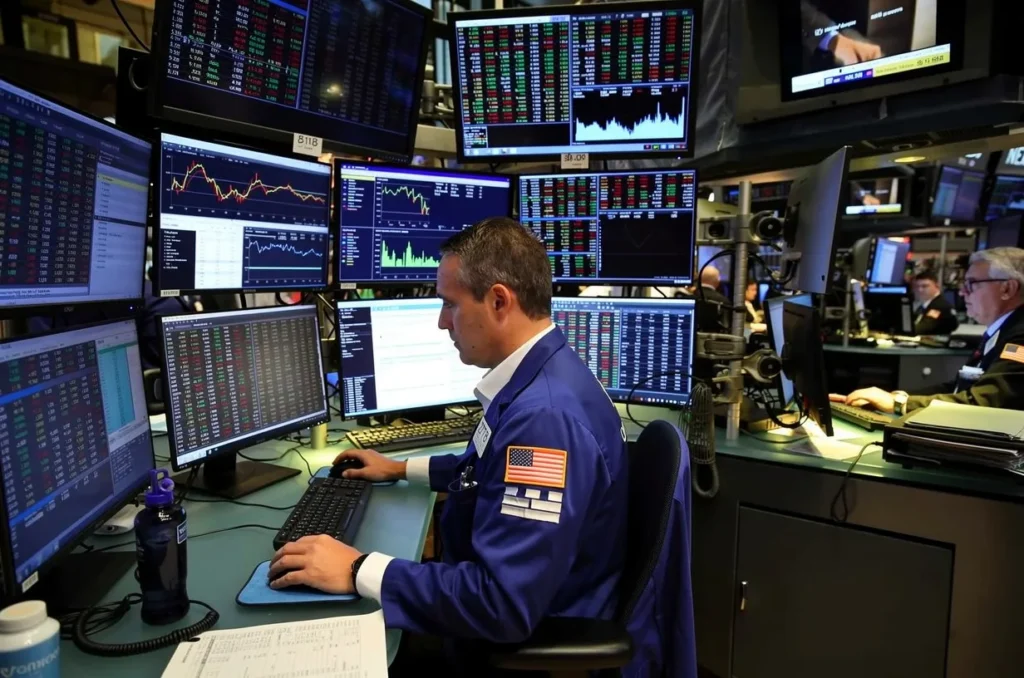
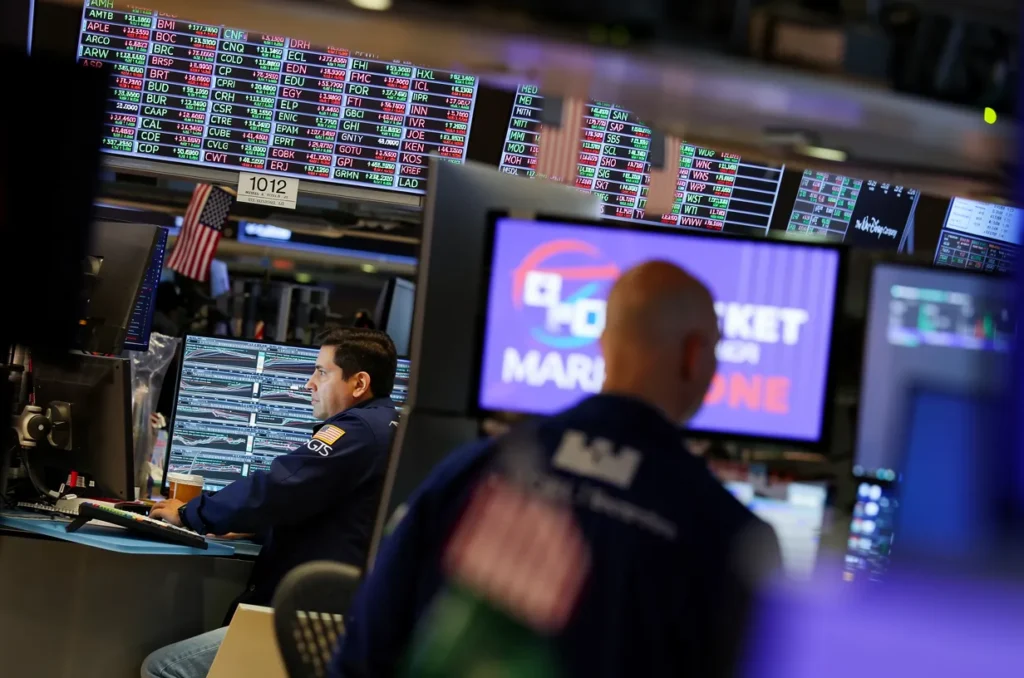
The initial reaction was severe. Nvidia shares fell 14% at the open, then recovered much of that decline.
The wider market also steadied. In a Thursday intraday snapshot, the Dow rose 0.4%, while the S&P 500 and Nasdaq gained approximately 0.3% each. Nvidia remained down about 4%.
The recovery was an early vote of confidence in AI spending beyond Nvidia. The larger risk lies in whether a leadership change alters the funding and supply commitments that hold the build-out together.
Rivals attract buyers while Nvidia faces the handover
The buying was particularly revealing inside the semiconductor industry.
AMD (NASDAQ: AMD) climbed 7.4% and Broadcom (NASDAQ: AVGO) gained 7.1% in a separate late-morning snapshot, making them the S&P 500’s strongest performers at that point.
Those gains express expectations about future business. They do not establish that customers have already redirected orders.
Still, the distinction matters. Investors were willing to pay more for competing suppliers even as they marked down the company most closely associated with the boom.
Nvidia’s board, meanwhile, appointed Harvey Jones as chairman and said it expected customer commitments and product development to continue uninterrupted. Kress will retain her CFO responsibilities during the transition.
The exit follows a board investigation announced November 8 into reports that Huang was targeted by a foreign intelligence effort. At that time, the board said it had no reason to believe national security or company secrets had been compromised.
Markets can reassess a company in minutes. Establishing confidence in a new leadership arrangement takes longer.
A CEO departure quickly becomes a story about competitors, customers and capital. Wall Street Access follows those consequences as they develop, connecting the headlines to the businesses affected.
Follow the Fallout in Your Morning Market Brief
Anthropic’s IPO brings the financial connections into view
Nvidia’s role extends into financing the companies using its technology.
Anthropic’s updated IPO filing identifies approximately $10 billion of planned investment from Nvidia, within a $26 billion private placement involving several technology companies.
The placement is contingent on completion of the offering and other conditions. The money has not simply arrived because agreements were signed.
That gives the leadership transition significance beyond chip orders. A change in Nvidia’s investment approach could affect how parts of the industry fund their expansion.
There is no announced cancellation of that commitment in the transition statement. The relevant question is whether the arrangements survive the handover on their existing terms.
Anthropic’s offering will also test whether public investors share the confidence expressed by its strategic backers.
Oil and borrowing costs keep the pressure on
The market has other complications to absorb.
Brent crude traded around $93.82 a barrel, while the 10-year Treasury yield rose to approximately 5.07% as hopes for an agreement ending the Iran conflict weakened.
Higher energy costs add to inflation concerns. Higher bond yields can raise financing costs for businesses and households, while reducing what investors are willing to pay for distant earnings.
Tuesday’s 0.4% monthly CPI increase had already strengthened expectations of a December Fed rate increase.
Crypto faces an additional source of pressure. MSCI’s November review lists Strategy (NASDAQ: MSTR) for removal from its US Prime Market 750 and US Investable Market 2500 indexes, effective after the November 30 close.
Funds tracking those benchmarks will need to adjust their holdings. The change concerns demand for Strategy’s shares; it does not itself require the company to sell bitcoin.
For the AI trade, the next scheduled operating test is Nvidia’s November 17 results, followed by its 5 p.m. Eastern earnings call.
Thursday showed that Wall Street could absorb the first shock. Orders, investment commitments and the new leadership’s decisions will determine how far the consequences travel.
Explore More Stories in Markets
Disclaimer
Wall Street Access is an independent financial publisher. Wall Street Access is not a financial advisor. No company mentioned has compensated Wall Street Access for the preparation, publication or distribution of this article. This content is provided for informational and educational purposes only and is not investment advice or a recommendation to buy, sell or hold any security. Investing involves risk, including the possible loss of principal.
Prices, market capitalizations, financial figures and other market data are based on information available as of the date and time of publication and may change without notice. Information is drawn from public sources believed to be reliable but is not guaranteed to be complete or accurate. Opinions and expectations expressed are our own and may change as new information becomes available.
Readers should conduct their own due diligence and contact a licensed financial professional before making any investment decision. Past performance does not guarantee future results. Any material ownership interest or conflict of interest, where applicable, will be disclosed separately.